

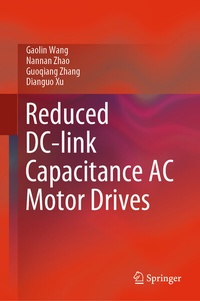
Reduced DC-link Capacitance AC Motor Drives
1st Edition
Published on 2. November 2020
XIV, 211 pages
978-981-15-8566-1 (ISBN)
Description

This book focuses on the advanced control of reduced dc-link capacitance AC motor drives. Compared with the conventional AC motor drives, the reduced DC-link capacitance motor drives could reduce the cost, enhance the reliability and improve the power density. The control strategies proposed in this book are verified by experimental results, which include high power factor control, drive system stability control, beat phenomenon suppression, enhanced flux-weakening control, anti-overvoltage control, etc. The major features of this book are the systematic analysis, effective and optimized control of the practical issues in industry application, which could help readers to learn the reduced dc-link capacitance PMSM drives and promote the drive system application. This book could benefit researchers, engineers, and students in the field of AC motor drives.
More details
Series
Language
English
Place of publication
Singapore
Singapore
Publishing group
Springer Singapore
Target group
Professional and scholarly
Product notice
Reflowable
Illustrations
XIV, 211 p. 172 illus., 153 illus. in color.
File size
15,28 MB
ISBN-13
978-981-15-8566-1 (9789811585661)
DOI
10.1007/978-981-15-8566-1
Schweitzer Classification
Other editions
Additional editions
Gaolin Wang | Nannan Zhao | Guoqiang Zhang
Reduced DC-link Capacitance AC Motor Drives
Book
11/2020
Springer
€149.79
Shipment within 3-4 weeks
Persons
Gaolin Wang (M'13-SM'18) received the B.S., M.S. and Ph.D. degrees in Electrical Engineering from Harbin Institute of Technology, Harbin, China, in 2002, 2004 and 2008, respectively. In 2009, he joined the Department of Electrical Engineering, Harbin Institute of Technology as a Lecturer, where he has been a Professor of Electrical Engineering since 2014. From 2009 to 2012, he was a Postdoctoral Fellow in Shanghai STEP Electric Corporation. He has authored more than 100 technical papers published in journals and conference proceedings (>50 IEEE Transactions papers). He is the holder of 20 Chinese patents. His current major research interests include AC motor drives.Dr. Wang serves as a Guest Editor of IEEE Transactions of Industrial Electronics, an Associate Editor for IEEE Access, IET Electric Power Applications and Journal of Power Electronics. He obtained the First Prize of science and technology progress of Heilongjing Province in 2019, and the Second Prize of science and technology progress of Ministry of Education in 2019. He was the recipient of the Outstanding Research Award and the Delta Young Scholar Award from the Delta Environmental and Educational Foundation in 2012 and 2014, respectively. He has been supported by the National Natural Science of China for Excellent Young Scholars. He published a book named "Position Sensorless Control Techniques for Permanent Magnet Synchronous Machine Drives" in Springer in 2019.
Nannan Zhao (S'18-M'19) received the B.S. and M.S. degrees in control science and engineering in 2013 and 2015, and the Ph.D. degree in electrical engineering in 2019, all from Harbin Institute of Technology. Currently he is a Postdoctoral Fellow and a Lecturer in the School of Electrical Engineering and Automation, Harbin Institute of Technology. He has authored more than 25 technique papers (14 IEEE Transactions papers) in the field of AC motor drives. His current research interests include advanced control of permanent magnet synchronous motor drives and position sensor-less control of ac motors. He is an IEEE member and supported by Postdoctoral Innovative Talent Support Program of China in 2019. He is nominated for the young engineer award of PCIM Asia 2020, and serves as the special session chair of reduced dc-link capacitance motor drives in IPEMC 2020.
Guoqiang Zhang's current research interests include parameter identification technique and control of electrical drives, with main focus on the sensorless field-oriented control of interior permanent magnet synchronous machines. Dr. Zhang has authored more than 30 technical papers published in journals and conference proceedings, including 10 papers in IEEE Transactions.Dr. Zhang is a member of IEEE, China Electrotechnical Society, China Power Supply Society. He gave a tutorial presentation on Advanced Sensorless Control for AC Motor Drives, and received Best paper award of CPSSC in 2017.He was the winner of National Postdoctoral Program for Innovative Talents in 2017.
Dianguo Xu (M'97-SM'12-F'17) received the B.S. degree in control engineering from Harbin Engineering University, Harbin, China, in 1982, and the M.S. and Ph.D. degrees in electrical engineering from the Harbin Institute of Technology (HIT), Harbin, in 1984 and 1989, respectively. In 1984, he joined the Department of Electrical Engineering, HIT, as an Assistant Professor, where since 1994, he has been a Professor. He was the Dean of the School of Electrical Engineering and Automation, HIT, from 2000 to 2010. He is currently the Vice President with HIT. He has published more than 600 technical papers. His research interests include renewable energy generation technology, power quality mitigation, sensorless vector-controlled motor drives, and high-performance PMSM servo systems. Dr. Xu is an Associate Editor of the IEEE Transactions on Industrial Electronics, the IEEE Transactionson Power Electronics, and the IEEE Journal of Emerging and Selected Topics in Power Electronics. He serves as the Chairman of the IEEE Harbin Section. He received the IEEE Industry Applications Society Outstanding Achievement Award in 2018.
Nannan Zhao (S'18-M'19) received the B.S. and M.S. degrees in control science and engineering in 2013 and 2015, and the Ph.D. degree in electrical engineering in 2019, all from Harbin Institute of Technology. Currently he is a Postdoctoral Fellow and a Lecturer in the School of Electrical Engineering and Automation, Harbin Institute of Technology. He has authored more than 25 technique papers (14 IEEE Transactions papers) in the field of AC motor drives. His current research interests include advanced control of permanent magnet synchronous motor drives and position sensor-less control of ac motors. He is an IEEE member and supported by Postdoctoral Innovative Talent Support Program of China in 2019. He is nominated for the young engineer award of PCIM Asia 2020, and serves as the special session chair of reduced dc-link capacitance motor drives in IPEMC 2020.
Guoqiang Zhang's current research interests include parameter identification technique and control of electrical drives, with main focus on the sensorless field-oriented control of interior permanent magnet synchronous machines. Dr. Zhang has authored more than 30 technical papers published in journals and conference proceedings, including 10 papers in IEEE Transactions.Dr. Zhang is a member of IEEE, China Electrotechnical Society, China Power Supply Society. He gave a tutorial presentation on Advanced Sensorless Control for AC Motor Drives, and received Best paper award of CPSSC in 2017.He was the winner of National Postdoctoral Program for Innovative Talents in 2017.
Dianguo Xu (M'97-SM'12-F'17) received the B.S. degree in control engineering from Harbin Engineering University, Harbin, China, in 1982, and the M.S. and Ph.D. degrees in electrical engineering from the Harbin Institute of Technology (HIT), Harbin, in 1984 and 1989, respectively. In 1984, he joined the Department of Electrical Engineering, HIT, as an Assistant Professor, where since 1994, he has been a Professor. He was the Dean of the School of Electrical Engineering and Automation, HIT, from 2000 to 2010. He is currently the Vice President with HIT. He has published more than 600 technical papers. His research interests include renewable energy generation technology, power quality mitigation, sensorless vector-controlled motor drives, and high-performance PMSM servo systems. Dr. Xu is an Associate Editor of the IEEE Transactions on Industrial Electronics, the IEEE Transactionson Power Electronics, and the IEEE Journal of Emerging and Selected Topics in Power Electronics. He serves as the Chairman of the IEEE Harbin Section. He received the IEEE Industry Applications Society Outstanding Achievement Award in 2018.
Content
1. Basic knowledge of AC motor Drives.- 2. High Power Factor Control of Grid Input Current.- 3. Resonance Suppression Between Line Inductor and DC-link Capacitor.- 4. Impedance Model based Stability Control.- 5. Analysis and Suppression of Beat Phenomenon.- 6. Flux-weakening Control Method.- 7. Motor Loss based Anti-overvoltage Control.- 8. Optimized Overmodulation Strategy.
