

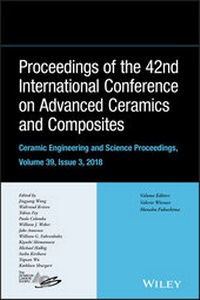
Proceedings of the 42nd International Conference on Advanced Ceramics and Composites, Volume 39, Issue 3
Description

More details
Other editions
Additional editions
Content
Introduction
ADVANCING FRONTIERS OF CERAMICS FOR SUSTAINABLE SOCIETAL DEVELOPMENT: INTERNATIONAL SYMPOSIUM IN HONOR OF DR. MRITYUNJAY SINGH
Progress in Polymer-Derived SiC-Based Fibers: Improvement of Surface Roughness The Influence of Casting-Calendering Process on the Microstructure of Pure Al2O3 Ceramic Substrate 15
S. X. Wang, H. F. Lan, W. J. Wang, Y. J. Huang, and S. J. Li
Improved Shielding Method for Reducing Magnetic Field Leakage through Magnetically Shielded Room Openings 23
H. Sugiyama, T. Tokuda, K. Kamata, T. Nakayama, T. Suzuki, and H. Suematsu
Oxynitride Glasses for Potential Bio medical Usage 33
Stuart Hampshire, Ahmed Bachar, Cyrille Mercier, Arnaud Tricoteaux, Anne Leriche, and Claudine Follet
Development of Ultra Low Density Refractory Granules (ULDRG) 53 for Kilns
L. K. Sharma and D. P. Karmakar
POROUS CERAMICS: NOVEL DEVELOPMENTS AND APPLICATIONS
Optical Response of Mesoporous Silica Layer on Plasmonic Array to Isopropanol Vapor 61
Shunsuke Murai, Hiroyuki Sakamoto, Koji Fujita, and Katsuhisa Tanaka
Fabrication and Microstructures of Porous Alumina with Porous-and-Denser Zebra-Patterned Surfaces Created by One-Pot Direct Blowing Method 69
Akihiro Shimamura, Mikinori Hotta, and Naoki Kondo
Fabrication Procedure for Porous Carbon Material with Three Dimensionally Networked Structure 77
Yusei Kaneda, Ryo Inoue, and Yasuo Kogo
VIRTUAL M ATERIALS (COMPUTATIONAL) DESIGN AND CERAMIC GENOME Numerical Modeling of the 2D Crack Propagation in Carbon-Carbon Composites 89
R. Piat, Y. Zuo, and P. Megyesi
MATERIALS FOR EXTREME ENVIRONMENTS: ULTRAHIGH TEMPERATURE CERAMICS (UHTCS) AND NANO-LAMINATED TERNARY CARBIDES AND NITRIDES (MAX PHASES)
Synthesis and Characterization of Novel Ni-Ti3SiC2 Composites 107
M. Dey, M. Fuka, F. AlAnazi, and S. Gupta
ADVANCED MATERIALS FOR SUSTAINABLE NUCLEAR FISSION AND FUSION ENERGY
Preliminary Characterization and Projections of PVD Coatings on SiC Cladding for Light Water Reactors 119
Caen Ang, David Carpenter, Kurt Terrani, and Yutai Katoh
SINGLE CRYSTALLINE MATERIALS FOR ELECTRICALS, OPTICAL MEDICAL APPLICATIONS
Advanced Sensors for CMC Gas Turbine Engine Components 137
Kevin Rivera, Matt Ricci, and Otto Gregory
ADDITIVE MANUFACTURING AND 3D PRINTING TECHNOLOGIES
Additive Manufacturing of Ceramics for Protection Systems:Additive Manufacturing of Ceramics for Protection Systems:Technical Challenges and Opportunities 147
Tyrone L Jones
Three Dimensional Ceramics Printed via Ink Jet Methods 163
David Crenshaw, Patrick Cigno, Phillip Kurtis, Gerry Wynick, Xingwu Wang,Ryan Jeffrey, Carol Craig, Sam Deriso, and Jim Royston
GEOPOLYMERS,CHEMIACLLY BONDED CERAMICS,ECO-FRIENDLY AND SUSTAINABLE MATERIALS
Microstructure and Flexure Strengths of Dolomite Particulate-Reinforced Geopolymer Composites 173
Patrick F. Keane and Waltraud M. Kriven
One-Part Geopolymers and Aluminosilicate Gel-Zeolite Composites Based on Silica: Factors Influencing Microstructure and Engineering Properties 183
G. J. G. Gluth, P. Sturm, S. Greiser, C. Jäger, and H.-C. Kühne G.J. G. Gluth, P. Sturm, S. Greiser, C. Jäger, and H.-C. Kühne
Thermal Resistant Alkali-Activated Materials Using Argillite and Two Types of Solution 197
Colin Dupuy, Myriam Fricheteau, Manon Elie, Ameni Gharzouni, Nathalie Texier-Mandoki, Xavier Bourbon and Sylvie Rossignol
Preliminary Mix Design Procedure for Alkali Activated Cement Mortars Based on Metakaolin and Industrial Waste Products Activated with Potasium Silicate 209
Luke Oakes, Allistair Wilkinson, and Bryan Magee Geopolymer Roof Tile 225
A. Reggiani
BIO-INSPIRED PROCESSING OF ADVANCED MATERIALS
Microstructure and Composition Characterization of Teeth from Different Species 235
Jun Tian, Hui Zeng, Hang Ping, Wei Ji, Jingjing Xie, Wenhao Chi, Hao Xie and Zhengyi Fu
7TH GLOBAL YOUNG INVESTIGATORS FORUM (GYIF)
Evaluation of Power Generation from Biomass using Solid Oxide Fuel Cell (SOFC) and Downdraft Gasifiers245
Shimpei Yamaguchi, Kazuaki Katagiri, Takuya Ehiro, Tomoatsu Ozaki and Atsushi Kakitsuji
PROGRESS IN POLYMER-DERIVED SiC-BASED FIBERS: IMPROVEMENT OF SURFACE ROUGHNESS
T. Ishikawa, K. Suwa, and R. Usukawa
Tokyo University of Science, Yamaguchi
1-1-1 Daigaku-Dori, Sanyo-Onoda, Yamaguchi 756-0884, Japan
ABSTRACT
Polymer-derived SiC-polycrystalline fiber (Tyranno SA) shows excellent heat-resistance up to 2000°C, and relatively high strength. However, to extend the application field, increase in the fiber's strength is eagerly required. Up to now, through our research, the relationship between the strength and residual defects of the fiber, which were formed during the heat-treatment processes (degradation of raw fiber and sintering), has been clarified. In this paper, we addressed the relationship between the heat-treatment condition and the surface roughness of the obtained SiC-polycrystalline fiber, using three different raw fibers (Elementary ratio: Si1Al0.01C1.5O0.4~0.5) and three types of carbon vessel (Open system, Partially closed system, and Closed system). With increase in the oxygen content in the raw fiber, the degradation during the heat-treatment process easily proceeded. This led to nearly stoichiometric composition of SiC crystal. And, higher oxygen content in the raw fiber and the closed system led to relatively high partial-pressure of SiO at the initial stage of the degradation process. In this case, the degradation reactions (SiO+2C=SiC+CO and SiO2+3C=SiC+2CO) in the inside of each filament became faster, and then the CO partial pressure at the surface region of each filament was found to be increased. In consequence, according to Le Chatelier's principle, the surface degradation reaction and grain growth of formed SiC crystals would be considered to become slower. That is to say, using the raw fiber with higher oxygen content and closed system (highest CO content in the reactor), much smoother surface of the SiC-polycrystalline fiber could be achieved.
INTRODUCTION
Since the first precursor ceramics using polycarbosilane was developed, lots of polymer-derived SiC-base fibers have been developed. Through these developments, the heat-resistances of the SiC-based fibers were remarkably increased from 1200°C to 2000°C. Of these fibers, SiC-polycrystalline fibers (Tyranno SA, Hi-Nicalon Type S, and Sylramic) show the highest heat-resistance up to 2000°C, and then have been actively evaluated for aerospace applications as SiC/SiC composites [1-5]. However, to extend the application field, increase in the fiber's strength is eagerly required. Up to now, through our research, the relationship between the strength and the residual defects contained in the fiber, which were formed during the production processes, has been clarified [6-9]. In these researches, we have proposed several new methods for reducing the residual defects, and demonstrated them using the conversion process from amorphous Si-Al-C-O fiber to SiC-polycrystalline fiber (Tyranno SA). Tyranno SA is produced by heat-treatment processes of amorphous Si-Al-C-O fiber which is synthesized from polyaluminocarbosilane. During the heat-treatment processes, a degradation of the Si-Al-C-O fiber and the subsequent sintering of the degraded fiber proceed as well, accompanied by a release of CO gas and compositional changes, to finally obtain the dense structure. Since these structural changes proceed in each filament, a strict control should be needed to minimize residual defects. As mentioned above, to reduce the residual defects, we proposed new conversion processes and demonstrated them. And then, using these new processes, the inside defects were remarkably reduced. In this case, by controlling the advantageous degradation-reaction and preventing the disappearance of gaseous SiO from each filament, residual carbon (one of residual defects) was remarkably reduced along with prevention of abnormal surface grain growth. In consequence, the surface roughness was relatively improved compared with the obtained surface using previous processes. However, the surface roughness was very sensitive depending on the atmospheric condition during the degradation process, and then obtaining much smoother surface was a relatively difficult problem. Smoother surface of the fiber is very important for obtaining good fibrous fracture behavior of ceramic matrix composites (CMCs) [10]. Accordingly, it should be important to clarify the relationship between the process condition and the surface roughness of the obtained fiber.
Here, we describe the formation mechanism of the surface structure and the relationship between the process condition and the surface roughness of the obtained SiC-polycrystalline fiber.
EXPERIMENTAL
The SiC-polycrystalline fiber (Tyranno SA) was synthesized by heat-treatment up to 1900°C of an amorphous Si-Al-C-O fiber, which is synthesized from polyaluminocarbosilane. The polyaluminocarbosilane was synthesized by a reaction of polycarbosilane with tetra-butoxyaluminum at 300°C in nitrogen atmosphere. A spun fiber was obtained by melt-spinning of the polyaluminocarbosilane, and then the spun fiber was cured at around 200°C in air. The cured fiber was fired at around 1300°C in nitrogen atmosphere to obtain the amorphous Si-Al-C-O fiber. The Si-Al-C-O fiber was composed of SiC fine crystals, oxide phases (estimated forms: SiO2, AlOx), and excess carbons. By the way, as mentioned above, since in this synthesis we used polyaluminocarbosilane which was synthesized by the reaction of polycarbosilane and tetra-butoxyaluminum, we presumed that the aluminum existed as some oxide forms in the Si-Al-C-O fiber. In the next step, the amorphous Si-Al-C-O fiber was heat-treated up to around 1500°C in argon gas atmosphere. During the heat-treatment, by the existence of the oxide phase and excess carbon in the fiber, the amorphous Si-Al-C-O fiber was degraded accompanied by a release of CO gas to obtain a porous degraded fiber. The porous degraded fiber was composed of a nearly stoichiometric SiC composition containing small amount of aluminum. In this case, since a part of the aluminum contained in the amorphous Si-Al-C-O fiber was found to vaporize as some oxide materials during the heat-treatment process, consequently a very small amount of aluminum (less than 1wt%) was contained in the degraded fiber. By the existence of the small amount of aluminum, at the next step, an effective sintering proceeded in each degraded filament composed of the nearly stoichiometric SiC crystals during further heat-treatment up to 2000°C in argon atmosphere. The production scheme of the polymer-derived SiC polycrystalline fiber using the Si-Al-C-O fiber as the raw fiber is shown in Fig.1. As mentioned in our previous papers, degradation reactions of the amorphous Si-Al-C-O fiber enclosed in red frame in this figure (Fig.1) strongly affects the final fine-structure (Cross-section and Surface) of the SiC-polycrystalline fiber. Especially, reaction condition concerning CO gas content during the degradation process is most important [6, 9]. Accordingly, in this research we adopted three types of reaction vessel (Open system, Partially closed system, and Closed system) made of carbon shown in Fig.2. For the heat-treatment (degradation reaction and sintering) of the Si-Al-C-O fiber, we used "Super High Temperature Inert Gas Furnace (NEWTONIAN Pascal-40, Produced by NAGANO)" under argon gas flow (1 L/min). The size of the heating zone (made of graphite and C/C composites) is 35 mm in diameter and 40 mm in height. Several types of raw fibers (about 10 mg) (Elementary ratio: Si1Al0.01C1.5O0.4~0.5) were used and located in each vessel. The programing rate and the maximum temperature were 400°C/min and 2000°C, respectively.
Figure 1 The production scheme of the SiC-polycrystalline fiber using a raw Si-Al-C-O fiber
Figure 2 Experimental condition for research on fiber's surface roughness
The surfaces and cross sections of the obtained fibers were observed using a field emission scanning electron microscope (FE-SEM), model JSM-700F (JEOL, Ltd.). Parts of surface region and inside of the several samples were sharpened by an etching machine using focused ion beam (FIB), and then the fine structures were observed by the transmission electron microscope (TEM), model JEM-2100F (JEOL, Ltd.). Surface roughness was observed using Atomic Force Microscope (AFM), model AFM 5000II (Hitachi, Ltd.).
RESULTS AND DISCUSSION
Morphological changes during the degradation process
As mentioned before, for obtaining the SiC-polycrystalline fiber, at the first step, the amorphous Si-Al-C-O fiber was heat-treated up to 1500°C in Ar gas atmosphere. During the heat-treatment process, by the existence of the oxide phase and excess carbon in the fiber, the amorphous Si-Al-C-O fiber was degraded accompanied by a release of CO gas to obtain a porous degraded fiber. This degradation of the Si-Al-C-O fiber proceeds mainly by the following two types of reactions.
The porous degraded fiber was composed of a nearly stoichiometric SiC composition containing small amount of aluminum (less than 1 wt%). By the existence of the small amount of aluminum, at the next step, an effective sintering proceeded in each degraded filament composed of the nearly stoichiometric SiC crystals during further heat-treatment up to 2000°C in Ar gas atmosphere. And then, the dense SiC-polycrystalline fiber was obtained. The morphological changes of each filament during the further heat-treatment are shown in Fig.3.
Figure 3...
