

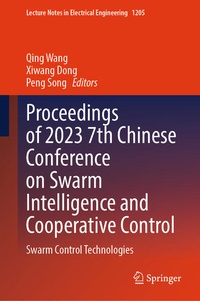
Proceedings of 2023 7th Chinese Conference on Swarm Intelligence and Cooperative Control
Description

This book includes original, peer-reviewed research papers from the 2023 7th Chinese Conference on Swarm Intelligence and Cooperative Control (CCSICC2023), held in Nanjing, China on November 17-19, 2023. The topics covered include but are not limited to: reviews and discussions of swarm intelligence, basic theories on swarm intelligence, swarm communication and networking, swarm perception, awareness and location, swarm decision and planning, cooperative control, cooperative guidance, swarm simulation and assessment.
The papers showcased here share the latest findings on theories, algorithms and applications in swarm intelligence and cooperative control, making the book a valuable asset for researchers, engineers, and university students alike.
More details
Other editions
Additional editions
Persons
Qing Wang is currently a research associate with the School of Automation Science and Electrical Engineering, Beihang University, Beijing, China. His research interests include distributed control, optimization, and game for multi-agent systems.
Xiwang Dong is with the Institute of Artificial Intelligence, Beihang University, Beijing 100191, China, also with the Science and Technology on
Aircraft Control Laboratory and School of Automation Science and Electrical Engineering, Beihang University, Beijing 100191, China, and also with the Key Laboratory of Dependable Service Computing in Cyber Physical Society (Chongqing University), Ministry of Education of China, Chongqing University, Chongqing 400044, China.
Xiwang Dong received the B.E. degree in automation from Chongqing University, Chongqing, China, in 2009, and the Ph.D. degree in control science and engineering from Tsinghua.
University, Beijing, China, in 2014. From 2014 to 2015, he was a Research Fellow with the School of Electrical and Electronic Engineering, Nanyang Technological University, Singapore, and from 2014 to 2018,
he was a Lecturer with the School of Automation Science and Electrical Engineering, Beihang University, Beijing, where he is currently a professor, and also an Associate Dean with the Institute of Artificial Intelligence.
His research interests include consensus, formation control, and containment control of swarm systems with applications to UAV swarm systems.
Prof. Dong was the recipient of the National Natural Science Fund for Excellent Young Scholars in 2019 and the Wu Wenjun Artificial Intelligence Excellent Youth
Award in 2018, and 2015. His four papers was also the recipient of the Best Paper Awards or Best Paper Nomination Awards in IEEE or IFAC conferences.
Peng Song is with the Chinese Institute of Command and Control, 10th Floor, Building 1, No.10, Chedaogou, Haidian District, Beijing, China (100089).
Peng Song is Deputy Secretary General with the Chinese Institute of Command and Control. His research interests include Command and Control, Intelligent command and scheduling system.
Content
- Intro
- Contents
- Inter-layer Generalized Synchronization for Fractional-Order Two-Layer Networks Based on Auxiliary-System Method
- 1 Introduction
- 2 Preliminaries
- 3 Inter-layer Generalized Synchronization for Fractional-Order Two-Layer Networks
- 4 Numerical Examples
- 5 Conclusion
- References
- Phase Transition at Small-Medium Scales Vicsek Model Based on Eigen Microstate Method
- 1 Introduction
- 2 Models
- 2.1 Standard Vicsek Model
- 2.2 The Method of Eigen Microstates ch2Li2021
- 3 Experiment and Result
- 4 Conclusion
- References
- Robust Fixed-Time Synchronization for FitzHugh-Nagumo Networks with Fast-Slow Time Scales
- 1 Introduction
- 2 Preliminaries
- 2.1 Useful Lemmas for Fixed-Time Synchronization
- 2.2 Problem Formulation
- 3 Main Results
- 3.1 Reachability of the Sliding-Mode Surfaces
- 3.2 Dynamics on the Sliding-Mode Surfaces
- 4 Numerical Simulations
- 5 Conclusions
- References
- Adaptive Fault-Tolerant Formation Control for Multiple UAVs Under Unknown Actuator Faults
- 1 Introduction
- 2 RUAV Dynamics Analysis
- 3 Adaptive Fault-Tolerant Formation Control
- 3.1 Outer-Loop Formation Guidance
- 3.2 Inner-Loop Adaptive FTC
- 4 Simulation Results
- 5 Conclusion
- References
- Parameter Tuning of PMSM Sliding Mode Control Based on Multi-agent Reinforcement Learning
- 1 Introduction
- 2 Reinforcement Learning Algorithm Selection
- 3 Design of Reinforcement Learning Algorithm
- 3.1 Design of Sliding Mode Control Law
- 3.2 Design of Observations and Rewards
- 3.3 Actor Critical Network Design
- 3.4 Model Training
- 4 Simulation and Experiment
- 5 Summary
- References
- Finite-Iteration Consensus Tracking Control of Nonlinear Multi-agent Systems with Input Sharing
- 1 Introduction
- 2 Preliminaries and Problem Description
- 2.1 Notations
- 2.2 Graph Theory
- 2.3 Problem Description
- 3 Main Results
- 4 Numerical Example
- 5 Conclusion
- References
- Overview of UAV Swarm Communication and Cooperative Operation in Denial Environment
- 1 Introduction
- 2 Typical Communication Mode of Drone Swarm
- 3 Unmanned Aerial Vehicle Ad Hoc Network
- 3.1 Concept and Characteristics of Unmanned Aerial Vehicle Self-organizing Network
- 3.2 UAV Ad Hoc Network Protocol Hierarchical Database Model
- 3.3 Key Technologies of Unmanned Aerial Vehicle Ad Hoc Networks
- 4 UAV Collaborative Operations
- 5 Conclusion
- References
- Online Updating Data-Driven Model Predictive Control for Quadrotors in Close Formation Based on Gaussian Process Regression
- 1 Introduction
- 2 Methodology
- 2.1 Notion
- 2.2 Quadrotor Dynamics
- 2.3 Gaussian Process Regression
- 2.4 Data Collection and Model Learning
- 2.5 Model Predictive Control
- 3 Simulation Experiment
- 3.1 Overview
- 3.2 Aerodynamic Effects
- 3.3 Simulation Setup
- 3.4 Result Analysis
- 4 Conclusion
- References
- Stability Analysis of the Heterogeneous Vehicle Platoon with Multiple Delays
- 1 Introduction
- 2 Preliminaries
- 2.1 Vehicle Dynamics and Communication Topology
- 2.2 Distributed Controller with Multiple Delays
- 2.3 Closed-Loop Platoon Dynamics
- 3 The Stability Analysis of the Heterogeneous Vehicle Platoon with Multiple Delays
- 3.1 Internal Stability Analysis
- 3.2 String Stability Analysis
- 4 Simulations
- 4.1 Internal Stability Verification
- 4.2 String Stability Verification
- 5 Conclusion
- References
- Resilient Consensus for Discrete-Time Multi-agent Systems with Dynamic Leader and Tolerance to Node Failure
- 1 Introduction
- 2 Preliminaries and Problem Statement
- 3 Main Results
- 3.1 Resilient Consensus Protocol
- 4 Robust Graphs Tolerant to Node Failure
- 5 Simulation
- 6 Conclusion
- References
- Consensus Problem of Discrete-Time Linear Multi-agent Systems with Non-convex Control Input and State Constraints
- 1 Introduction
- 2 Notations and Preliminaries
- 3 Model and Problem Statement
- 4 Algorithm and Model Conversion
- 5 Consensus Analysis
- 6 Numerical Example
- 7 Conclusion
- References
- Model-Free Formation Control: Multi-input Adaptive Super-Twisting Approach Based on Barrier Function
- 1 Introduction
- 2 Problem Formulation and Preliminaries
- 2.1 Quadrotor Position Model
- 2.2 Useful Lemmas and Assumptions
- 3 Adaptive STWC Design Based on Barrier Function
- 3.1 Design of Sliding Motion
- 3.2 Convergence Analysis
- 4 Simulation
- 5 Conclusion
- References
- Dynamic Event-Triggered Optimal Consensus Control of Nonlinear Multi-agent Systems with Input Saturation
- 1 Introduction
- 2 Preliminaries and Problem Formulation
- 2.1 Algebraic Graph Theory
- 2.2 Problem Formulation
- 3 Optimal Consensus Control Protocol Design
- 3.1 Distributed Control Protocol Based on ADP Method
- 3.2 Online ADP Scheme for the Coupled HJB Equation
- 4 DETC Optimal Consesus Control Design
- 4.1 DETC Design
- 4.2 Stability Analysis
- 5 Simulation
- 6 Conclusions
- References
- Collision-Free Formation Control of Multi-agent System with Low Oscillation
- 1 Introduction
- 2 Background
- 2.1 Graph Theory
- 2.2 Multi-agent System
- 3 Main Results
- 3.1 Formation Control Algorithm
- 3.2 Stability Analysis
- 3.3 Collision Avoidance Analysis
- 4 Experiment
- 5 Conclusion
- References
- Robust Cooperative Control for a Class of Heterogeneous Air-Ground System
- 1 Introduction
- 2 Mathematical Model
- 2.1 Graph Theory
- 2.2 Model of Air-Ground System
- 2.3 Control Problem Statement
- 3 Robust Coordinated Controller Design
- 4 Robust Stability Analysis
- 5 Simulation Results
- 6 Conclusion
- References
- Finite-Time Extended State Observer-Based Performance-Critical Control for Uncertain MIMO Nonlinear Systems
- 1 Introduction
- 2 Preliminaries and Problem Formulation
- 2.1 Notations
- 2.2 Preliminaries
- 2.3 Problem Formulation
- 3 Controller Design and Analysis
- 3.1 Finite-Time Extended State Observer
- 3.2 Design and Analysis of Controller
- 4 Simulation Example
- 5 Conclusions
- References
- Distributed Control of Multi-unmanned Aerial Vehicle Circumnavigation Formation Based on Partial Differential Equations
- 1 Introduction
- 2 Overall System Design and Problem Description
- 2.1 Formation Control Law Design
- 2.2 Collision Avoidance Design with Repulsion Field Function
- 2.3 State Estimation Algorithm Based on Kalman Filter
- 3 Numerical Simulation
- 3.1 Scenario Design
- 3.2 Parameter Setting
- 4 Simulation Experiment
- 4.1 Simulation System Architecture
- 4.2 Simulation Results
- 4.3 Result Analysis
- 5 Conclusion
- References
- QMIX: Monotone Valued Function Decomposition Algorithm for Switching Formation-Contrianment Control with Local Information
- 1 Introduction
- 2 Problem Description and Topology Setting
- 2.1 Task Description
- 2.2 UAVs Topology Model
- 2.3 Formation Setting
- 3 Design of Formation-Containment Control Algorithms for Arbitrary Topological Shapes
- 3.1 Hungarian Algorithm Assignment
- 3.2 Design of Formation-Containment Algorithm
- 4 Simulation
- 4.1 Analysis of Algorithm Complexity
- 4.2 Analysis of Simulation Results
- 4.3 Simulation Testing of Formation-Containment Control
- 4.4 Model Comparison and Verification
- 5 Conclusion
- References
- Data-Driven Model Predictive Control Strategy for Battery Energy Storage System
- 1 Introduction
- 2 Mathematical Modeling
- 2.1 Equivalent Circuit Model
- 2.2 BESS Model Description
- 3 Koopman MPC of BESS
- 3.1 The Koopman Operator
- 3.2 Data-Driven Based Koopman Linearization
- 3.3 Model Predictive Control
- 4 Simulation Results
- 5 Conclusion and Future Work
- References
- Gaussian Process Regression Based Pose Tracking Control for Multiple Spacecraft Rendezvous
- 1 Introduction
- 2 Preliminaries and Problem Statement
- 2.1 Modeling of Relative Motion Dynamics
- 2.2 Gaussian Process Regression
- 2.3 Control Objective
- 3 Controller Design and Stability Analysis
- 3.1 Ideal Model Based Nominal Controller Design
- 3.2 GPR-Based Uncertainty Online Learning
- 3.3 GPR-Based Pose Tracking Controller Design
- 3.4 Stability Analysis of Controlled System
- 4 Simulation Example
- 5 Conclusions
- References
- Resilient Consensus-Based Distributed Signal Reconstruction Against Byzantine Attacks
- 1 Introduction
- 2 Preliminaries
- 2.1 Mathematical Notation and Terminology
- 2.2 Sensor Network
- 2.3 Byzantine Attacks
- 3 Main Result
- 4 Simulation Examples
- 5 Conclusion
- References
- Safety Assurance in Multi-UAV Formation Tracking Control Amidst Missile Threats
- 1 Introduction
- 2 Preliminaries
- 2.1 Graph Theory
- 2.2 System Dynamic
- 2.3 Relaxed Converse Control Lyapunov-Barrier Functions
- 3 Distributed Safety-Stability Formation Control Strategy
- 3.1 Controller Design of Leader UAV
- 3.2 Controller Design of Follower UAV
- 4 Safety-Stability Analysis
- 5 Simulation Verification
- 6 Conclusion
- References
- Multi-agent Deep Reinforcement Learning Based Multi-objective Charging Control for Electric Vehicle Charging Station
- 1 Introduction
- 2 Problem Formulation
- 2.1 Operation Details of the EVCS
- 2.2 Multiple Objectives of the Charging Control
- 3 Markov Game Model
- 3.1 Markov Game Formulation
- 3.2 Policies and Goals
- 4 Multi-agent Actor-Double-Critic Algorithm
- 4.1 Individual Learning
- 4.2 Collective Learning
- 4.3 Multi-agent Double Learning
- 5 Performance Evaluation
- 5.1 Environmental Setup
- 5.2 Training Performance
- 5.3 Charging Control Performance
- 6 Conclusion
- References
- Dynamic Asynchronous Event-Triggered Leader-Following Consensus of Heterogeneous Multi-agent Systems
- 1 Introduction
- 2 Preliminaries
- 2.1 Algebraic Graph Basics
- 2.2 Problem Formulation and Assumptions
- 3 Control Design
- 3.1 Design of Event-Triggering Condition
- 3.2 Design of Controller Structure
- 3.3 Coupled Lyapunov Inequalities
- 3.4 Design of Dynamics of r
- 4 System Stability and Consensus Analysis
- 4.1 Boundedness of Closed-Loop Signals
- 4.2 Exclusion of Zeno Behavior
- 5 Conclusion
- A Appendix
- A.1 Proof of Lemma 2
- References
- Formation Tracking for Autonomous Surface Vessels Based on an Improved Reaching Law
- 1 Introduction
- 2 Preliminaries and Problem Description
- 2.1 Preliminaries
- 2.2 Dynamics of ASVs
- 3 Main Results
- 4 Simulation and Comparison Results
- 4.1 Formation Tracking Performance
- 4.2 Comparison Results
- 5 Conclusions
- References
- A Method of Multi-aircrafts Cooperative Control Using Sliding Mode Technology in Formation Flight
- 1 Introduction
- 2 Formation Kinematics Modeling
- 2.1 Aircraft Motion Model
- 2.2 Transformation Matrix of the Leader-Follower Model
- 2.3 Formation Model
- 3 Trajectory Tracking Controller Based on Sliding Mode Control Technology
- 4 Simulation Verification
- 5 Conclusion
- References
- Fractional-Order Event-Triggered Formation Control for Multi-UAV Systems with Collision Avoidance
- 1 Introdution
- 2 Preliminaries and Problem Formulation
- 2.1 Notations and Graph Theory
- 2.2 Problem Formulation
- 3 Results
- 3.1 Collision Avoidance Potential(CAP) Functions
- 3.2 Fractional-Order Continuous Event-Triggered Formation Control with Collision Avoidance
- 4 Simulation Results
- 5 Conclusions
- References
- APF-Based Control for On-Orbit Swarm Guard Against Multiple Threat Targets
- 1 Introduction
- 2 Problem Description
- 2.1 Coordinate System and Dynamics
- 2.2 Description of the Swarm Guard Mission
- 3 Method
- 3.1 Mission Assignment
- 3.2 Individual Control
- 4 Simulation
- 4.1 One-To-One Defense
- 4.2 Swarm-To-Swarm Defense
- 5 Conclusions
- References
- Reentry Vehicle Formation Control Method Based on Adaptive Dynamic Programming
- 1 Introduction
- 2 Problem Formulation
- 2.1 Reentry Vehicle Centroid Motion Model
- 2.2 Description of Optimal Trajectory Tracking Control Problem
- 2.3 Problem Description for Reentry Vehicle Formation Control
- 3 Nominal Trajectory Tracking Control Method
- 3.1 Principle of ADP
- 3.2 Quadratic Network Training Method Based on Optimal Learning Rate
- 4 Leader-Follower Adaptive Formation Control Methods
- 4.1 Network Offline Training-Online Fitting Strategy
- 4.2 Algorithm Flow
- 5 Simulation Verification
- 5.1 Network Training Results
- 5.2 Formation Tracking Results
- 6 Conclusion
- References
- Optimal Bipartite Consensus Control for Nonlinear Multiagent Systems Based on Reinforcement Learning
- 1 Introduction
- 2 Preliminaries
- 2.1 Graph Theory
- 2.2 Bipartite Consensus of MASs
- 3 Optimal Bipartite Consensus Problem of MASs
- 3.1 Optimal Bipartite Consensus Problem
- 3.2 Stability Analysis and Nash Equilibrium
- 4 Reinforcement Learning Algorithm
- 4.1 Q-function-Based PI Method
- 4.2 Convergence Analysis of the PI Algorithm
- 4.3 Construction of Critic Networks and Actor Networks
- 5 Simulation
- 6 Conclusion
- References
- Fixed-Time Leader-Following Consensus for Multi-agent Systems
- 1 Introduction
- 2 Preliminaries
- 2.1 Graph Theory
- 2.2 Relevant Definition and Lemma
- 3 New FXT Stability Result
- 4 FXT Leader-Following Consensus
- 4.1 Problem Formulation
- 4.2 Main Results
- 5 Simulation Results
- 6 Conclusion
- References
- Prescribed-Time Fault-Tolerant Synchronization of Complex Dynamical Networks By Linear Time-Varying Protocol
- 1 Introduction
- 2 Problem Statement
- 2.1 Graph Theory
- 2.2 Model Description
- 3 Prescribed-Time Synchronization by Bounded Linear Time-Varying Protocol
- 4 Simulation Results
- 5 Conclusion
- References
- Circular Formation Cooperative Control of UAVs Based Solely on Distance Information
- 1 Introduction
- 2 System Description
- 2.1 The Model of UAVs
- 2.2 Local Circular Motion
- 3 The Circular Motion and Target Track
- 3.1 Circular Motion
- 3.2 Target Track
- 4 Simulation
- 5 Conclusion
- References
- An Improved Dynamic Matrix Control for the Quadrotor UAV Trajectory Tracking
- 1 Introduction
- 2 A Quadrotor UAV Model
- 3 Controller Design for the Quadrotor UAV
- 3.1 Design of the LADRC Controller
- 3.2 Design of the IDMC
- 3.3 Control Scheme of the Quadrotor UAV
- 4 Simulations
- 4.1 Comparisons of the DMC and the IDMC
- 4.2 IDMC on a Quadrotor UAV
- 5 Conclusions
- References
- Practical Distance-Based Formation Stabilization and Tracking of Nonholonomic Multi-agent Systems
- 1 Introduction
- 2 Background and Preliminaries
- 2.1 Graph Theory and Some Useful Lemmas
- 2.2 Problem Formulation
- 3 Formation Control Law
- 3.1 Transformation of Nonholonomic Kinematics
- 3.2 Practical Formation Stabilization
- 3.3 Practical Formation Tracking
- 4 Numerical Simulations
- 5 Conclusions
- References
- A Multi-agent Deep Reinforcement Learning Framework for UAV Swarm
- 1 Introduction
- 2 Single-Agent Deep Reinforcement Learning
- 3 Multi-agent Deep Reinforcement Learning
- 4 Multi-agent Deep Reinforcement Learning
- 4.1 Environment Perception Based on Probability Graph Mode
- 4.2 Multi-agent Reward Function Model
- 4.3 Multi-agent Stability Model Based on Deep Reinforcement Learning
- 5 Conclusion
- References
- Common Aircraft Formation Control Methods and Application Prospects of High Order Fully Actuated System Theory in Aircraft Formation Control
- 1 Introduction
- 2 Common Aircraft Formation Control Methods
- 2.1 Leader-Follower Style
- 2.2 Behavior Based Formation Control
- 2.3 Virtual Structure Method
- 2.4 Artificial Potential Field Method
- 3 Application Prospects of High Order Fully Actuated System Theory in Aircraft Formation Control
- 3.1 Development of High Order Fully Actuated System Theory
- 3.2 Application of Fully Actuated System Theory in Aircraft Control
- 3.3 Practice of Fully Actuated System Method in Multi-agent Collaborative Control
- 3.4 Application Prospects of Fully Actuated System Theory in Aircraft Formation Control
- 4 Conclusion
- References
- New Sufficient Conditions on Global Exponential Stability of Delayed Inertial Neural Networks Based on a Direct Parameterized Method
- 1 Introduction
- 1.1 Introduction
- 1.2 Notations
- 2 Preliminaries
- 3 A Direct Parameterized Method
- 4 A Numerical Example
- 5 Conclusions
- References
- Finite Coverage Control Strategy for Multi-robot Networks with Sensor Constraints and Obstacle Avoidance
- 1 Introduction
- 2 Preliminary Knowledge and Problem Statements
- 2.1 Control Barrier Function
- 2.2 Problem Statement
- 3 Limited Coverage Control
- 4 Distributed Obstacle Avoidance Control Algorithm for Multiple Robots Based on Control Obstacle Functions
- 5 Simulation Results
- 5.1 Limited Coverage Control
- 5.2 Limited Coverage Safety Control Based on Control Barrier Functions
- 6 Conclusion
- References
- Iterative Learning Collaborative Planning Control for Rigid and Soft Robot
- 1 Introduction
- 2 Problem Description
- 3 Design of Input Mapping Compensation
- 4 Learning-Based Input Mapping Iterative Learning Control
- 4.1 Controller Structure Design
- 4.2 Optimization Problems for Trajectory Tracking Tasks and Description of Robot Collaborate Constraints
- 5 Experiments
- 6 Conclusion
- References
- Dynamic Event-Triggered Optimal Control Strategy of Unknown Nonlinear Systems
- 1 Introduction
- 2 Problem Statement
- 3 Dynamic Event-Triggered Control Strategy
- 4 Identifier-Critic NN
- 4.1 Identifier NN
- 4.2 Critic NN
- 5 Simulation Results
- 6 Conclusion
- References
- Pseudoinverse and Distributed Robust Data-Enabled Predictive Control for Linear Time-Invariant Systems with Disturbances
- 1 Introduction
- 2 System Representation and Fundamental Lemma
- 3 Distributionally Robust Data-Enabled Predictive Control
- 3.1 Problem Setup
- 3.2 Main Results
- 4 Simulation Example
- 5 Conclusion
- References
- Signed Average Consensus of Signed Networks Under Directed Communication Topologies
- 1 Introduction
- 2 Preliminaries
- 3 Signed Average Consensus
- 4 Simulations
- 5 Conclusions
- References
- A Mission-Driven Flocking Control Scheme for UAV Swarm Formation Flight
- 1 Introduction
- 2 Problem Statement
- 2.1 Graph Theory
- 2.2 UAV Dynamics
- 2.3 Four Areas Around a UAV
- 3 Online Trajectory Generation Based on DMPC
- 3.1 Prediction Model and Trajectory Parameterization
- 3.2 Physical Limits
- 3.3 Continuity Constraints
- 3.4 Collision Avoidance
- 3.5 Objective Function
- 4 Flocking Controller Based on Optimal Consensus
- 4.1 Flocking Model
- 4.2 Optimization Problem Construction
- 4.3 Consensus Formation
- 4.4 Control Effort
- 4.5 Trajectory Tracking, Collision Avoidance and Cohesion
- 5 Simulations
- 5.1 Scenario 1
- 5.2 Scenario 2
- 6 Conclusion
- References
- Fixed-Time Event-Triggered Time-Varying Formation Control for Second-Order Multi-agent Systems Under Directed Topologies
- 1 Introduction
- 2 Preliminaries
- 3 TVFTC Design and Analysis
- 4 Simulation Results
- 5 Conclusion
- References
- Leader-Follower Formation Control of Non-holonomic Robots with Collision Avoidance by Using Artificial Potential Field
- 1 Introduction
- 2 Problem Description
- 2.1 Kinematic Model of Non-holonomic Mobile Robot
- 2.2 Kinematic Model of Leader-Follower Formation Scheme
- 3 Control Algorithm Design
- 4 Obstacle Avoidance Based on Artificial Potential Field
- 5 Stability Analysis
- 6 Simulation Verification
- 6.1 Simulation of Leader-Follower Formation
- 6.2 Simulation of Collision Avoidance
- 7 Conclusions
- References
- Hybrid Dynamic Output Feedback Based Formation Control for Heterogeneous Multi-agent Systems
- 1 Introduction
- 2 Preliminaries and Problem Statement
- 2.1 ISS of Impulsive Systems
- 2.2 Problem Statement
- 3 Main Results
- 3.1 Controller Design and Closed-Loop System
- 3.2 Asymptotical Convergence
- 3.3 Exponential Convergence
- 4 Simulation
- 5 Conclusion
- References
- Terrain-Adaptive Cooperative Braking Control for Heavy-Haul Trains
- 1 Introduction
- 2 Modeling
- 3 Cooperative Braking Control
- 3.1 Cooperative Braking Control Framework
- 3.2 Consensus Based Velocity Tracker
- 3.3 Distance Separation Tracker
- 3.4 Closed-Loop Control System
- 4 Simulation Results
- 4.1 Parameter Setting
- 4.2 Simulation Results
- 5 Conclusion
- References
- Event-Triggered Consensus for Heterogeneous Battery Energy Storage Systems in Droop-Controlled Microgrids
- 1 Introduction
- 2 Battery Energy Storage System Model
- 2.1 Droop Control
- 2.2 State Space Model
- 3 Adaptive Event-Triggered Consensus Protocol
- 3.1 Local Controller Design with Aperiodic Communication
- 3.2 Global Event-Triggered Consensus Under Directed Topology
- 4 Illustrative Examples
- 4.1 Case Study 1: Load Variation Testing
- 4.2 Case Study 2: Comparison with Periodical Transmission Mechanism
- 5 Conclusion
- References
- Fixed-Time Consensus of Second-Order Leader-Following Multi-agent Systems via Event-Triggered Intermittent Control
- 1 Introduction
- 2 Formulation and Preliminaries
- 2.1 Graph Theory
- 2.2 Stability of Fixed-Time
- 2.3 Problem Formulation
- 3 Main Results
- 3.1 Fixed-Time Distributed Observer Design
- 3.2 Distributed Aperiodic Intermittent Controller Design
- 4 Simulation Examples
- 5 Conclusion
- References
- Distributed Iterative Sequential Action Control for Multiple Nonlinear Dynamic Systems
- 1 Introduction
- 2 Problem Formulation
- 3 Distributed Analytical Optimal Controller Design
- 3.1 Explicit Analytic Solution
- 3.2 Optimal Control Action
- 4 Numerical Simulation
- 4.1 Example Description
- 4.2 Simulation Result
- 5 Conclusion
- References
- Encrypted MPC Design for Load Frequency Control of Smart Grids Under Cyber-Attacks
- 1 Introduction
- 2 Modelling
- 2.1 LFC System
- 2.2 Cyber-Attacks Module
- 3 Description of Control Scheme
- 3.1 Quantization Scheme
- 3.2 Homomorphic Encryption Scheme
- 3.3 Model Predictive Control Scheme
- 4 Numerical Simulation Results and Analyses
- 4.1 Simulation Settings
- 4.2 Analysis of Experiment Results
- 5 Conclusion
- References
- Time-Varying Formation Control of Drones Using Consensus Theory
- 1 Introduction
- 2 Dynamic Description of UAV Cluster Formation
- 2.1 Time-Varying Formation Control Law Design
- 2.2 Description of UAV Cluster Topology
- 2.3 Proof of Algorithm Stability
- 3 Simulation and Analysis
- 3.1 Test on Wedge Formation of UAV Swarm
- 3.2 Large-Scale Formation Switch of UAV Swarm
- 4 Conclusion
- References
- Integrated Leaderless Consensus Protocol Design for Linear Systems Based on Output Feedback
- 1 Introduction
- 2 Preliminaries
- 3 Integrated Consensus Protocol Based on Output Feedback
- 4 Numerical Simulation
- 5 Conditions
- References
- Distributed Super-Twisting Sliding Mode Adaptive Fault-Tolerant Control for Multiple UAVs with Prescribed Performance
- 1 Introduction
- 2 Preliminaries and Problem Statement
- 2.1 UAV Dynamics
- 2.2 UAV Actuator Fault Model
- 2.3 Description of RBFNNs
- 2.4 Control Objective
- 3 Main Results
- 3.1 Distributed Sliding-Mode Observer
- 3.2 Disturbance Observer and RBFNNs
- 3.3 Controller Design
- 3.4 Stability Analysis
- 4 Simulation Results
- 5 Conclusions and Future Works
- References
- Agile Maneuvering Control for Non-contact Satellite Platform
- 1 Introduction
- 2 Problem Formulation
- 2.1 System Description
- 2.2 Dynamics Modeling
- 3 Controller Design
- 3.1 Sliding Mode Adaptive Control Law Design
- 4 Simulation Analysis
- 5 Conclusion
- References
- Consensus-Based Aggregation Control and Formation Tracking Control for Fixed-Wing UAV Swarm System
- 1 Introduction
- 2 Preliminaries and Problem Description
- 3 Main Results
- 3.1 Consensus-Based Aggregation Control
- 3.2 Path Tracking Controller Design
- 3.3 Formation Tracking Controller Design
- 4 Simulation Experiment
- 5 Conclusions
- References
- Distributed Adaptive Consensus Control for Euler-Lagrange Systems with Unknown Parameters and Event-Triggered Communication
- 1 Introduction
- 2 Problem Formulation
- 2.1 System Model
- 2.2 Communication Topology
- 2.3 Event-Triggered Communication
- 2.4 Control Objective
- 3 Controller Design
- 4 Stability Analysis
- 5 Simulation Results
- 6 Conclusion
- References
- Event-Based Adaptive Control for MIMO Nonlinear Systems Against Deception Attacks via a Single Parameter Learning Method
- 1 Introduction
- 2 Preliminaries and Problem Formulation
- 2.1 Problem Description
- 2.2 Neural Network
- 3 Main Results
- 3.1 DETM-Based Adaptive Controller Design
- 3.2 Stability Analysis
- 4 Simulation Example
- 5 Conclusion
- References
- Author Index
