

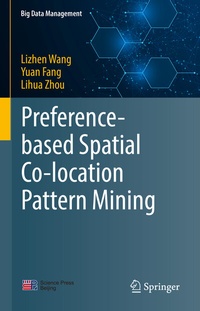
Preference-based Spatial Co-location Pattern Mining
1st Edition
Published on 4. January 2022
XVI, 294 pages
978-981-16-7566-9 (ISBN)
Description

The development of information technology has made it possible to collect large amounts of spatial data on a daily basis. It is of enormous significance when it comes to discovering implicit, non-trivial and potentially valuable information from this spatial data. Spatial co-location patterns reveal the distribution rules of spatial features, which can be valuable for application users. This book provides commercial software developers with proven and effective algorithms for detecting and filtering these implicit patterns, and includes easily implemented pseudocode for all the algorithms. Furthermore, it offers a basis for further research in this promising field.
Preference-based co-location pattern mining refers to mining constrained or condensed co-location patterns instead of mining all prevalent co-location patterns. Based on the authors' recent research, the book highlights techniques for solving a range of problems in this context, including maximal co-location pattern mining, closed co-location pattern mining, top-k co-location pattern mining, non-redundant co-location pattern mining, dominant co-location pattern mining, high utility co-location pattern mining, user-preferred co-location pattern mining, and similarity measures between spatial co-location patterns.
Presenting a systematic, mathematical study of preference-based spatial co-location pattern mining, this book can be used both as a textbook for those new to the topic and as a reference resource for experienced professionals.
Preference-based co-location pattern mining refers to mining constrained or condensed co-location patterns instead of mining all prevalent co-location patterns. Based on the authors' recent research, the book highlights techniques for solving a range of problems in this context, including maximal co-location pattern mining, closed co-location pattern mining, top-k co-location pattern mining, non-redundant co-location pattern mining, dominant co-location pattern mining, high utility co-location pattern mining, user-preferred co-location pattern mining, and similarity measures between spatial co-location patterns.
Presenting a systematic, mathematical study of preference-based spatial co-location pattern mining, this book can be used both as a textbook for those new to the topic and as a reference resource for experienced professionals.
More details
Series
Language
English
Place of publication
Singapore
Singapore
Publishing group
Springer Singapore
Target group
Professional and scholarly
Product notice
Reflowable
Illustrations
XVI, 294 p. 1 illus.
File size
14,47 MB
ISBN-13
978-981-16-7566-9 (9789811675669)
DOI
10.1007/978-981-16-7566-9
Schweitzer Classification
Other editions
Additional editions
Lizhen Wang | Yuan Fang | Lihua Zhou
Preference-based Spatial Co-location Pattern Mining
Book
01/2022
Springer
€149.79
Shipment within 3-4 weeks
Persons
Wang, Lizhen received her BS and MSc degrees in computational mathematics from Yunnan University, in 1983 and 1988, respectively, and her PhD degree in computer science from the University of Hudersfield, UK, in 2008. She is a professor at the School of Computer Science and Engineering, Yunnan University, and leader of the "Spatial Big Data Mining and Decision Support Innovation" team in Yunnan Province. She was the winner of the special allowance of Yunnan Provincial Government. She serves as the reviewer for several respected international journals, including Information Sciences and the International Journal of Geographical Information Science, and for more than 10 prestigious international conferences, such as AAAI, IJCAI andPAKDD. She has published more than 90 papers related to spatial data mining as well as 3 books. She is a member of the IEEE and the ACM.
Fang, Yuan received her BS and MSc degrees in computer science from Nanjing Agricultural University, in 2008 and 2014, respectively, and her PhD degree in computer science from the Yunnan University, in 2018. She is currently a postdoctoral follow of South-Western Institute for Astronomy Research (SWIFAR), Yunnan University. She has published 15 papers on data mining in various journals and at conferences. Her research interests include spatial data mining, big data analytics and their applications.
Zhou, Lihua received her BS and MSc degrees in information and electronic science from Yunnan University in 1989 and 1992 respectively, and her PhD degree in communication and information system from Yunnan University in 2010. She is currently a professor at the School of Computer Science and Engineering, Yunnan University. She has published more than 50 papers on data mining in various journals and at conferences.
Fang, Yuan received her BS and MSc degrees in computer science from Nanjing Agricultural University, in 2008 and 2014, respectively, and her PhD degree in computer science from the Yunnan University, in 2018. She is currently a postdoctoral follow of South-Western Institute for Astronomy Research (SWIFAR), Yunnan University. She has published 15 papers on data mining in various journals and at conferences. Her research interests include spatial data mining, big data analytics and their applications.
Zhou, Lihua received her BS and MSc degrees in information and electronic science from Yunnan University in 1989 and 1992 respectively, and her PhD degree in communication and information system from Yunnan University in 2010. She is currently a professor at the School of Computer Science and Engineering, Yunnan University. She has published more than 50 papers on data mining in various journals and at conferences.
Content
Chapter 1: Introduction.- Chapter 2: Maximal Prevalent Co-location Patterns.- Chapter 3: Maximal Sub-prevalent Co-location Patterns.- Chapter 4: SPI-Closed Prevalent Co-location Patterns.- Chapter 5: Top-k Probabilistically Prevalent Co-location Patterns.- Chapter 6: Non-Redundant Prevalent Co-location Patterns.- Chapter 7: Dominant Spatial Co-location Patterns.- Chapter 8: High Utility Co-location Patterns.- Chapter 9: High Utility Co-location Patterns with Instance Utility.- Chapter 10: Interactively Post-mining User-preferred Co-location Pat-terns with a Probabilistic Model.- Chapter 11: Vector-Degree: A General Similarity Measure for Spatial Co-Location Patterns.
