

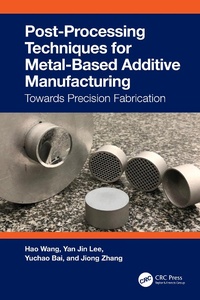
Post-Processing Techniques for Metal-Based Additive Manufacturing
Towards Precision Fabrication
1st Edition
Published on 4. September 2023
288 pages
978-1-000-93554-7 (ISBN)
Description

This book shares insights on post-processing techniques adopted to achieve precision-grade surfaces of additive manufactured metals including material characterization techniques and the identified material properties.
Post-processes are discussed from support structure removal and heat treatment to the material removal processes including hybrid manufacturing. Also discussed are case studies on unique applications of additive manufactured metals as an exemplary of the considerations taken during post-processing design and selection.
Addresses the critical aspect of post-processing for metal additive manufacturing
Provides systematic introduction of pertinent materials
Demonstrates post-process technique selection with the enhanced understanding of material characterization methods and evaluation
Includes in-depth validation of ultra-precision machining technology
Reviews precision fabrication of industrial-grade titanium alloys, steels, and aluminium alloys, with additive manufacturing technology
The book is aimed at researchers, professionals, and graduate students in advanced manufacturing, additive manufacturing, machining, and materials processing.
Post-processes are discussed from support structure removal and heat treatment to the material removal processes including hybrid manufacturing. Also discussed are case studies on unique applications of additive manufactured metals as an exemplary of the considerations taken during post-processing design and selection.
Addresses the critical aspect of post-processing for metal additive manufacturing
Provides systematic introduction of pertinent materials
Demonstrates post-process technique selection with the enhanced understanding of material characterization methods and evaluation
Includes in-depth validation of ultra-precision machining technology
Reviews precision fabrication of industrial-grade titanium alloys, steels, and aluminium alloys, with additive manufacturing technology
The book is aimed at researchers, professionals, and graduate students in advanced manufacturing, additive manufacturing, machining, and materials processing.
More details
Edition
1. Auflage
Language
English
Place of publication
London
United Kingdom
Publishing group
Taylor & Francis Ltd
Target group
College/higher education
Professional and scholarly
Illustrations
20 Tables, black and white; 63 Line drawings, black and white; 72 Halftones, black and white; 135 Illustrations, black and white
ISBN-13
978-1-000-93554-7 (9781000935547)
Copyright in bibliographic data and cover images is held by Nielsen Book Services Limited or by the publishers or by their respective licensors: all rights reserved.
Schweitzer Classification
Other editions
Additional editions
Hao Wang | Yan Jin Lee | Yuchao Bai
Post-Processing Techniques for Metal-Based Additive Manufacturing
Towards Precision Fabrication
Book
01/2025
1st Edition
CRC Press
€71.70
Shipment within 10-20 days
Hao Wang | Yan Jin Lee | Yuchao Bai
Post-Processing Techniques for Metal-Based Additive Manufacturing
Towards Precision Fabrication
Book
09/2023
1st Edition
CRC Press
€186.50
Shipment within 10-20 days
Persons
Hao Wang (PhD, MSME, MASME) is an Alexander von Humboldt fellow, and Assistant Professor at the Department of Mechanical Engineering in National University of Singapore. He was awarded the Japan Society for the Promotion of Science (JSPS) fellowship in 2020. He has a persistent dedication to the research in micro-cutting theory and the physics of machining processes. His research covers system and process development, design and implementation of machining and polishing systems, material characterisation, etc. His research themes are centralized on bridging the gap between additive manufacturing and ultra-precision machining technology. He has published over 110 peer-reviewed journal articles. He is currently serving as an Associate Editor for the Journal of Intelligent Manufacturing.
Yan Jin Lee is a Research Fellow in the Department of Mechanical Engineering at the National University of Singapore. His research focuses on novel solutions to augment the ultra-precision machining process to produce optical-grade surface finishing with nanoscopic roughness. His PhD research revealed novel physical effects of coatings on the ultra-precision machining of brittle single crystals, which had earned him the NUS President's Graduate Fellowship and the Heidenhain Scholarship recognized by the European Society for Precision Engineering and Nanotechnology. He currently sits on the International Scientific Committee for the European Society for Precision Engineering and Nanotechnology. Presently, he characterizes the machinability of anisotropic brittle materials and aerospace metals by incorporating nano-/microscopic surface effects in micro-cutting and the finite element method numerical modelling. His experience in assessing the machinability of various metals, such as maraging steels and aluminium alloys, is beneficial to provide a perspective from conventional approaches when compared with post-processes for additive manufacturing.
Bai Yuchao is a Senior Research Fellow at the Department of Mechanical Engineering in National University of Singapore. He received his Bachelor's degree and PhD from South China University of Technology in 2013 and 2018, respectively. He has been engaged in the development of additive manufacturing technology and manufacturing process since 2013. His main research interest includes laser metal additive manufacturing and post-processing, multi-material manufacturing, ultra-precision post-processing, and hybrid manufacturing processing for comprehensive research in the field. He is the topic editor of the journal Coating, and the author of more than 40 peer-reviewed scientific papers on metal additive manufacturing and post-processing. He has co-authored a book "Powder-bed laser melting additive manufacturing technology" (Associate Editor, Chinese Edition). His expertise and innovation in the development of additive manufacturing machines and additive/subtractive hybrid machine process designs have yielded a number of patents, where 50 were successfully patented by China and Japan, and four are pending Patent Cooperation Treaty (PCT). Several successful patents have been applied in commercial 3D printers. His patent on additive/milling hybrid manufacturing technology obtained the Silver Patent Award and the national Invention-Entrepreneurship Gold Award. Currently, he is serving as a reviewer for more than a dozen international SCI-indexed journals.
Zhang Jiong is a research fellow at Department of Mechanical Engineering, National University of Singapore (NUS). He obtained his PhD from the Department of Mechanical Engineering at NUS and an M.S. (mechanical engineering) from Shanghai Jiao Tong University and a B.A. (mechanical engineering) from Zhejiang University. His research focuses on post-processing for additive manufacturing, internal polishing, and ultraprecision machining. He is particularly interested in developing and modelling post-processing techniques for additively manufactured components, including support removal and surface quality enhancement. He has published more than 23 peer-reviewed journal papers in top-tiered journals such as Additive Manufacturing, Rapid Prototyping Journal, International Journal of Machine Tools and Manufacture, Materials and Design, Precision Engineering, etc. He has also published nine conference papers and one book chapter. In addition, he is a member of euspen's International Scientific Committee since 2021 and has been serving as an active reviewer for several SCI-indexed journals.
Yan Jin Lee is a Research Fellow in the Department of Mechanical Engineering at the National University of Singapore. His research focuses on novel solutions to augment the ultra-precision machining process to produce optical-grade surface finishing with nanoscopic roughness. His PhD research revealed novel physical effects of coatings on the ultra-precision machining of brittle single crystals, which had earned him the NUS President's Graduate Fellowship and the Heidenhain Scholarship recognized by the European Society for Precision Engineering and Nanotechnology. He currently sits on the International Scientific Committee for the European Society for Precision Engineering and Nanotechnology. Presently, he characterizes the machinability of anisotropic brittle materials and aerospace metals by incorporating nano-/microscopic surface effects in micro-cutting and the finite element method numerical modelling. His experience in assessing the machinability of various metals, such as maraging steels and aluminium alloys, is beneficial to provide a perspective from conventional approaches when compared with post-processes for additive manufacturing.
Bai Yuchao is a Senior Research Fellow at the Department of Mechanical Engineering in National University of Singapore. He received his Bachelor's degree and PhD from South China University of Technology in 2013 and 2018, respectively. He has been engaged in the development of additive manufacturing technology and manufacturing process since 2013. His main research interest includes laser metal additive manufacturing and post-processing, multi-material manufacturing, ultra-precision post-processing, and hybrid manufacturing processing for comprehensive research in the field. He is the topic editor of the journal Coating, and the author of more than 40 peer-reviewed scientific papers on metal additive manufacturing and post-processing. He has co-authored a book "Powder-bed laser melting additive manufacturing technology" (Associate Editor, Chinese Edition). His expertise and innovation in the development of additive manufacturing machines and additive/subtractive hybrid machine process designs have yielded a number of patents, where 50 were successfully patented by China and Japan, and four are pending Patent Cooperation Treaty (PCT). Several successful patents have been applied in commercial 3D printers. His patent on additive/milling hybrid manufacturing technology obtained the Silver Patent Award and the national Invention-Entrepreneurship Gold Award. Currently, he is serving as a reviewer for more than a dozen international SCI-indexed journals.
Zhang Jiong is a research fellow at Department of Mechanical Engineering, National University of Singapore (NUS). He obtained his PhD from the Department of Mechanical Engineering at NUS and an M.S. (mechanical engineering) from Shanghai Jiao Tong University and a B.A. (mechanical engineering) from Zhejiang University. His research focuses on post-processing for additive manufacturing, internal polishing, and ultraprecision machining. He is particularly interested in developing and modelling post-processing techniques for additively manufactured components, including support removal and surface quality enhancement. He has published more than 23 peer-reviewed journal papers in top-tiered journals such as Additive Manufacturing, Rapid Prototyping Journal, International Journal of Machine Tools and Manufacture, Materials and Design, Precision Engineering, etc. He has also published nine conference papers and one book chapter. In addition, he is a member of euspen's International Scientific Committee since 2021 and has been serving as an active reviewer for several SCI-indexed journals.
Content
1. Introduction. 2. Unique Properties of Additively Manufactured Metals. 3. Manufacturing Workflow. 4. Machinability of Additively Manufactured Metals. 5. Abrasive-based Finishing Processes. 6. Thermal-based Finishing Processes. 7. Chemical-based Finishing Processes. 8. Theoretical Modelling Considerations for Post-processing. 9. Hybrid Additive Manufacturing. 10. Case Studies. 11. Future of Post-processing.
