

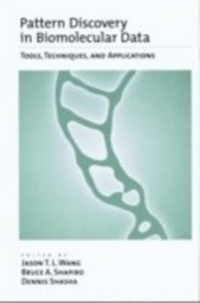
Pattern Discovery in Biomolecular Data
Tools, Techniques, and Applications
1st Edition
Published on 28. October 1999
272 pages
978-0-19-802806-2 (ISBN)
Description

Finding patterns in biomolecular data, particularly in DNA and RNA, is at the center of modern biological research. These data are complex and growing rapidly, so the search for patterns requires increasingly sophisticated computer methods. Pattern Discovery in Biomolecular Data provides a clear, up-to-date summary of the principal techniques. Each chapter is self-contained, and the techniques are drawn from many fields, including graph theory, information theory, statistics, genetic algorithms, computer visualization, and vision. Since pattern searches often benefit from multiple approaches, the book presents methods in their purest form so that readers can best choose the method or combination that fits their needs. The chapters focus on finding patterns in DNA, RNA, and protein sequences, finding patterns in 2D and 3D structures, and choosing system components. This volume will be invaluable for all workers in genomics and genetic analysis, and others whose research requires biocomputing.
More details
Other editions
Additional editions
Jason T. L. Wang | Bruce A. Shapiro | Dennis Shasha
Pattern Discovery in Biomolecular Data
Tools, Techniques, and Applications
Book
12/1999
Oxford University Press Inc
€148.56
Shipment within 15-20 days
Content
- Intro
- Contents
- Contributors
- Introduction
- Part I: Finding Patterns in Sequences
- 1 Discovering Patterns in DNA Sequences by the Algorithmic Significance Method
- 1.1 Encoding Schemes
- 1.2 Algorithms for Minimal Length Encoding
- 1.3 Algorithmic Significance
- 1.4 Applications
- 1.5 Future Work and Generalizations
- 2 Assembling Blocks
- 2.1 Algorithmic Techniques
- 2.2 Future Work and Generalizations
- 3 MEME, MAST, and Meta-MEME: New Tools for Motif Discovery in Protein Sequences
- 3.1 Software for Finding Sequence Motifs
- 3.2 Methods
- 3.3 Results
- 3.4 Discussion
- 4 Pattern Discovery and Classification in Biosequences
- 4.1 Pattern Discovery in Protein Sequences
- 4.2 Classification of DNA Sequences
- 4.3 Generalizations and Future Work
- Part II: Finding Patterns in 3D Structures
- 5 Motif Discovery in Protein Structure Databases
- 5.1 Protein Motifs
- 5.2 Computational Approaches to Knowledge Discovery
- 5.3 Assessing Protein Motifs and Discovery Methods
- 5.4 Issues in Protein Motif Discovery
- 5.5 Conclusion
- 6 Systematic Detection of Protein Structural Motifs
- 6.1 Structural Building Blocks
- 6.2 Symbol String Representation of 3D Structures
- 6.3 Detection of Structural Motifs by Structure Comparisons
- 6.4 Detection of Structural Motifs by Sequence Comparisons
- 6.5 Discussion and Future Directions
- 7 Representation and Matching of Small Flexible Molecules in Large Databases of 3D Molecular Information
- 7.1 The Representation Scheme
- 7.2 Storage/Retrieval and Threading
- 7.3 The Algorithm
- 7.4 Experimental Results
- 7.5 Discussion
- Part III: System Components for Discovery
- 8 A Framework for Biological Pattern Discovery on Networks of Workstations
- 8.1 Biological Pattern Discovery
- 8.2 Biological Pattern Discovery Framework
- 8.3 Parallel Computing on Networks of Workstations
- 8.4 Parallel E-dag Traversal in PLinda
- 9 Discovering Concepts in Structural Data
- 9.1 Algorithmic Techniques
- 9.2 Future Work and Generalizations
- 10 Overview: A System for Tracking and Managing the Results from Sequence Comparison Programs
- 10.1 Related Work
- 10.2 Molecular Biology Applications and Databases
- 10.3 Algorithmic Techniques
- 10.4 The Overview Information Model
- 10.5 Biological Experiments and Applications: User Scenarios
- 10.6 Future Work and Generalizations
- 11 RNA Structure Analysis: A Multifaceted Approach
- 11.1 A Brief Introduction to RNA
- 11.2 RNA Folding Problem
- 11.3 The Genetic Algorithm: An Overview
- 11.4 The Structurelab Workbench
- 11.5 Structurelab in Use
- 11.6 Future Directions and Challenges
- Glossary
- A
- B
- C
- D
- E
- G
- H
- I
- K
- L
- M
- N
- O
- P
- R
- S
- T
- U
- References
- Index
- A
- B
- C
- D
- E
- F
- G
- H
- I
- K
- L
- M
- N
- O
- P
- Q
- R
- S
- T
- U
- V
- W
- Y
- Z
