

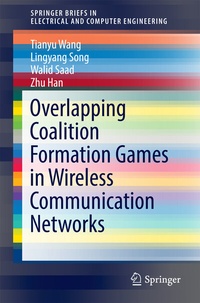
Overlapping Coalition Formation Games in Wireless Communication Networks
Description

This brief introduces overlapping coalition formation games (OCF games), a novel mathematical framework from cooperative game theory that can be used to model, design and analyze cooperative scenarios in future wireless communication networks.
The concepts of OCF games are explained, and several algorithmic aspects are studied. In addition, several major application scenarios are discussed. These applications are drawn from a variety of fields that include radio resource allocation in dense wireless networks, cooperative spectrum sensing for cognitive radio networks, and resource management for crowd sourcing. For each application, the use of OCF games is discussed in detail in order to show how this framework can be used to solve relevant wireless networking problems.
Overlapping Coalition Formation Games in Wireless Communication Networks provides researchers, students and practitioners with a concise overview of existing works in this emerging area,exploring the relevant fundamental theories, key techniques, and significant applications.
More details
Other editions
Additional editions
Persons
Content
- Intro
- Preface
- Acknowledgement
- Contents
- Abbreviations
- 1 Introduction
- 1.1 Coalition Formation Games
- 1.1.1 Game Models
- 1.1.2 Core of Coalition Formation Games
- 1.2 Overlapping Coalition Formation Games
- 1.2.1 Game Models
- 1.2.2 mathcalA-core of Overlapping Coalition Formation Games
- 1.3 Computing o-Stable Outcomes for OCF games
- 1.3.1 o-Stable Outcomes
- 1.3.2 K-coalition OCF Games
- 1.3.3 K-task OCF Games
- References
- Bibliography
- 2 Interference Management in Heterogenous Networks
- 2.1 Introduction
- 2.2 System Model
- 2.3 Interference Management as OCF Games
- 2.3.1 K-Coalition OCF Game Model
- 2.3.2 Coalition Formation Algorithm
- 2.3.3 Simulation Results
- 2.4 Summary
- References
- 3 Cooperative Spectrum Sensing in Cognitive Radio
- 3.1 Introduction
- 3.2 System Model
- 3.2.1 Local Sensing
- 3.2.2 Data Reporting
- 3.2.3 Data Fusion
- 3.3 DCS as an Optimization Problem
- 3.3.1 Qm+Qf Criterion
- 3.3.2 Qm/Qf Criterion
- 3.4 DCS Based on Overlapping Coalition Formation Games
- 3.4.1 OCF-Game Model
- 3.4.2 Algorithm Based on Overlapping Coalition Formation
- 3.4.3 Convergence and Overhead
- 3.5 DCS Based on Nonoverlapping Coalition Formation Games
- 3.5.1 Nonoverlapping CF-Game Model
- 3.5.2 Algorithm Based on Nonoverlapping Coalition Formation
- 3.5.3 Convergence and Overhead
- 3.6 Practical Issues
- 3.7 Simulation Results and Analysis
- 3.7.1 Comparison of DCS Algorithms
- 3.7.2 Power and Bandwidth Constraints
- 3.7.3 Convergence, Overhead, and Complexity
- 3.8 Summary
- References
- 4 Challenges and Future Works
- 4.1 Challenges of OCF Games
- 4.2 Other Applications
- 4.2.1 Multiradio Traffic Offloading
- 4.2.2 Cooperative Communications
- 4.2.3 Smartphone Sensing
- 4.2.4 Subchannel Allocation in NOMA
- 4.2.5 Pilot Reuse in Massive MIMO
- References
