

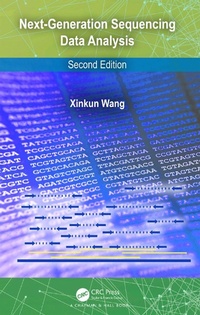
Next-Generation Sequencing Data Analysis
2nd Edition
Published on 6. July 2023
434 pages
978-1-000-89719-7 (ISBN)
Description

Next-generation DNA and RNA sequencing has revolutionized biology and medicine. With sequencing costs continuously dropping and our ability to generate large datasets rising, data analysis becomes more important than ever. Next-Generation Sequencing Data Analysis walks readers through next-generation sequencing (NGS) data analysis step by step for a wide range of NGS applications.
For each NGS application, this book covers topics from experimental design, sample processing, sequencing strategy formulation, to sequencing read quality control, data preprocessing, read mapping or assembly, and more advanced stages that are specific to each application. Major applications include:
RNA-seq: Both bulk and single cell (separate chapters)
Genotyping and variant discovery through whole genome/exome sequencing
Clinical sequencing and detection of actionable variants
De novo genome assembly
ChIP-seq to map protein-DNA interactions
Epigenomics through DNA methylation sequencing
Metagenome sequencing for microbiome analysis
Before detailing the analytic steps for each of these applications, the book presents introductory cellular and molecular biology as a refresher mostly for data scientists, the ins and outs of widely used NGS platforms, and an overview of computing needs for NGS data management and analysis. The book concludes with a chapter on the changing landscape of NGS technologies and data analytics.
The second edition of this book builds on the well-received first edition by providing updates to each chapter. Two brand new chapters have been added to meet rising data analysis demands on single-cell RNA-seq and clinical sequencing. The increasing use of long-read sequencing has also been reflected in all NGS applications. This book discusses concepts and principles that underlie each analytic step, along with software tools for implementation. It highlights key features of the tools while omitting tedious details to provide an easy-to-follow guide for practitioners in life sciences, bioinformatics, biostatistics, and data science. Tools introduced in this book are open source and freely available.
For each NGS application, this book covers topics from experimental design, sample processing, sequencing strategy formulation, to sequencing read quality control, data preprocessing, read mapping or assembly, and more advanced stages that are specific to each application. Major applications include:
RNA-seq: Both bulk and single cell (separate chapters)
Genotyping and variant discovery through whole genome/exome sequencing
Clinical sequencing and detection of actionable variants
De novo genome assembly
ChIP-seq to map protein-DNA interactions
Epigenomics through DNA methylation sequencing
Metagenome sequencing for microbiome analysis
Before detailing the analytic steps for each of these applications, the book presents introductory cellular and molecular biology as a refresher mostly for data scientists, the ins and outs of widely used NGS platforms, and an overview of computing needs for NGS data management and analysis. The book concludes with a chapter on the changing landscape of NGS technologies and data analytics.
The second edition of this book builds on the well-received first edition by providing updates to each chapter. Two brand new chapters have been added to meet rising data analysis demands on single-cell RNA-seq and clinical sequencing. The increasing use of long-read sequencing has also been reflected in all NGS applications. This book discusses concepts and principles that underlie each analytic step, along with software tools for implementation. It highlights key features of the tools while omitting tedious details to provide an easy-to-follow guide for practitioners in life sciences, bioinformatics, biostatistics, and data science. Tools introduced in this book are open source and freely available.
More details
Edition
2nd edition
Language
English
Place of publication
London
United Kingdom
Publishing group
Taylor & Francis Ltd
Target group
Professional and scholarly
Illustrations
60 Line drawings, color; 10 Halftones, color; 70 Illustrations, color
ISBN-13
978-1-000-89719-7 (9781000897197)
Copyright in bibliographic data and cover images is held by Nielsen Book Services Limited or by the publishers or by their respective licensors: all rights reserved.
Schweitzer Classification
Other editions
Additional editions
Xinkun Wang
Next-Generation Sequencing Data Analysis
Book
07/2023
2nd Edition
CRC Press
€154.50
Shipment within 15-20 days
Person
Dr. Xinkun Wang is a research professor and the director of the Next-Generation Sequencing Facility at Northwestern University in Chicago. Dr. Wang's first foray into the genomics field was during his doctoral training, performing microarray-based gene expression analysis. From 2005 to 2015, he was the founding director of the University of Kansas Genomics Facility, prior to moving to Northwestern to head the Northwestern University Sequencing Facility (NUSeq) in late 2015. Dr. Wang is a renowned expert on genomics technologies and data mining, and their applications to the biomedical field. Besides his monographic publications, he has published extensively in neuroscience, with a focus on brain aging and neurodegenerative diseases (mostly Alzheimer's disease).
Dr. Wang has served as principal investigator on dozens of grants. Dr. Wang's other professional activities include serving on journal editorial boards, and as reviewers for journals, publishers, and funding agencies. Dr. Wang is a member of American Society of Human Genetics, Association of Biomolecular Resource Facilities, the Honor Society of Phi Kappa Phi, and Society for Neuroscience. Dr. Wang was born in Shandong province, China, and is a first-generation college graduate. His off-work hobbies include cycling and Alpine skiing.
Dr. Wang has served as principal investigator on dozens of grants. Dr. Wang's other professional activities include serving on journal editorial boards, and as reviewers for journals, publishers, and funding agencies. Dr. Wang is a member of American Society of Human Genetics, Association of Biomolecular Resource Facilities, the Honor Society of Phi Kappa Phi, and Society for Neuroscience. Dr. Wang was born in Shandong province, China, and is a first-generation college graduate. His off-work hobbies include cycling and Alpine skiing.
Content
1. The Cellular System and The Code of Life. 2. DNA Sequence: the Genome Base. 3. RNA: the Transcribed Sequence. 4. Next-Generation Sequencing (NGS) Technologies: Ins and Outs. 5. Early-Stage Next-Generation Sequencing (NGS) Data Analysis: Common Steps. 6. Computing Needs for Next-Generation Sequencing (NGS) Data Management and Analysis. 7. Transcriptomics by Bulk RNA-Seq. 8. Transcriptomics by Single Cell RNA-Seq. 9. Small RNA Sequencing. 10. Genotyping and Variation Discovery by Whole Genome/Exome Sequencing. 11. Clinical Sequencing and Detection of Actionable Variants. 12. De Novo Genome Assembly with Long and/or Short Reads. 13. Mapping Protein-DNA Interactions with ChIP-Seq. 14. Epigenomics by DNA Methylation Sequencing. 15. Whole Metagenome Sequencing for Microbial Community Analysis. 16. What's Next for Next-Generation Sequencing (NGS)?.
