

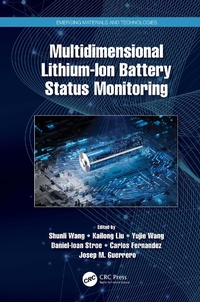
Multidimensional Lithium-Ion Battery Status Monitoring
1st Edition
Published on 28. December 2022
354 pages
978-1-000-79960-6 (ISBN)
Description

Multidimensional Lithium-Ion Battery Status Monitoring focuses on equivalent circuit modeling, parameter identification, and state estimation in lithium-ion battery power applications. It explores the requirements of high-power lithium-ion batteries for new energy vehicles and systematically describes the key technologies in core state estimation based on battery equivalent modeling and parameter identification methods of lithium-ion batteries, providing a technical reference for the design and application of power lithium-ion battery management systems.
Reviews Li-ion battery characteristics and applications.
Covers battery equivalent modeling, including electrical circuit modeling and parameter identification theory
Discusses battery state estimation methods, including state of charge estimation, state of energy prediction, state of power evaluation, state of health estimation, and cycle life estimation
Introduces equivalent modeling and state estimation algorithms that can be applied to new energy measurement and control in large-scale energy storage
Includes a large number of examples and case studies
This book has been developed as a reference for researchers and advanced students in energy and electrical engineering.
Reviews Li-ion battery characteristics and applications.
Covers battery equivalent modeling, including electrical circuit modeling and parameter identification theory
Discusses battery state estimation methods, including state of charge estimation, state of energy prediction, state of power evaluation, state of health estimation, and cycle life estimation
Introduces equivalent modeling and state estimation algorithms that can be applied to new energy measurement and control in large-scale energy storage
Includes a large number of examples and case studies
This book has been developed as a reference for researchers and advanced students in energy and electrical engineering.
More details
Series
Edition
1. Auflage
Language
English
Place of publication
London
United Kingdom
Publishing group
Taylor & Francis Ltd
Target group
Professional and scholarly
Product notice
Reflowable
Illustrations
26 Tables, black and white; 124 Line drawings, black and white; 85 Halftones, black and white; 209 Illustrations, black and white
ISBN-13
978-1-000-79960-6 (9781000799606)
Copyright in bibliographic data and cover images is held by Nielsen Book Services Limited or by the publishers or by their respective licensors: all rights reserved.
Schweitzer Classification
Other editions
Additional editions
Shunli Wang | Kailong Liu | Yujie Wang
Multidimensional Lithium-Ion Battery Status Monitoring
Book
10/2024
1st Edition
CRC Press
€74.20
Shipment within 10-20 days

Shunli Wang | Kailong Liu | Yujie Wang
Multidimensional Lithium-Ion Battery Status Monitoring
Book
12/2022
1st Edition
CRC Press
€193.13
Shipment within 10-20 days
Persons
Shunli Wang is Professor with the School of Electrical Engineering, Southwest University of Science and Technology, China. He is an authoritative expert in the field of new energy research, the head of DTlab and the new energy measurement & control research team, modeling and state estimation strategy research for lithium-ion batteries. He received the B.Sc. degree and Ph.D. degree in electrical engineering from the Southwest University of Science and Technology. He has undertaken more than 40 projects and 30 patents, published more than 100 research papers as well as won 20 awards such as Young Scholar, Science & Technology Progress Awards, and University & Enterprise Innovative Talent Team et al, developed multiple generation battery systems to improve the reliability and expand the application field with significant social and economic benefits.
Kailong Liu received the Ph.D. degree in electrical engineering from Queen's University, Belfast, U.K., in 2018. He is a Senior Research Fellow with the Warwick Manufacturing Group, The University of Warwick, Coventry, U.K. His research interests include modeling, optimization, and control with applications to electrical/hybrid vehicles, energy storage, and battery manufacture and management.
Yujie Wang is a postdoctoral research fellow in the Department of Automation at the University of Science and Technology of China.
Daniel-Ioan Stroe received the Dipl.-Ing. degree in automatics from the Transilvania University of Brasov, Romania, in 2008, and the M.Sc. degree in wind power systems and the Ph.D. degree in lifetime modelling of lithium-ion batteries from Aalborg University (AAU), Aalborg, Denmark, in 2010 and 2014, respectively. He has been with AAU since 2010. He is currently an Associate Professor with AAU Energy, where he leads the Batteries Research Group, and the Battery Systems Testing Laboratory. He was a Visiting Researcher with RWTH Aachen, Germany, in 2013. He has coauthored over 150 journals and conference papers in various battery-related topics. His current research interests include the area of energy storage systems for grid and e-mobility, lithium-based batteries testing, modelling, and diagnostics and their lifetime estimation.
Carlos Fernandez is a Lecturer in Bioanalytical Chemistry at Robert Gordon University, U.K. He received his PhD in Electrocatalytic Reactions from The University of Hull. He than worked as Consultant Technologist in Hull and in a postdoctoral position in Manchester developing an electrochemical sensor using screen printed electrodes to detect methamphetamine, ampthetamine and ecstasy in oral fluid for the purpose of roadside testing.
Josep M. Guerrero has been a Full Professor with the Department of Energy Technology, Aalborg University, Denmark since 2011, where he is responsible for the Microgrid Research Program. He is a guest Professor at the Chinese Academy of Science and the Nanjing University of Aeronautics and Astronautics; Chair Professor at Shandong University; Distinguished Guest Professor at Hunan University; and Visiting Professor Fellow at Aston University, UK.
Kailong Liu received the Ph.D. degree in electrical engineering from Queen's University, Belfast, U.K., in 2018. He is a Senior Research Fellow with the Warwick Manufacturing Group, The University of Warwick, Coventry, U.K. His research interests include modeling, optimization, and control with applications to electrical/hybrid vehicles, energy storage, and battery manufacture and management.
Yujie Wang is a postdoctoral research fellow in the Department of Automation at the University of Science and Technology of China.
Daniel-Ioan Stroe received the Dipl.-Ing. degree in automatics from the Transilvania University of Brasov, Romania, in 2008, and the M.Sc. degree in wind power systems and the Ph.D. degree in lifetime modelling of lithium-ion batteries from Aalborg University (AAU), Aalborg, Denmark, in 2010 and 2014, respectively. He has been with AAU since 2010. He is currently an Associate Professor with AAU Energy, where he leads the Batteries Research Group, and the Battery Systems Testing Laboratory. He was a Visiting Researcher with RWTH Aachen, Germany, in 2013. He has coauthored over 150 journals and conference papers in various battery-related topics. His current research interests include the area of energy storage systems for grid and e-mobility, lithium-based batteries testing, modelling, and diagnostics and their lifetime estimation.
Carlos Fernandez is a Lecturer in Bioanalytical Chemistry at Robert Gordon University, U.K. He received his PhD in Electrocatalytic Reactions from The University of Hull. He than worked as Consultant Technologist in Hull and in a postdoctoral position in Manchester developing an electrochemical sensor using screen printed electrodes to detect methamphetamine, ampthetamine and ecstasy in oral fluid for the purpose of roadside testing.
Josep M. Guerrero has been a Full Professor with the Department of Energy Technology, Aalborg University, Denmark since 2011, where he is responsible for the Microgrid Research Program. He is a guest Professor at the Chinese Academy of Science and the Nanjing University of Aeronautics and Astronautics; Chair Professor at Shandong University; Distinguished Guest Professor at Hunan University; and Visiting Professor Fellow at Aston University, UK.
Content
1. Battery Characteristics and Parameters. 2. Equivalent Modeling and Parameter Identification. 3. Battery State of Charge Estimation. 4. Battery State of Health Estimation. 5. Battery State of Power Estimation. 6. Battery State of Energy and Cycle Life Estimation.
