

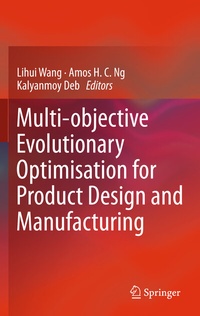
Multi-objective Evolutionary Optimisation for Product Design and Manufacturing
Description

With the increasing complexity and dynamism in today's product design and manufacturing, more optimal, robust and practical approaches and systems are needed to support product design and manufacturing activities. Multi-objective Evolutionary Optimisation for Product Design and Manufacturing presents a focused collection of quality chapters on state-of-the-art research efforts in multi-objective evolutionary optimisation, as well as their practical applications to integrated product design and manufacturing.
Multi-objective Evolutionary Optimisation for Product Design and Manufacturing consists of two major sections. The first presents a broad-based review of the key areas of research in multi-objective evolutionary optimisation. The second gives in-depth treatments of selected methodologies and systems in intelligent design and integrated manufacturing.
Recent developments and innovations in multi-objective evolutionary optimisation make Multi-objective Evolutionary Optimisation for Product Design and Manufacturing a useful text for a broad readership, from academic researchers to practicing engineers.
More details
Other editions
Additional editions
Persons
Lihui Wang is a professor of virtual manufacturing at the University of Skövde's Virtual Systems Research Centre in Sweden. He was previously a senior research scientist at the Integrated Manufacturing Technologies Institute, National Research Council of Canada. He is also an adjunct professor in the Department of Mechanical and Materials Engineering at the University of Western Ontario, and a registered professional engineer in Canada. His research interests and responsibilities are in web-based and sensor-driven real-time monitoring and control, distributed machining process planning, adaptive assembly planning, collaborative design, supply chain management, as well as intelligent and adaptive manufacturing systems.
Amos Ng has a PhD in Computer Sciences and Engineering from De Montfort University, United Kingdom. He received his MPhil and BEng in Manufacturing Engineering from City University of Hong Kong. He has been Associate Professor at the University of Skövde, where he was previously Senior Lecturer and Research Assistant, since 2009. He is a Chartered Engineer in the United Kingdom and a member of the Institution of Engineering and Technology. His main research interest is in applying simulation-based optimisation to manufacturing systems design and analysis.
Kalyanmoy Deb has a PhD in Engineering Mechanics from the University of Alabama, USA, which also awarded his MS. He received his BTech in Mechanical Engineering from the Indian Institute of Technology Kharagpur. Since 1999 he has been Professor at the Indian Institute of Technology Kanpur, India, where he was previously Associate Professor and Assistant Professor. His research interests are computational optimization, evolutionary computation, multi-criterion optimization and decision analysis, applied optimal design, design and control of intelligent systems, modeling and simulation.
