

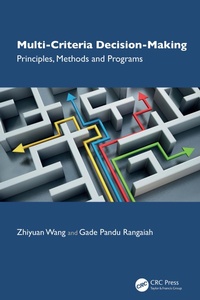
Multi-Criteria Decision-Making
Principles, Methods and Programs
1st Edition
Published on 16. March 2026
296 pages
978-1-040-52104-5 (ISBN)
Description

This textbook for advanced undergraduate and graduate students provides a clear and practical guide to the principles and methods for structuring and solving complex problems that include multiple, often conflicting criteria.
The book introduces the foundations of multi-criteria decision-making (MCDM) and its relationship with complementary approaches such as multi-objective optimization and goal programming. It then presents three major MCDM methods: reference-type methods such as TOPSIS, aggregation-type methods such as AHP, and outranking-type methods such as ELECTRE. Each method is explained with numerical examples, and strengths and limitations discussed. Preprocessing techniques are also covered. The book highlights user-friendly software tools, including Microsoft Excel-based programs and open-source Python libraries. End-of-chapter exercises are also provided to ensure that readers can consolidate their knowledge and apply this to real-world applications.
This textbook is vital for advanced undergraduate and graduate students taking decision science and optimization courses in disciplines such as engineering, business, finance, and management. Its focus on recent methods and developments will ensure that students are well prepared for employment in their field or for further research alike.
The book introduces the foundations of multi-criteria decision-making (MCDM) and its relationship with complementary approaches such as multi-objective optimization and goal programming. It then presents three major MCDM methods: reference-type methods such as TOPSIS, aggregation-type methods such as AHP, and outranking-type methods such as ELECTRE. Each method is explained with numerical examples, and strengths and limitations discussed. Preprocessing techniques are also covered. The book highlights user-friendly software tools, including Microsoft Excel-based programs and open-source Python libraries. End-of-chapter exercises are also provided to ensure that readers can consolidate their knowledge and apply this to real-world applications.
This textbook is vital for advanced undergraduate and graduate students taking decision science and optimization courses in disciplines such as engineering, business, finance, and management. Its focus on recent methods and developments will ensure that students are well prepared for employment in their field or for further research alike.
Reviews / Votes
A clear and practice-oriented reference on multi-criteria decision-making, with a well-articulated connection to complementary approaches such as multi-objective optimization. Highly relevant for process engineering, energy systems, and sustainability applications, the book is well suited for undergraduate and graduate (Master's and PhD) education, as well as engineering practice. The combination of sound theoretical foundations, illustrative numerical examples, and accessible software tools makes it a particularly effective resource for both learning and practical implementation.Dr. Catherine Azzaro-Pantel, Professor in Chemical Engineering, Universite de Toulouse, Institut National Polytechnique de Toulouse, France
Through the integration of illustrative programs, worked examples, and sound theoretical principles, this book presents a coherent approach to multi-criteria decision-making. Its emphasis on practical usability makes it a valuable reference for advanced students and practitioners working in complex engineering and decision-analysis problems.
Dr. Christopher Teoh, Assistant Professor, DigiPen Institute of Technology Singapore
This book offers a really clear and well-organized look at multi-criteria decision-making (MCDM). What I liked most is how it bridges the gap between complex theories and how they actually work in the real world.
Instead of just focusing on abstract concepts, it uses helpful numerical examples and computational methods that make the material much easier to grasp. Whether you are a student or a professional, this is a practical and accessible guide that shows you exactly how to apply these methods to solve real problems.
Dr. Sayed Ameenuddin Irfan, Director (Data and AI), UpGrad
This forthcoming book by Professors Rangaiah and Wang offers a clear, comprehensive, and practice-oriented introduction to multicriteria decision-making (MCDM), a methodology that has become essential across engineering, science, and technology. Beginning with real-world examples, from catalyst selection to renewable energy evaluation, the authors present MCDM as a rigorous yet accessible framework for navigating complex decisions involving multiple, often conflicting criteria. Their use of the CAUSE (Criteria, Alternatives, Uncertainties, Stakeholders, Environmental factors) framework and a step-by-step MCDM workflow gives readers a strong conceptual foundation while emphasizing the importance of transparency, systematic analysis, and informed judgment.
The book stands out for its balance of theory, algorithms, and practical tools. Dedicated chapters cover multi-objective optimization, normalization techniques, objective and subjective weighting methods, and a broad suite of ranking approaches, all supported by examples and ready-to-use software in Excel and Python. Its modular structure makes it ideal both as a textbook and as a reference for practitioners. With its strong engineering orientation, particularly relevant to chemical engineering, process design, sustainability assessment, and materials selection, this volume promises to become a key resource for students, educators, researchers, and professionals seeking robust, modern decision-making methods.
Jules Thibault, Department of Chemical and Biological Engineering, University of Ottawa, Canada
More details
Edition
1. Auflage
Language
English
Place of publication
London
United Kingdom
Publishing group
Taylor & Francis Ltd
Target group
College/higher education
Illustrations
93 Tables, black and white; 27 Line drawings, black and white; 27 Illustrations, black and white
File size
28,14 MB
ISBN-13
978-1-040-52104-5 (9781040521045)
Copyright in bibliographic data and cover images is held by Nielsen Book Services Limited or by the publishers or by their respective licensors: all rights reserved.
Schweitzer Classification
Other editions
Additional editions
Book
03/2026
1st Edition
CRC Press
€137.30
Shipment within 10-20 days
Persons
Zhiyuan Wang is a Lecturer at Singapore University of Social Sciences, where he teaches within the School of Business. Prior to this, he served as an Assistant Professor at DigiPen Institute of Technology Singapore. He holds a B.Eng. and a Ph.D. from National University of Singapore, and an M.Sc. from Nanyang Technological University.
Gade Pandu Rangaiah has been with National University of Singapore since 1982, where he has received numerous teaching awards and is now an Emeritus Professor. Prior to joining NUS, he received B.Tech. from Andhra University, India; M.Tech. from I.I.T. Kanpur, India; and Ph.D. from Monash University, Australia, and worked in Engineers India Limited for two years.
Gade Pandu Rangaiah has been with National University of Singapore since 1982, where he has received numerous teaching awards and is now an Emeritus Professor. Prior to joining NUS, he received B.Tech. from Andhra University, India; M.Tech. from I.I.T. Kanpur, India; and Ph.D. from Monash University, Australia, and worked in Engineers India Limited for two years.
Content
1. Introduction 2. Multi-Objective Optimization 3. Goal Programming 4. Normalization Methods 5. Objective Weighting Methods 6. Subjective Weighting Methods 7. Multi-Criteria Decision-Making - Reference-Type Methods 8. Multi-Criteria Decision-Making - Aggregation-Type Methods 9. Multi-Criteria Decision-Making - Outranking-Type Methods 10. Programs and Software for Multi-Criteria Decision-Making. Appendix: Alternatives-Criteria Matrix (ACM) for Selected Applications
