

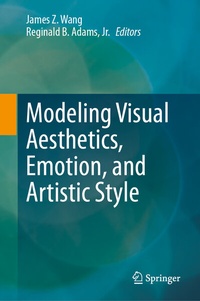
Modeling Visual Aesthetics, Emotion, and Artistic Style
Description

Modeling Visual Aesthetics, Emotion, and Artistic Style offers a comprehensive exploration of the increasingly significant topic of the complex interplay between human perception and digital technology. It embodies the cumulative knowledge and efforts of a wide array of active researchers and practitioners from diverse fields including computer vision, affective computing, robotics, psychology, data mining, machine learning, art history, and movement analysis. This volume seeks to address the profound and challenging research questions related to the computational modeling and analysis of visual aesthetics, emotions, and artistic style, vital components of the human experience that are increasingly relevant in our digitally connected world.
The book's vast scope encompasses a broad range of topics. The initial chapters lay a strong foundation with background knowledge on emotion models and machine learning, which then transitions into exploring social visual perception in humans and its technological applications. Readers will uncover the psychological and neurological foundations of social and emotional perception from faces and bodies. Subsequent sections broaden this understanding to include technology's role in detecting discrete and subtle emotional expressions, examining facial neutrality, and including research contexts that involve children as well as adults. Furthermore, the book illuminates the dynamic intersection of art and technology, the language of photography, the relationship between breath-driven robotic performances and human dance, and the application of machine learning in analyzing artistic styles.
This book sets itself apart with its unique multidisciplinary approach, encouraging collaboration across related domains. Packed with comprehensive tutorials, theoretical reviews, novel methodologies, empirical investigations, and comparative analyses, the book offers a rich combination of knowledge and methodologies. The book's focus on cutting-edge research not only presents the latest developments in the field but also illuminates potential paths that can lead to significant advancements in computer and robotic applications.
More details
Other editions
Additional editions
Persons
Reginald B. Adams, Jr. is a Professor of Psychology at The Pennsylvania State University. He received his Ph.D. in social psychology from Dartmouth College in 2002. Reg is interested in how we extract social and emotional meaning from nonverbal cues, particularly via the face. His work addresses how multiple social messages (e.g., emotion, gender, race, age, etc.) combine across multiple modalities and interact to form the unified representations that guide our impressions of and responses to others. Although his questions are social psychological in origin, his research draws upon vision cognition and affective neuroscience to address social perception at the functional and neuroanatomical levels. With his colleagues, Reg helped establish and champion the subfield of Social Vision by publishing an edited volume titled The Science of Social Vision (Adams, Ambady, Nakayama, & Shimojo, 2010, Oxford University Press).
