

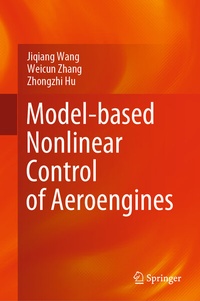
Model-based Nonlinear Control of Aeroengines
Description

This book aims to develop systematic design methodologies to model-based nonlinear control of aeroengines, focusing on (1) modelling of aeroengine systems-both component-level and identification-based models will be extensively studied and compared; and (2) advanced nonlinear control designs-set-point control, transient control and limit-protection control approaches will all be investigated. The model-based design has been one of the pivotal technologies to advanced control and health management of propulsion systems. It can fulfil advanced designs such as fault-tolerant control, engine modes control and direct thrust control. As a consequence, model-based design has become an important research area in the field of aeroengines due to its theoretical interests and engineering significance. One of the central issues in model-based controls is the tackling of nonlinearities. There are publications concerning with either nonlinear modelling or nonlinear controls; yet, they are scattered throughout the literature. It is time to provide a comprehensive summary of model-based nonlinear controls. Consequently, a series of important results are obtained and a systematic design methodology is developed which provides consistently enhanced performance over a large flight/operational envelope, and it is thus expected to provide useful guidance to practical engineering in aeroengine industry and research.
More details
Other editions
Additional editions
Persons
Ji qiang Wang is Associate Professor of Systems Control at Nanjing University of Aeronautics and Astronautics. He obtained his Ph.D. from Sheffield University, UK, in 2009. His research interests are in the general area of complex systems modelling, control and health management, with particular application to active control and energy harvesting, smart structures and turbine power systems. Specifically, he developed systematically a geometric design methodology for active control and energy harvesting towards performance limit; he initiated and proposed model-based nonlinear control of gas turbine power systems. He has been involved around 30 research projects from various sources as PIs & Co-PIs. He has published over 100 papers in international journals and conferences, with 8 filed patents and further 16 patents in review.
He is Sectary to Society of Artificial Intelligence Simulation Technology, Chinese Simulation Federation; Committee Member of Society of Intelligent Aerospace Systems, Chinese Association for Artificial Intelligence; Committee Member of Centre for Innovation in Aerospace Technology, NUAA Society for Science and Technology.
Weicun Zhang is Associate Professor at the School of Automation and Electrical Engineering, University of Science and Technology Beijing. He obtained his Ph.D. degree in Control Theory and Applications from Tsinghua University in 1993. His research interest covers adaptive control, multiple model adaptive control, intelligent control, their applications, etc.
Zhongzhi Hu is Professor at the Institute of Aeroengine Research, Tsinghua University. He obtained his Ph.D. degree in Control Theory from British Columbia University, Canada, in 1996. His research interest covers airworthiness certification, intelligent aeroengine control and aeroengine health management systems.
