

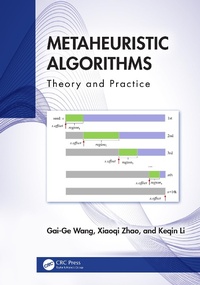
Metaheuristic Algorithms
Theory and Practice
1st Edition
Published on 3. April 2024
470 pages
978-1-040-00034-2 (ISBN)
Description

This book introduces the theory and applications of metaheuristic algorithms. It also provides methods for solving practical problems in such fields as software engineering, image recognition, video networks, and in the oceans.
In the theoretical section, the book introduces the information feedback model, learning-based intelligent optimization, dynamic multi-objective optimization, and multi-model optimization. In the applications section, the book presents applications of optimization algorithms to neural architecture search, fuzz testing, oceans, and image processing. The neural architecture search chapter introduces the latest NAS method. The fuzz testing chapter uses multi-objective optimization and ant colony optimization to solve the seed selection and energy allocation problems in fuzz testing. In the ocean chapter, deep learning methods such as CNN, transformer, and attention-based methods are used to describe ENSO prediction and image processing for marine fish identification, and to provide an overview of traditional classification methods and deep learning methods.
Rich in examples, this book will be a great resource for students, scholars, and those interested in metaheuristic algorithms, as well as professional practitioners and researchers working on related topics.
In the theoretical section, the book introduces the information feedback model, learning-based intelligent optimization, dynamic multi-objective optimization, and multi-model optimization. In the applications section, the book presents applications of optimization algorithms to neural architecture search, fuzz testing, oceans, and image processing. The neural architecture search chapter introduces the latest NAS method. The fuzz testing chapter uses multi-objective optimization and ant colony optimization to solve the seed selection and energy allocation problems in fuzz testing. In the ocean chapter, deep learning methods such as CNN, transformer, and attention-based methods are used to describe ENSO prediction and image processing for marine fish identification, and to provide an overview of traditional classification methods and deep learning methods.
Rich in examples, this book will be a great resource for students, scholars, and those interested in metaheuristic algorithms, as well as professional practitioners and researchers working on related topics.
More details
Edition
1. Auflage
Language
English
Place of publication
London
United Kingdom
Publishing group
Taylor & Francis Ltd
Target group
College/higher education
Professional and scholarly
Illustrations
141 Tables, black and white; 113 Line drawings, black and white; 11 Halftones, black and white; 124 Illustrations, black and white
File size
21,97 MB
ISBN-13
978-1-040-00034-2 (9781040000342)
Copyright in bibliographic data and cover images is held by Nielsen Book Services Limited or by the publishers or by their respective licensors: all rights reserved.
Schweitzer Classification
Other editions
Additional editions
Book
05/2026
1st Edition
CRC Press
€65.00
Shipment within 10-20 days
Book
04/2024
1st Edition
CRC Press
€185.00
Shipment within 10-20 days
Persons
Gai-Ge Wang is currently a Professor with the Ocean University of China, Qingdao, China. His entire published works have been cited more 15,000 times (Google Scholar). The latest Google H-index and i10-index are 62 and 131, respectively. Of his 81 Highly Cited Papers, 15 were selected by Web of Science and 66 selected by Scopus. His research interests include swarm intelligence, evolutionary computation, and big data optimization.
Xiaoqi Zhao is currently working at Qingdao University of Technology, China. She graduated from Ocean University of China with a PhD degree and her main research interests are information security, fuzz testing and intelligent optimization.
Keqin Li is a SUNY Distinguished Professor (USA) and a National Distinguished Professor (China). He is a Fellow of the Institute of Electrical and Electronics Engineers (IEEE), a Fellow of the American Association for the Advancement of Science (AAAS), and a Fellow of the Asia-Pacific Artificial Intelligence Association (AAIA). He is a Member of Academia Europaea (Academician of the Academy of Europe).
Xiaoqi Zhao is currently working at Qingdao University of Technology, China. She graduated from Ocean University of China with a PhD degree and her main research interests are information security, fuzz testing and intelligent optimization.
Keqin Li is a SUNY Distinguished Professor (USA) and a National Distinguished Professor (China). He is a Fellow of the Institute of Electrical and Electronics Engineers (IEEE), a Fellow of the American Association for the Advancement of Science (AAAS), and a Fellow of the Asia-Pacific Artificial Intelligence Association (AAIA). He is a Member of Academia Europaea (Academician of the Academy of Europe).
Content
1. Introduction 2. Information Feedback Models (IFM) and Its Applications 3. Learning-Based Intelligent Optimization Algorithms 4. Dynamic Multi-objective Optimization 5. Multimodal Multi-objective Optimization 6. Neural Architecture Search 7. Fuzzing 8. Application of Intelligent Algorithms in the Ocean 9. Image processing
