

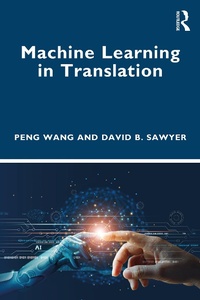
Machine Learning in Translation
1st Edition
Published on 12. April 2023
218 pages
978-1-000-83865-7 (ISBN)
Description

Machine Learning in Translation introduces machine learning (ML) theories and technologies that are most relevant to translation processes, approaching the topic from a human perspective and emphasizing that ML and ML-driven technologies are tools for humans.
Providing an exploration of the common ground between human and machine learning and of the nature of translation that leverages this new dimension, this book helps linguists, translators, and localizers better find their added value in a ML-driven translation environment. Part One explores how humans and machines approach the problem of translation in their own particular ways, in terms of word embeddings, chunking of larger meaning units, and prediction in translation based upon the broader context. Part Two introduces key tasks, including machine translation, translation quality assessment and quality estimation, and other Natural Language Processing (NLP) tasks in translation. Part Three focuses on the role of data in both human and machine learning processes. It proposes that a translator's unique value lies in the capability to create, manage, and leverage language data in different ML tasks in the translation process. It outlines new knowledge and skills that need to be incorporated into traditional translation education in the machine learning era. The book concludes with a discussion of human-centered machine learning in translation, stressing the need to empower translators with ML knowledge, through communication with ML users, developers, and programmers, and with opportunities for continuous learning.
This accessible guide is designed for current and future users of ML technologies in localization workflows, including students on courses in translation and localization, language technology, and related areas. It supports the professional development of translation practitioners, so that they can fully utilize ML technologies and design their own human-centered ML-driven translation workflows and NLP tasks.
Providing an exploration of the common ground between human and machine learning and of the nature of translation that leverages this new dimension, this book helps linguists, translators, and localizers better find their added value in a ML-driven translation environment. Part One explores how humans and machines approach the problem of translation in their own particular ways, in terms of word embeddings, chunking of larger meaning units, and prediction in translation based upon the broader context. Part Two introduces key tasks, including machine translation, translation quality assessment and quality estimation, and other Natural Language Processing (NLP) tasks in translation. Part Three focuses on the role of data in both human and machine learning processes. It proposes that a translator's unique value lies in the capability to create, manage, and leverage language data in different ML tasks in the translation process. It outlines new knowledge and skills that need to be incorporated into traditional translation education in the machine learning era. The book concludes with a discussion of human-centered machine learning in translation, stressing the need to empower translators with ML knowledge, through communication with ML users, developers, and programmers, and with opportunities for continuous learning.
This accessible guide is designed for current and future users of ML technologies in localization workflows, including students on courses in translation and localization, language technology, and related areas. It supports the professional development of translation practitioners, so that they can fully utilize ML technologies and design their own human-centered ML-driven translation workflows and NLP tasks.
Reviews / Votes
"Machine Learning in Translation by Wang and Sawyer offers a new and important perspective on the topic by discussing machine learning concepts from a linguistic perspective. They offer an entryway to an in-depth understanding of machine learning concepts for linguists, closing a long-existing gap in literature suitable for machine learning education for this audience."Tabea De Wille, University of Limerick, Ireland
More details
Edition
1. Auflage
Language
English
Place of publication
London
United Kingdom
Publishing group
Taylor & Francis Ltd
Target group
College/higher education
Professional and scholarly
Illustrations
9 Tables, black and white; 24 Line drawings, black and white; 24 Illustrations, black and white
ISBN-13
978-1-000-83865-7 (9781000838657)
Copyright in bibliographic data and cover images is held by Nielsen Book Services Limited or by the publishers or by their respective licensors: all rights reserved.
Schweitzer Classification
Other editions
Additional editions
Peng Wang | David B. Sawyer
Machine Learning in Translation
Book
04/2023
1st Edition
Routledge
€196.10
Shipment within 10-20 days
Peng Wang | David B. Sawyer
Machine Learning in Translation
Book
04/2023
1st Edition
Routledge
€57.40
Shipment within 10-20 days
Persons
Peng Wang is a freelance conference interpreter with the Translation Bureau, Public Works and Government Services Canada, a part-time professor in the School of Translation and Interpretation, University of Ottawa and Course designer and instructor for Think NLP and Machine Translation Masterclass at the Localization Institute. She has published two books in Chinese, including Harry Potter and Its Chinese Translation.
David B. Sawyer is Director of Language Testing at the U.S. State Department's Foreign Service Institute and a Senior Lecturer at the University of Maryland, USA. He is the author of Foundations of Interpreter Education: Curriculum and Assessment and co-editor of The Evolving Curriculum in Interpreter and Translator Education: Stakeholder Perspectives and Voices (both John Benjamins).
David B. Sawyer is Director of Language Testing at the U.S. State Department's Foreign Service Institute and a Senior Lecturer at the University of Maryland, USA. He is the author of Foundations of Interpreter Education: Curriculum and Assessment and co-editor of The Evolving Curriculum in Interpreter and Translator Education: Stakeholder Perspectives and Voices (both John Benjamins).
Content
List of figures and tables
Introduction
PART I - HUMAN AND MACHINE APPROACHES TO TRANSLATION
1. Convergence of two approaches to translation
2. Levels of analysis
3. Predicative language models
PART II - MACHINE LEARNING TASKS IN TRANSLATION 4. Machine translation
5. Machine translation quality assessment and quality estimation
6. Intentionality and NLP tasks in translation
PART III - DATA IN HUMAN AND MACHINE LEARNING 7. Translation-computer interaction through language data
8. Balancing machine and human learning in translation
9. Impact of machine learning on translator education
Epilogue - Human-centered machine learning in translation
References
Index
Introduction
PART I - HUMAN AND MACHINE APPROACHES TO TRANSLATION
1. Convergence of two approaches to translation
2. Levels of analysis
3. Predicative language models
PART II - MACHINE LEARNING TASKS IN TRANSLATION 4. Machine translation
5. Machine translation quality assessment and quality estimation
6. Intentionality and NLP tasks in translation
PART III - DATA IN HUMAN AND MACHINE LEARNING 7. Translation-computer interaction through language data
8. Balancing machine and human learning in translation
9. Impact of machine learning on translator education
Epilogue - Human-centered machine learning in translation
References
Index
