

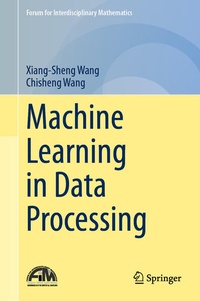
Machine Learning in Data Processing
Description

Machine learning has become a cornerstone of modern data-driven science and technology. For mathematics students and researchers, understanding the mathematical foundations behind machine learning is essential, even if they never work directly with real-world datasets.
This book provides a rigorous yet accessible introduction to the core mathematical ideas that underpin machine learning. Topics such as linear and nonlinear regression, regularization techniques, and the fundamentals of neural networks are explained in detail from a clear mathematical perspective.
Unlike many existing texts that emphasize coding and practical implementation, this book focuses on theoretical results and conceptual understanding. It is designed for readers who want to grasp the mathematics behind machine learning without writing code.
Who should read this book?
- Mathematics students and researchers interested in machine learning but with little programming experience.
- Scientists and engineers who have applied machine learning in practice and now seek a deeper understanding of its mathematical foundations.
More details
Other editions
Additional editions
Persons
Dr. Xiang-Sheng Wang earned his Ph.D. in Mathematics in 2009 from City University of Hong Kong, in a program jointly awarded by the University of Science and Technology of China. He is currently an Associate Professor in the Department of Mathematics at the University of Louisiana at Lafayette. His research focuses on asymptotic analysis, computational mathematics, and mathematical biology. Dr. Wang has extensive teaching experience across both undergraduate and graduate levels, offering courses such as Numerical Analysis, Machine Learning for Beginners, Numerical Methods, Differential Equations, and Advanced Mathematics for Engineers and Scientists.
Dr. Chisheng Wang received the B.S. degree from Beijing Normal University, Beijing, China, the M.S. degree from the Institute of Remote Sensing Applications, Chinese Academy of Sciences, Beijing, and the Ph.D. degree from the Department of Land Surveying and Geo-Informatics, The Hong Kong Polytechnic University, Kowloon, Hong Kong. He is currently a Professor in the Department of Urban Informatics, School of Architecture & Urban Planning, Shenzhen University, Shenzhen, Guangdong, China. His research interests include image processing and remote sensing applications.
Content
1 Matrix.- 2 Linear Regression.- 3 Regularization.- 4 Nonlinear Regression.- 5 Shallow Neural Network.- 6 Deep Neural Network.- 7 Batch Normalization.- 8 Support Vector Machine.- 9 Gradient Methods.- 10 Dimensionality Reduction.- A Related Topics.- B Hints to Selected Exercise Problems.- Index.
