

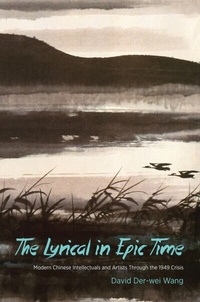
The Lyrical in Epic Time
Modern Chinese Intellectuals and Artists Through the 1949 Crisis
1st Edition
Published on 28. July 2015
496 pages
978-0-231-53857-2 (ISBN)
Description

In this book, David Der-wei Wang uses the lyrical to rethink the dynamics of Chinese modernity. Although the form may seem unusual for representing China's social and political crises in the mid-twentieth century, Wang contends that national cataclysm and mass movements intensified Chinese lyricism in extraordinary ways.
Wang calls attention to the form's vigor and variety at an unlikely juncture in Chinese history and the precarious consequences it brought about: betrayal, self-abjuration, suicide, and silence. Despite their divergent backgrounds and commitments, the writers, artists, and intellectuals discussed in this book all took lyricism as a way to explore selfhood in relation to solidarity, the role of the artist in history, and the potential for poetry to illuminate crisis. They experimented with poetry, fiction, film, intellectual treatise, political manifesto, painting, calligraphy, and music. Western critics, Wang shows, also used lyricism to critique their perilous, epic time. He reads Martin Heidegger, Theodor Adorno, Cleanth Brooks, and Paul de Man, among others, to complete his portrait.
The Chinese case only further intensifies the permeable nature of lyrical discourse, forcing us to reengage with the dominant role of revolution and enlightenment in shaping Chinese-and global-modernity. Wang's remarkable survey reestablishes Chinese lyricism's deep roots in its own native traditions, along with Western influences, and realizes the relevance of such a lyrical calling of the past century to our time.
Wang calls attention to the form's vigor and variety at an unlikely juncture in Chinese history and the precarious consequences it brought about: betrayal, self-abjuration, suicide, and silence. Despite their divergent backgrounds and commitments, the writers, artists, and intellectuals discussed in this book all took lyricism as a way to explore selfhood in relation to solidarity, the role of the artist in history, and the potential for poetry to illuminate crisis. They experimented with poetry, fiction, film, intellectual treatise, political manifesto, painting, calligraphy, and music. Western critics, Wang shows, also used lyricism to critique their perilous, epic time. He reads Martin Heidegger, Theodor Adorno, Cleanth Brooks, and Paul de Man, among others, to complete his portrait.
The Chinese case only further intensifies the permeable nature of lyrical discourse, forcing us to reengage with the dominant role of revolution and enlightenment in shaping Chinese-and global-modernity. Wang's remarkable survey reestablishes Chinese lyricism's deep roots in its own native traditions, along with Western influences, and realizes the relevance of such a lyrical calling of the past century to our time.
All prices
More details
Other editions
Additional editions
David Der-wei Wang
The Lyrical in Epic Time
Modern Chinese Intellectuals and Artists Through the 1949 Crisis
Book
01/2015
Columbia University Press
€76.87
Article not available at the moment
Person
David Der-wei Wang is Edward C. Henderson Professor of Chinese and Comparative Literature at Harvard University. His works include The Monster That Is History: History, Violence, and Fictional Writing in Twentieth-Century China; Fin-de-siècle Splendor: Repressed Modernity in Late Qing Fiction, 1849-1911; and Fictional Realism in Twentieth-Century China.
Content
Acknowledgments
Prologue
Introduction: Inventing the "Lyrical Tradition"
Part I
1. "A History with Feeling"
2. The Three Epiphanies of Shen Congwen
3. Of Dream and Snake: He Qifang, Feng Zhi, and Born-Again Lyricism
4. A Lyricism of Betrayal: The Enigma of Hu Lancheng
Part II
5. The Lyrical in Epic Time: The Music and Poetry of Jiang Wenye
6. The Riddle of the Sphinx: Lin Fengmian and the Polemics of Realism in Modern Chinese Painting
7. The Spring That Brought Eternal Regret: Fei Mu, Mei Lanfang, and the Poetics of Screening China
8. And History Took a Calligraphic Turn: Tai Jingnong and the Art of Writing
Coda: Toward a Critical Lyricism
Notes
Glossary of Chinese Characters
Bibliography
Index
Prologue
Introduction: Inventing the "Lyrical Tradition"
Part I
1. "A History with Feeling"
2. The Three Epiphanies of Shen Congwen
3. Of Dream and Snake: He Qifang, Feng Zhi, and Born-Again Lyricism
4. A Lyricism of Betrayal: The Enigma of Hu Lancheng
Part II
5. The Lyrical in Epic Time: The Music and Poetry of Jiang Wenye
6. The Riddle of the Sphinx: Lin Fengmian and the Polemics of Realism in Modern Chinese Painting
7. The Spring That Brought Eternal Regret: Fei Mu, Mei Lanfang, and the Poetics of Screening China
8. And History Took a Calligraphic Turn: Tai Jingnong and the Art of Writing
Coda: Toward a Critical Lyricism
Notes
Glossary of Chinese Characters
Bibliography
Index

