

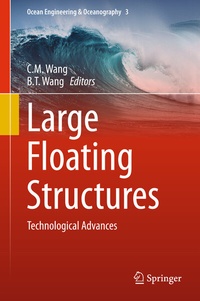
Large Floating Structures
Description

More details
Other editions
Additional editions
Persons
C.M. Wang is a Professor of Civil and Environmental Engineering at the National University of Singapore (NUS). He received his Ph.D. degree from Monash University in 1982. Currently, he is the Director for the Engineering Science Programme, at NUS. He is also an Adjunct Professor in the Department of Civil Engineering, Monash University, Australia. He is a Chartered Structural Engineer, a Fellow of the Academy of Engineering Singapore, a Fellow of the Institution of Engineers Singapore and a Fellow of the Institution of Structural Engineers. He is presently the Chairman of the IStructE Singapore Regional Group. Prof. Wang's research interests are in the areas of structural stability, vibration, optimization, nanostructures and very large floating structures. He is listed in Thomson Reuters' Highly Cited Researcher under the Engineering category.
B.T. Wang holds a Master of Public Policy and Management and a Bachelor of Architecture with Honours. He was a Public Transport Authority CEO Scholar and has been a Project Manager with the Infrastructure Delivery team within the State Government of Western Australia. Having worked across a number of sectors including Rail, Defence and Correctional Services, his projects have received awards such as the Master Builders Excellence in Construction Award and National Sustainability Award. He is currently undertaking the Master of Laws (Juris Doctor) programme at Monash University where he serves on the Law Review Editorial Committee. His research interests lie in Infrastructure and Major Projects as acts of positioning the city within a global arena and Ocean Space Colonisation and Technologies. He plans to move into Construction Law, specialising in Public Private Partnerships - a project delivery method well suited to large global urban projects including the proposals and projects captured within this book.
Content
Chapter 1: Great Ideas Float to the Top.- Chapter 2: Floating Performance Stage at the Marina Bay, Singapore.- Chapter 3: Yumemai Floating Swing Arch Bridge of Osaka, Japan.- Chapter 4: Floating Oil Storage Bases, Japan.- Chapter 5: Ujina Floating Ferry Pier and Kan-On Floating Breakwater, Japan.- Chapter 6: Floating Offshore Wind Turbine, Nagasaki, Japan.- Chapter 7: Large Marine Concrete Structures: The Norwegian Design Experience.- Chapter 8: Mega-Float.- Chapter 9: Large Spar Drilling and Production Platforms for Deep Water Oil and Gas.- Chapter 10: OTEC Platform.- Chapter 11: Mobile Offshore Base.- Chapter 12: Lilypad: Floating Ecopolis for Climatical Refugees.
