

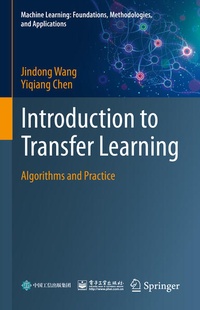
Introduction to Transfer Learning
Description

Transfer learning is one of the most important technologies in the era of artificial intelligence and deep learning. It seeks to leverage existing knowledge by transferring it to another, new domain. Over the years, a number of relevant topics have attracted the interest of the research and application community: transfer learning, pre-training and fine-tuning, domain adaptation, domain generalization, and meta-learning.
This book offers a comprehensive tutorial on an overview of transfer learning, introducing new researchers in this area to both classic and more recent algorithms. Most importantly, it takes a "student's" perspective to introduce all the concepts, theories, algorithms, and applications, allowing readers to quickly and easily enter this area. Accompanying the book, detailed code implementations are provided to better illustrate the core ideas of several important algorithms, presenting good examples for practice.
More details
Other editions
Additional editions
Persons
Jindong Wang is currently a senior researcher at Microsoft Research Asia. Before that, he obtained his PhD from the Institute of Computing Technology, Chinese Academy of Sciences, in 2019. His main research interests are in transfer learning, domain adaptation, domain generalization, and their applications in ubiquitous computing systems. He has co-published a Chinese-language textbook, Introduction to Transfer Learning , and numerous papers in leading journals and conferences, such as the IEEE TKDE , TNNLS , ACM TIST , NeurIPS, CVPR, IJCAI, UbiComp, and ACMMM. He was awarded the best application paper at the IJCAI'19 federated learning workshop and best paper at ICCSE'18. He has served as the publicity chair of IJCAI'19 and the transfer learning session chair of ICDM'19.
Yiqiang Chen is currently a professor at the Institute of Computing Technology, Chinese Academy of Sciences. His main research interests are in artificial intelligence and pervasive computing. He has published more than 180 papers in leading journals and conferences such as the IEEE TKDE , AAAI, and IJCAI. He has served as the general PC chair of the IEEE UIC 2019, PCC 2017, and CWCC 2019. He is a founding committee member of the IEEE wearable and intelligent interaction committee (IWCD) and an associate editor for IEEE TETCI and IJMLC . He has won several best paper awards, including best application paper at IJCAI-FL'19, IJIT 15th anniversary best paper award, and ICCSE'18 best paper award.
