

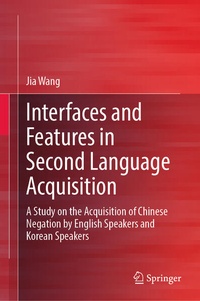
Interfaces and Features in Second Language Acquisition
Description

This book presents comprehensive and rigorous research on the acquisition of Chinese negation by L1-English and L1-Korean learners within the theoretical framework of the Interface Hypothesis and the Feature Reassembly Hypothesis. The results from grammaticality judgment data (N=182) and learner corpus data (overall scale: 15.19 million characters) reveal multiple factors contributing to the variability in L2 acquisition at the interfaces involved with Chinese negative structures, including L1 influence, the quantity (input frequency) and the quality of the target input (input consistency and regularity), as well as L2 proficiency. These factors also underlie the detectability and reassembly of the [±realis] features encoded with bu and mei, the two primary negation markers in Mandarin Chinese, in different licensing contexts. Task modality (written vs. aural) seems to play a role in L2 learners' access to explicit and implicit knowledge about Chinese negation, but the effect of task modality is constrained by other factors such as structural/feature complexity, L2 proficiency, and L1-L2 similarity. The approach of employing both elicited experimental data and authentic learner corpus data furnishes new evidence for the acquisition Chinese negation by L2 learners. The findings of this study are of significance to the examination of the Interface Hypothesis and the Feature Reassembly Hypothesis in generative-oriented SLA research.
More details
Other editions
Additional editions
Person
Jia Wang is currently working as a research associate at the Institute for International Studies of Nanjing University. She graduated from Beijing Normal University with a master's degree in TCSL in 2012 and then worked as a Chinese teaching assistant for a year at Bucknell University in the USA. In 2018, she graduated from City University of Hong Kong with a Ph.D. degree in applied linguistics. Her main research interests include Chinese grammar, teaching Chinese as a second/foreign language, and second language acquisition. She has published papers in prestigious journals in linguistics, such as Chinese Teaching in the World, Lingua, and Modern Foreign Languages. She is also a co-author of the book Language as a Prism: Introduction to Cross-disciplinary Linguistics published by Foreign Language Teaching and Research Press. Since the start of her career at Nanjing University in 2019, Dr. Wang has been teaching several undergraduate courses to L2 Chinese learners, including ChineseListening, Advanced Chinese Writing, and Business Chinese Writing. She was awarded the Outstanding Teaching Award in undergraduate education at Nanjing University in the year of 2020. Her recent research is on L2 Chinese writing, and she has been working on a research project Peer Assessment in online CFL writing, which is granted by Center for Language Education and Cooperation
