

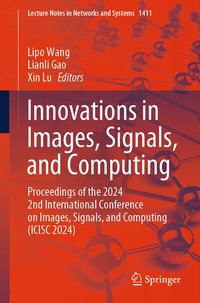
Innovations in Images, Signals, and Computing
Description

This book consists of papers on the recent progresses in the state-of-the-art in images, signals, and their intersections with computing. The book can be useful for researchers, including professors, graduate students, as well as R & D staff in the industry, with a general interest in images, signals, and their intersections with computing. The work printed in this book was presented at the 2024 2nd International Conference on Images, Signals, and Computing (ICISC 2024), held from 21-23 September 2024, Chengdu, China. All papers were rigorously peer-reviewed by experts in the areas.
More details
Other editions
Additional editions
Persons
Prof. Lipo Wang received the bachelor's degree from National University of Defense Technology (China) and PhD from Louisiana State University (USA). He is presently with the School of Electrical and Electronic Engineering, Nanyang Technological University, Singapore. His research interest is artificial intelligence for image and data processing. He has 400+ publications, 2 patents, and 15,000+ Google Scholar citations. He was keynote speaker for 50+ international conferences. He is Editor-in-Chief of International Journal of Computational Intelligence and Applications, Senior Editor of IEEE Transactions on Systems, Man, and Cybernetics: Systems, and Associate Editor of IEEE Transactions on Neural Networks and Learning Systems. He is/was Associate Editor/Editorial Board Member of 30+ international journals, including 2 other IEEE Transactions, and guest editor for 10+ journal special issues. He was a member of the Board of Governors of the International Neural Network Society, IEEE Computational Intelligence Society (CIS), and the IEEE Biometrics Council. He served as CIS Vice President for Technical Activities and Chair of Emergent Technologies Technical Committee, as well as Chair of Education Committee of the IEEE Engineering in Medicine and Biology Society (EMBS). He was President of the Asia-Pacific Neural Network Assembly (APNNA, renamed as APNNS - "Society") and received the APNNA Excellent Service Award. He was founding Chair of both the EMBS Singapore Chapter and CIS Singapore Chapter.
Prof. Lianli Gao received her bachelor's degree from University of Electronic Science and Technology of China and PhD from The University of Queensland (Australia). Her research interests include multimedia understanding, computer vision, artificial intelligence (AI), machine learning, and AI for Robotics. She has published over 100 publications at prestigious journals and proceedings in prominent conferences (including IEEE/ACM Transactions and CCF-A papers (Chinese Computing Federation A ranked (e.g., CVPR, ICCV, NeurIPS, ICML, and ICLR)). She served as Associate Editor of IEEE Transactions on Multimedia, Area chairs of ICCV, CVPR, ECCV, ACM MM and AAAI etc.
Dr Xin Lu received the B.Sc. and M.Sc. degrees from Harbin Institute of Technology (HIT), Harbin, China, in 2008 and 2010, respectively, and the Ph.D. degree in computer science from the University of Warwick, Coventry, U.K., in 2013. He is currently an Associate Professor with the School of Computer Science and Informatics, De Montfort University (DMU), Leicester, U.K. Before joining DMU, he was a Lecturer (Assistant Professor) with the School of Electronics and Information Engineering, HIT. His current research interests include video coding standards, data compression, deep learning, convolutional neural network, multimedia coding and transmission, and pattern recognition. He serves as a member of the IST/37 committee on "Coding of picture, audio, multimedia and hypermedia information" of the British Standard Institute (BSI), and is acting as UK Delegate for ISO/IEC JTC1/SC29 (a.k.a MPEG & JPEG). He has published more than 40 peer-reviewed research papers. His research activities have been supported by the Royal Society, the China National Natural Science Foundation, the Chinese Ministry of Education, Heilongjiang Provincial Natural Science Foundation of China, Harbin Science and Technology Bureau, and DMU 'Living in a Digital Society Spotlight' funding, etc.
Content
Images and Signals.- Artificial Intelligence and Computing.
