

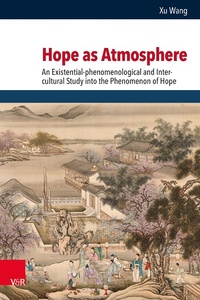
Hope as Atmosphere
An Existential-phenomenological and Inter-cultural Study into the Phenomenon of Hope
1st Edition
Published on 11. July 2022
149 pages
978-3-647-56858-4 (ISBN)
Description

In this thesis, the phenomenon of fundamental hope is understood as atmosphere. As a metaphor, hope as atmosphere finds a new expression of hope other than the light-metaphor that dominates the discourse of hope. Hope is not only the light that illuminates the dark moments of life, but also, more fundamentally, in the air, it lies in the sphere in-between and saturates each life experience and every living moment. As an existential reality, hope as atmosphere reveals our hopeful way of atmospheric co-existence. Communal love constitutes the ground of this hopeful co-existence, it keeps the hopeful co-existence constantly refreshed and open, guaranteeing more possibilities of hope. On the basis of communal love, hopeful co-existence shows its ontological meaning as a way towards life. The thesis of hope as atmosphere finds resonance and expression not only in Christian trinitarianly based understanding of hope, but also in the most central doctrine of co-humanity in Confucianism.
Xu Wang is a researcher in the Institute of World Religions of Chinese Academy of Social Sciences in China. In 2019 she was the prizewinner of Xiongwei Award for Young Scholars (Paper Award.
Xu Wang is a researcher in the Institute of World Religions of Chinese Academy of Social Sciences in China. In 2019 she was the prizewinner of Xiongwei Award for Young Scholars (Paper Award.
More details
Other editions
Additional editions
Xu Wang
Hope as Atmosphere
An Existential-phenomenological and Inter-cultural Study into the Phenomenon of Hope
Book
07/2022
1st Edition
Vandenhoeck & Ruprecht
from
€65.00
Shipment within 5-7 days
Person
Xu Wang is a researcher in the Institute of World Religions of Chinese Academy of Social Sciences in China. In 2019 she was the prizewinner of Xiongwei Award for Young Scholars (Paper Award.
Content
- Intro
- Title Page
- Copyright
- Acknowledgments
- Table of Contents
- List of Figures
- Introduction
- 1. Philosophical Understandings of Hope
- 1.1 Grammar of Hope
- 1.1.1 The Objective Side of Hope
- 1.1.2 The Subjective Side of Hope
- 1.1.3 Hope in Different Parts of Speech
- 1.2 Fundamental Hope
- 1.2.1 The Distinction between Ordinary Hope and Fundamental Hope
- 1.2.2 Fundamental Hope as a Fundamental Human Existential
- 1.3 Ontological Presuppositions of Hope
- 2. The Possibility of a Phenomenology of Hope
- 2.1 Hope in Heidegger's Existential Phenomenology
- 2.2 Critiques of Heidegger's Existentiality
- 2.3 Marcel's Phenomenology of Hope
- 2.3.1 The Ontological Foundation of Hope
- 2.3.2 The Two-fold Definition of Absolute Hope
- 2.3.3 Hope for the Immortality of Love
- 2.3.4 Critical Acceptance of Marcel's Phenomenology of Hope
- 3. Christian Theological Understandings of Hope
- 3.1 Philosophical Hope and Christian Hope
- 3.2 Christian Hope in the Context of Christian Eschatology
- 3.3 The Trinitarian Basis of Christian Hope
- 3.4 The Human Bearers of Christian Hope
- 3.5 Deification as the Unambiguous Spes Quae of Christian Hope
- 3.6 Hope in a Christian Context
- 4. Atmosphere, Qi(?) and the Existentiality of In-betweenness
- 4.1 The Concept of Atmosphere
- 4.1.1 Atmosphere as the Reformulation of Affectivity
- 4.1.2 Atmosphere as the Sphere of Bodily Presence
- 4.1.3 Atmosphere as the Affordances of Air
- 4.2 Being-in-the-air and Atmospheric Co-existence
- 4.3 Zhang Zai's Philosophy of Qi
- 4.3.1 Qi as the Cosmological and Ontological Foundation of Chinese Philosophy
- 4.3.2 Qi as Resonance and Void
- 4.3.3 The Way of Great Harmony
- 4.4 In-betweenness as the Most Basic Characteristic of Human Existence
- 4.4.1 Atmospheric Co-existence as an Expression of Existentiality of In-betweenness
- 4.4.2 The Relativity of Self-center
- 4.4.3 In-betweenness and Mineness
- 5. Fundamental Hope Revisited
- 5.1 Fundamental Hope in an Existentiality of In-betweenness
- 5.2 Changing Metaphors from Light to Atmosphere
- 5.2.1 The Metaphor of Light in Hope
- 5.2.2 Hope as Atmosphere
- 5.3 Hopeful Co-existence in Patria and in Via
- 5.3.1 Hopeful Co-existence in Patria
- 5.3.2 Hopeful Co-existence in Via
- 5.3.3 Hopeful Co-existence in Via and in Patria
- 5.4 Hopeful Co-existence in Joy
- 5.4.1 The Connection between Hope and Joy
- 5.4.2 The Joy of Hopeful Co-existence
- 5.5 Hopeful Co-existence in Love and towards Life
- 5.5.1 Hopeful Co-existence in Love
- 5.5.2 Hopeful Co-existence towards Life
- 5.6 Hopeful Co-existence as Virtue
- 5.6.1 Hopeful Co-existence as a Good Way of Co-existence
- 5.6.2 Hopeful Co-existence as Moral Directions
- 5.6.3 The Desperate Ways of Existence
- 6. Resonating with Confucian and Christian Traditions
- 6.1 The Confucian Way of Hopeful Co-existence
- 6.1.1 Ren (?) as Co-humanity
- 6.1.2 Compassion as the Concrete Beginning of Co-humanity (Ren)
- 6.1.3 One Body with the Universe
- 6.1.4 The Confucian Way of Hopeful Co-existence
- 6.1.5 Singing Together in the Spring Breeze
- 6.2 The Christian Way of Hopeful Co-existence
- 6.2.1 The Triune God as Hopeful Co-existence
- 6.2.2 The Human Person and the Church as the Concrete Loci of Christian Human Hopeful Co-existence
- 6.2.3 Deification as Way of hopeful co-existence between God and Human
- 6.2.4 The End is Music
- 6.3 Fundamental Hope and Ultimate Hope
- Conclusion
- Bibliography
- Index
