

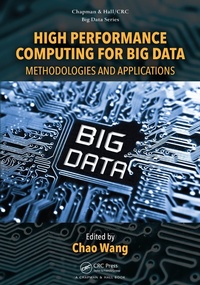
High Performance Computing for Big Data
Methodologies and Applications
Published on 16. October 2017
286 pages
978-1-4987-8400-9 (ISBN)
Description

High-Performance Computing for Big Data: Methodologies and Applications explores emerging high-performance architectures for data-intensive applications, novel efficient analytical strategies to boost data processing, and cutting-edge applications in diverse fields, such as machine learning, life science, neural networks, and neuromorphic engineering.
The book is organized into two main sections. The first section covers Big Data architectures, including cloud computing systems, and heterogeneous accelerators. It also covers emerging 3D IC design principles for memory architectures and devices. The second section of the book illustrates emerging and practical applications of Big Data across several domains, including bioinformatics, deep learning, and neuromorphic engineering.
Features
Covers a wide range of Big Data architectures, including distributed systems like Hadoop/Spark
Includes accelerator-based approaches for big data applications such as GPU-based acceleration techniques, and hardware acceleration such as FPGA/CGRA/ASICs
Presents emerging memory architectures and devices such as NVM, STT- RAM, 3D IC design principles
Describes advanced algorithms for different big data application domains
Illustrates novel analytics techniques for Big Data applications, scheduling, mapping, and partitioning methodologies
Featuring contributions from leading experts, this book presents state-of-the-art research on the methodologies and applications of high-performance computing for big data applications.
About the Editor
Dr. Chao Wang is an Associate Professor in the School of Computer Science at the University of Science and Technology of China. He is the Associate Editor of ACM Transactions on Design Automations for Electronics Systems (TODAES), Applied Soft Computing, Microprocessors and Microsystems, IET Computers & Digital Techniques, and International Journal of Electronics. Dr. Chao Wang was the recipient of Youth Innovation Promotion Association, CAS, ACM China Rising Star Honorable Mention (2016), and best IP nomination of DATE 2015. He is now on the CCF Technical Committee on Computer Architecture, CCF Task Force on Formal Methods. He is a Senior Member of IEEE, Senior Member of CCF, and a Senior Member of ACM.
The book is organized into two main sections. The first section covers Big Data architectures, including cloud computing systems, and heterogeneous accelerators. It also covers emerging 3D IC design principles for memory architectures and devices. The second section of the book illustrates emerging and practical applications of Big Data across several domains, including bioinformatics, deep learning, and neuromorphic engineering.
Features
Covers a wide range of Big Data architectures, including distributed systems like Hadoop/Spark
Includes accelerator-based approaches for big data applications such as GPU-based acceleration techniques, and hardware acceleration such as FPGA/CGRA/ASICs
Presents emerging memory architectures and devices such as NVM, STT- RAM, 3D IC design principles
Describes advanced algorithms for different big data application domains
Illustrates novel analytics techniques for Big Data applications, scheduling, mapping, and partitioning methodologies
Featuring contributions from leading experts, this book presents state-of-the-art research on the methodologies and applications of high-performance computing for big data applications.
About the Editor
Dr. Chao Wang is an Associate Professor in the School of Computer Science at the University of Science and Technology of China. He is the Associate Editor of ACM Transactions on Design Automations for Electronics Systems (TODAES), Applied Soft Computing, Microprocessors and Microsystems, IET Computers & Digital Techniques, and International Journal of Electronics. Dr. Chao Wang was the recipient of Youth Innovation Promotion Association, CAS, ACM China Rising Star Honorable Mention (2016), and best IP nomination of DATE 2015. He is now on the CCF Technical Committee on Computer Architecture, CCF Task Force on Formal Methods. He is a Senior Member of IEEE, Senior Member of CCF, and a Senior Member of ACM.
More details
Series
Language
English
Place of publication
Philadelphia, PA
United States
Publishing group
Taylor & Francis Inc
Target group
Professional and scholarly
Illustrations
118 Illustrations, black and white
File size
8,73 MB
ISBN-13
978-1-4987-8400-9 (9781498784009)
Copyright in bibliographic data and cover images is held by Nielsen Book Services Limited or by the publishers or by their respective licensors: all rights reserved.
Schweitzer Classification
Other editions
Additional editions
Book
06/2020
1st Edition
Chapman & Hall/CRC
€67.50
Shipment within 15-20 days
Book
10/2017
1st Edition
Chapman & Hall/CRC
€146.80
Shipment within 15-20 days
Person
Prof. Chao Wang received B.S. and Ph.D. degrees from School of Computer Science, University of Science and Technology of China, in 2006 and 2011 respectively. He has been a postdoctoral researcher in USTC from 2011 to 2013. He also worked with Infineon Technologies A.G. in 2007-2008. He is the associate editor of Microprocessors and Microsystems, IET Computers & Digital Techniques, and International Journal of Electronics.
Content
Section I Big Data Architectures
Chapter 1 ? Dataflow Model for Cloud Computing Frameworks in Big Data
Dong Dai, Yong Chen, and Gangyong Jia
Chapter 2 ? Design of a Processor Core Customized for Stencil Computation
Youyang Zhang, Yanhua Li, and Youhui Zhang
Chapter 3 ? Electromigration Alleviation Techniques for 3D Integrated Circuits
Yuanqing Cheng, Aida Todri-Sanial, Alberto Bosio, Luigi Dilillo, Patrick Girard, Arnaud Virazel, Pascal Vivet, and Marc Belleville
Chapter 4 ? A 3D Hybrid Cache Design for CMP Architecture for Data-Intensive Applications
Ing-Chao Lin, Jeng-Nian Chiou, and Yun-Kae Law
Section II Emerging Big Data Applications
Chapter 5 ? Matrix Factorization for Drug-Target Interaction Prediction
Yong Liu, Min Wu, Xiao-Li Li, and Peilin Zhao
Chapter 6 ? Overview of Neural Network Accelerators
Yuntao Lu, Chao Wang, Lei Gong, Xi Li, Aili Wang, and Xuehai Zhou
Chapter 7 ? Acceleration for Recommendation Algorithms in Data Mining
Chongchong Xu, Chao Wang, Lei Gong, Xi Li, Aili Wang, and Xuehai Zhou
Chapter 8 ? Deep Learning Accelerators
Yangyang Zhao, Chao Wang, Lei Gong, Xi Li, Aili Wang, and Xuehai Zhou
Chapter 9 ? Recent Advances for Neural Networks Accelerators and Optimizations
Fan Sun, Chao Wang, Lei Gong, Xi Li, Aili Wang, and Xuehai Zhou
Chapter 10 ? Accelerators for Clustering Applications in Machine Learning
Yiwei Zhang, Chao Wang, Lei Gong, Xi Li, Aili Wang, and Xuehai Zhou
Chapter 11 ? Accelerators for Classification Algorithms in Machine Learning
Shiming Lei, Chao Wang, Lei Gong, Xi Li, Aili Wang, and Xuehai Zhou
Chapter 12 ? Accelerators for Big Data Genome Sequencing
Haijie Fang, Chao Wang, Shiming Lei, Lei Gong, Xi Li, Aili Wang, and Xuehai Zhou
Chapter 1 ? Dataflow Model for Cloud Computing Frameworks in Big Data
Dong Dai, Yong Chen, and Gangyong Jia
Chapter 2 ? Design of a Processor Core Customized for Stencil Computation
Youyang Zhang, Yanhua Li, and Youhui Zhang
Chapter 3 ? Electromigration Alleviation Techniques for 3D Integrated Circuits
Yuanqing Cheng, Aida Todri-Sanial, Alberto Bosio, Luigi Dilillo, Patrick Girard, Arnaud Virazel, Pascal Vivet, and Marc Belleville
Chapter 4 ? A 3D Hybrid Cache Design for CMP Architecture for Data-Intensive Applications
Ing-Chao Lin, Jeng-Nian Chiou, and Yun-Kae Law
Section II Emerging Big Data Applications
Chapter 5 ? Matrix Factorization for Drug-Target Interaction Prediction
Yong Liu, Min Wu, Xiao-Li Li, and Peilin Zhao
Chapter 6 ? Overview of Neural Network Accelerators
Yuntao Lu, Chao Wang, Lei Gong, Xi Li, Aili Wang, and Xuehai Zhou
Chapter 7 ? Acceleration for Recommendation Algorithms in Data Mining
Chongchong Xu, Chao Wang, Lei Gong, Xi Li, Aili Wang, and Xuehai Zhou
Chapter 8 ? Deep Learning Accelerators
Yangyang Zhao, Chao Wang, Lei Gong, Xi Li, Aili Wang, and Xuehai Zhou
Chapter 9 ? Recent Advances for Neural Networks Accelerators and Optimizations
Fan Sun, Chao Wang, Lei Gong, Xi Li, Aili Wang, and Xuehai Zhou
Chapter 10 ? Accelerators for Clustering Applications in Machine Learning
Yiwei Zhang, Chao Wang, Lei Gong, Xi Li, Aili Wang, and Xuehai Zhou
Chapter 11 ? Accelerators for Classification Algorithms in Machine Learning
Shiming Lei, Chao Wang, Lei Gong, Xi Li, Aili Wang, and Xuehai Zhou
Chapter 12 ? Accelerators for Big Data Genome Sequencing
Haijie Fang, Chao Wang, Shiming Lei, Lei Gong, Xi Li, Aili Wang, and Xuehai Zhou
