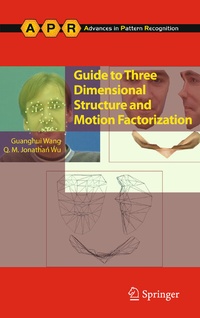
Guide to Three Dimensional Structure and Motion Factorization
Description

The problem of structure and motion recovery from image sequences is an important theme in computer vision. Considerable progress has been made in this field during the past two decades, resulting in successful applications in robot navigation, augmented reality, industrial inspection, medical image analysis, and digital entertainment, among other areas. However, many of these methods work only for rigid objects and static scenes. The study of non-rigid structure from motion is not only of academic significance, but also has important practical applications in real-world, nonrigid or dynamic scenarios, such as human facial expressions and moving vehicles.
This practical guide/reference provides a comprehensive overview of Euclidean structure and motion recovery, with a specific focus on factorization-based algorithms. The book discusses the latest research in this field, including the extension of the factorization algorithm to recover the structure of non-rigid objects, and presents some new algorithms developed by the authors. Readers require no significant knowledge of computer vision, although some background on projective geometry and matrix computation would be beneficial.
Topics and features: presents the first systematic study of structure and motion recovery of both rigid and non-rigid objects from images sequences; discusses in depth the theory, techniques, and applications of rigid and non-rigid factorization methods in three dimensional computer vision; examines numerous factorization algorithms, covering affine, perspective and quasi-perspective projection models; provides appendices describing the mathematical principles behind projective geometry, matrix decomposition, least squares, and nonlinear estimation techniques; includes chapter-ending review questions, and a glossary of terms used in the book.
This unique text offers practical guidance in real applications and implementations of 3D modeling systems for practitioners incomputer vision and pattern recognition, as well as serving as an invaluable source of new algorithms and methodologies for structure and motion recovery for graduate students and researchers.
More details
Other editions
Additional editions