

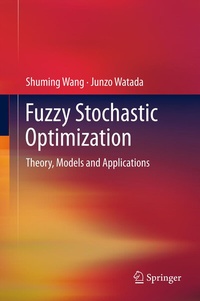
Fuzzy Stochastic Optimization
Description

In 2014, winner of "Outstanding Book Award" by The Japan Society for Fuzzy Theory and Intelligent Informatics.
Covering in detail both theoretical and practical perspectives, this book is a self-contained and systematic depiction of current fuzzy stochastic optimization that deploys the fuzzy random variable as a core mathematical tool to model the integrated fuzzy random uncertainty. It proceeds in an orderly fashion from the requisite theoretical aspects of the fuzzy random variable to fuzzy stochastic optimization models and their real-life case studies.
The volume reflects the fact that randomness and fuzziness (or vagueness) are two major sources of uncertainty in the real world, with significant implications in a number of settings. In industrial engineering, management and economics, the chances are high that decision makers will be confronted with information that is simultaneously probabilistically uncertain and fuzzily imprecise, and optimization in the form of a decision must be made in an environment that is doubly uncertain, characterized by a co-occurrence of randomness and fuzziness. This book begins by outlining the history and development of the fuzzy random variable before detailing numerous optimization models and applications that include the design of system controls for a dam.
Reviews / Votes
From the reviews:
"Fuzzy stochastic optimization models can be divided into two main classes: single-stage and multistage models. The book consists of three parts: 'Theory', 'Models' and 'Real-life applications'. . This book may be useful for students and researchers in uncertain programming." (Róbert Fullér, Mathematical Reviews, January, 2013)
More details
Other editions
Additional editions
Persons
In 2014, winner of "Outstanding Book Award" by The Japan Society for Fuzzy Theory and Intelligent Informatics. Dr. Shuming Wang received his Ph.D in Engineering at WASEDA University, Japan, 2011. He was a Special Research Fellow of the Japan Society for the Promotion of Science (JSPS), Japan, and worked as a Researcher in Research Institute and Risk Management Division of China Galaxy Securities Co. LTD (HQ), Beijing, China. Currently, Dr. Wang is being with National University of Singapore (NUS) as a Research Fellow, he is also an Adjunct Researcher of WASEDA University, Japan.
Dr. Wang has published more than 20 international journal and conference papers in the fields of optimization under uncertainty, soft computing, and industrial engineering. He has also served as a referee for several international journals, including , IEEE Transactions on Systems, Man & Cybernetics: Systems, IEEE Transactions on Systems, Man & Cybernetics: Cybernetics, IEEE Transactions on Industrial Electronics, IEEE Transactions on Engineering Management, Annals of Operations Research, International Journal of Production Research, and Journal of Global Optimization.
Dr. Junzo Watada is currently a full professor of Management Engineering, Knowledge Engineering and Soft Computing at Graduate School of Information, Production & Systems, Waseda University. He is the Principal Editor, a Co-Editor and an A
ssociate Editor of various international journals, including International Journal of Biomedical Soft Computing and Human Sciences, ICIC Express Letters, International J ournal of Systems and Control Engineering, and Fuzzy Optimization & Decision Making.Content
Part I: Theory.- Fuzzy Random Variable.- Fuzzy Stochastic Renewal Processes.- Part II: Models.- System Reliability Optimization Models with Fuzzy Random Lifetimes.- Recourse-Based Fuzzy Random Facility Location Model with Fixed Capacity.- Two-Stage Fuzzy Stochastic Programming with Value-at-Risk: A Generic Model.- VaR-Based Fuzzy Random Facility Location Model with Variable Capacity.- Part III: Real-Life Applications.
