

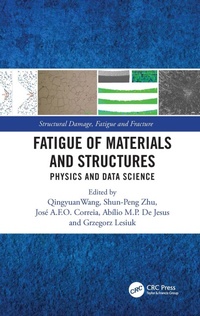
Fatigue of Materials and Structures
Physics and Data Science
1st Edition
Published on 19. May 2025
494 pages
978-1-040-34016-5 (ISBN)
Description

Fatigue failure of engineering materials and structures has long been a great challenge for structural integrity, reliability and safety in mechanical, civil and aerospace engineering. These failure mechanisms and their modeling are critical concerns for managing aging structures, and directly affect sustainability across society.
In this context, the fundamental theories and methods of fatigue failure of engineering materials and structures are discussed in detail. Fatigue damage accumulation, crack initiation and crack growth analysis are presented from materials to structures, deterministic to probabilistic fatigue, physics to data science, uniaxial to multiaxial fatigue, and extremely low cycle fatigue to very high cycle fatigue. The focus is on mechanical understanding and risk management for design, maintenance, and operation.
Some recent advancements include fatigue of additive manufactured (AM) metals and advanced materials, which could potentially transform fatigue analysis and offer new perspectives on fatigue failure mechanisms and reliability design. Both experimental supporting evidence and simulation benefits are demonstrated. It integrates recent developments in artificial intelligence with fatigue in AM metals and advanced materials. It provides case studies, and future research challenges for the fusion of fatigue physics modeling with data analytics, for graduate students and advanced practitioners.
In this context, the fundamental theories and methods of fatigue failure of engineering materials and structures are discussed in detail. Fatigue damage accumulation, crack initiation and crack growth analysis are presented from materials to structures, deterministic to probabilistic fatigue, physics to data science, uniaxial to multiaxial fatigue, and extremely low cycle fatigue to very high cycle fatigue. The focus is on mechanical understanding and risk management for design, maintenance, and operation.
Some recent advancements include fatigue of additive manufactured (AM) metals and advanced materials, which could potentially transform fatigue analysis and offer new perspectives on fatigue failure mechanisms and reliability design. Both experimental supporting evidence and simulation benefits are demonstrated. It integrates recent developments in artificial intelligence with fatigue in AM metals and advanced materials. It provides case studies, and future research challenges for the fusion of fatigue physics modeling with data analytics, for graduate students and advanced practitioners.
More details
Series
Edition
1. Auflage
Language
English
Place of publication
London
United Kingdom
Publishing group
Taylor & Francis Ltd
Target group
College/higher education
Professional and scholarly
Illustrations
24 Tables, black and white; 174 Line drawings, color; 60 Line drawings, black and white; 89 Halftones, color; 13 Halftones, black and white; 263 Illustrations, color; 73 Illustrations, black and white
File size
107,67 MB
ISBN-13
978-1-040-34016-5 (9781040340165)
Copyright in bibliographic data and cover images is held by Nielsen Book Services Limited or by the publishers or by their respective licensors: all rights reserved.
Schweitzer Classification
Other editions
Additional editions
Qingyuan Wang | Shun-Peng Zhu | Jose Correia
Fatigue of Materials and Structures
Physics and Data Science
Book
05/2025
1st Edition
CRC Press
€280.30
Shipment within 10-20 days
Persons
Qingyuan Wang is a Professor and the President of Chengdu University, China and a Professor at Sichuan University, China as well as a fellow of the International Association of Advanced Materials.
Shun-Peng Zhu is Professor at University of Electronic Science and Technology of China.
Jose Correia is a Researcher at the University of Porto, Portugal.
Abilio de Jesus is an Associate Professor at the University of Porto, Portugal.
Grzegorz Lesiuk is a Professor at the Wroclaw University of Technology in Poland.
Shun-Peng Zhu is Professor at University of Electronic Science and Technology of China.
Jose Correia is a Researcher at the University of Porto, Portugal.
Abilio de Jesus is an Associate Professor at the University of Porto, Portugal.
Grzegorz Lesiuk is a Professor at the Wroclaw University of Technology in Poland.
Content
1. Introduction and Overview 2. Variable Amplitude Fatigue 3. Multiaxial Fatigue 4. Fatigue Crack Growth 5. Ultra Low Cycle Fatigue 6. Very High Cycle Fatigue 7. Fatigue Reliability 8. Fatigue of Additive Manufactured Materials 9. Fatigue of Joints and Structures 10. Fatigue Modeling with Artificial Intelligence and Machine Learning 11. Advances in Fatigue: Hydrogels, Biomaterials, Ceramics, and Small Scale Dimensional Materials
