

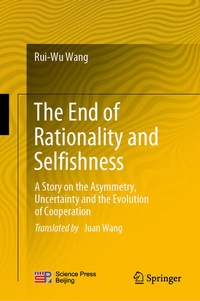
The End of Rationality and Selfishness
Description

This book reviews the antinomy of rationality and selfishness raised from egoism, though rationality and selfishness are understood as basic evolutionary dynamics of humans and other organisms in both classical economics and evolutionary biology. Based on the research and a comparison with human's social cooperative behavior, the author presents his belief that the social cooperative system, in its essence, cooperation and conflict are of uncertain stochasticity resulting from their intrinsic asymmetric interaction between cooperative partners. The book then discusses limitations of Newton's methodology of monism in both biology and social science. The understanding of the asymmetric and uncertain characteristics found in cooperation system needs perspective of quantum physics of pluralism. At the end of the book, the author undertakes a review of consistency of Newtonian and monism philosophy and the links between quantum physics and pluralism philosophy.
More details
Other editions
Additional editions
Persons
Professor Rui-Wu Wang
Prof. School of Ecology and Environment
Associate Editor, Proceeding of the Royal Society B
Associate Editor, Scientific Reports
Academic Editor, PLOS ONE
email:wangrw@nwpu.edu.cn
Northwestern Polytechnical University, West Youyi Road, Xi'an, Shaanxi. 710072, China.
Editor experience
Professor Rui-Wu Wang is Associate Editor for Proceeding of the Royal Society B (2014-2018) and Academic Editor for Scientific Reports, PLOS one, Frontier in Ecology and Evolution (guest editor).
Employment & Education
Professor Rui-Wu Wang (2015-present) is Professor at the School of Ecology and Environment, Northwestern Polytechnical University; (2010 to 2015) Professor and Principal Investigator of Experimental and Theoretical Ecology, Kunming Institute of Zoology, Chinese Academy of Sciences; (2008-2010) Associate professor, State Key Laboratory of Genetic Resources and Evolution, Kunming Institute of Zoology, Chinese Academy of Science; (2003-2008) Assistant Professor, State Key Laboratory of Genetic Resources and Evolution and Kunming Institute of Zoology, Chinese Academy of Science. In 1998-2003, Professor Rui-Wu Wang did Ph.D. and M.S. in Graduate School of Chinese Academy of Sciences, and in 1996-1997, Economics and English language training, Xi'an branch of Chinese Academy of Science. In 1994-1996, Professor Rui-Wu Wang was a bio-chemistry student, in Shanxi Education College.
Research interests:
Professor Rui-Wu Wang's focus areas include ecosystem stability, mutualism, social biology, chaos theory and game theory. Professor Rui-Wu Wang's research interests include (1) evolution and maintenance of cooperative systems, especially in insect-plant mutualisms; (2) mathematical and statistical modeling on theevolution of cooperation and species coexistence; (3) evolution of sociality of termite ; and (4) sex ratio evolution under the selective pressure of environment. Professor Rui-Wu Wang's study system involves fig-fig wasps, sociality of termite and bacteria.
Professor Rui-Wu Wang was a reviewer for the following:
Ecology, Journal of Animal Ecology, Oikos, Ecology and Evolution, Behavioral Ecology, Biological Journal of the Linnean Society, Bulletin of Entomological Research,Botanical Studies, PLOS ONE, Scientific Reports, Chinese Science Bulletin, Science China: Life Sciences, Biodiversity Science, Zoological Research (in Chinese).
