

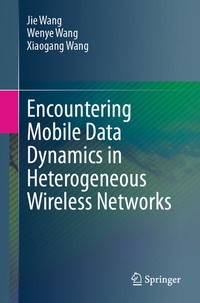
Encountering Mobile Data Dynamics in Heterogeneous Wireless Networks
Description

This book offers a systematic view of data services in heterogeneous wireless networks, from the perspectives of cause, governing rules, and impact of data's mobility on such networks. Specifically, it covers application requirements break-down, network modeling, performance analysis and evaluation by examining mobile data dynamics that are particularly important to data service provisioning. Additionally, application prospects such as information dissemination, fog computing, Internet-of-Things and dynamic spectrum access are discussed on the basis of these dynamics. Theoretic analysis, example illustrations, and algorithms are also presented to provide a concise coverage of this important area of networking.
Mobile data dynamics refers to the stochastic processes of information, geographical coverage and spectrum, which accompanies the movements of data across wireless networks. Owing to the challenge raised by a high level of network heterogeneity, and the innate requirement on scalability, knowledge on the evolution of mobile data dynamics is essential to the design and deployment of emerging data services and applications, such as Internet-of-Things, data/task offloading and edge-based machine learning/inference.
This book is designed for researchers and advanced-level students in the field of wireless networking and edge computing, who seek to understand the models and evolutions of mobile data dynamics for future edge applications. Practitioners, who specialize in the design, operation and maintenance of edge computing systems will also want to purchase this book as a reference.
More details
Other editions
Additional editions
Persons
Jie Wang is an Assistant Professor with the School of Software Engineering, Tongji University, Shanghai, China. She received her Ph.D. in Computer Engineering from North Carolina State University at Raleigh, NC, 2019. Her current research interests include mobile/edge computing, federated learning, performance evaluation of networked systems (including wireless networks, IoT, cyber-physical systems, and social networks).
Wenye Wang received her Ph.D. degree in Computer Engineering from the Georgia Institute of Technology, Atlanta, GA, USA, 2002, respectively. She is a professor with the Department of Electrical and Computer Engineering, North Carolina State University, Raleigh, NC, USA. Her research interests include modeling, analysis, and performance evaluation of wireless and mobile networks, spectrum sensing and surveillance, RF sensing and applications to Internet of Things (IoT). Dr. Wang has been a member of ACM since 1998 and a member of the Eta Kappa Nu and Gamma Beta Phi honorary societies since 2001. She was the recipient of the NSF CAREER award 2006, and an IEEE Fellow of Class 2017.
Xiaogang (Cliff) Wang graduated from North Carolina State University with a Ph.D. degree in computer engineering in 1996. He is an adjunct faculty member of computer science in the College of Engineering at North Carolina State University. Dr. Wang has been carrying out research in the area of computer vision, medical imaging, high speed networks, and most recently information security.
Content
Preface.- Introduction.- Information Dynamics.- Coverage Dynamics.- Governing Rules.- Spectrum Dynamics.- Conclusion and Future Directions.
