

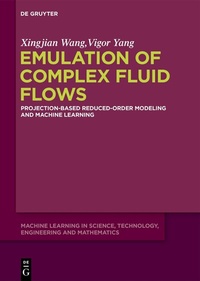
Emulation of Complex Fluid Flows
Description

While artificial intelligence has made significant strides in imaging and natural language processing, its utilization in engineering science remains relatively new. This book aims to introduce machine learning techniques to facilitate the emulation of complex fluid flows. The work focuses on projection-based reduced-order models (ROMs) that condense high-dimensional data into a low-dimensional subspace by leveraging principal components. Techniques like proper orthogonal decomposition (POD) and convolutional autoencoder (CAE) are utilized to configure this subspace, establishing a functional mapping between input parameters and solution fields. The applicability of POD-based ROMs for spatial and spatiotemporal problems are explored across various engineering scenarios, including flow past a cylinder, supercritical turbulent flows, and hydrogen-blended combustion. To capture intricate dynamics, common POD, kernel-smoothed POD, and common kernel-smoothed POD methods are developed in sequence. Additionally, the effectiveness of POD and CAE in capturing nonlinear features are compared. This book is designed to benefit graduate students and researchers interested in the intersection of data and engineering sciences.
More details
Other editions
Additional editions
Persons
Prof. Xingjian Wang received his Ph.D. from the Georgia Institute of Technology in 2016 and is currently associate professor in the Department of Energy and Power at Tsinghua University. He previously served as assistant professor in the Department of Mechanical and Civil Engineering at the Florida Institute of Technology. His research focuses on the interdisciplinary study of engineering science and machine learning, particularly in developing reduced-order models and analyzing complex fluid flows and combustion under extreme conditions. Dr. Wang has received multiple awards, including the 2020 iLASS Asia Best Paper Award and the 2019 SPES Award from the American Statistical Society. His contributions to the field are well-recognized, with several articles featured as Editor's Picks and highlighted on the front cover of Physics of Fluids .
Prof. Vigor Yang is professor of aerospace engineering and a faculty member of the Machine Learning PhD Program at the Georgia Institute of Technology. He is also the founding director of Georgia Tech's James C. Wu Laboratory of Artificial Intelligence in Technology, Engineering, and Computing (ArTEC). Prof. Yang's research lies at the interface between engineering and data sciences, driving forward the integration of artificial intelligence and engineering disciplines for cutting-edge solutions. His extensive body of work includes advancements in thermal-fluid dynamics and propulsion, with a strong emphasis on leveraging machine learning to enhance these areas. He is a member of the U.S. National Academy of Engineering, an academician of the Academia Sinica, and a foreign member of the Chinese Academy of Engineering and the Indian National Academy of Engineering
