

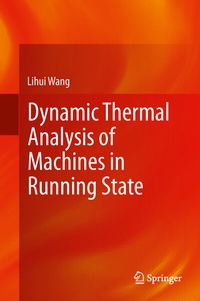
Dynamic Thermal Analysis of Machines in Running State
Description

With the increasing complexity and dynamism in today's machine design and development, more precise, robust and practical approaches and systems are needed to support machine design. Existing design methods treat the targeted machine as stationery. Analysis and simulation are mostly performed at the component level. Although there are some computer-aided engineering tools capable of motion analysis and vibration simulation etc., the machine itself is in the dry-run state. For effective machine design, understanding its thermal behaviours is crucial in achieving the desired performance in real situation.
Dynamic Thermal Analysis of Machines in Running State presents a set of innovative solutions to dynamic thermal analysis of machines when they are put under actual working conditions. The objective is to better understand the thermal behaviours of a machine in real situation while at the design stage. The book has two major sections, with the first section presenting a broad-based review of the key areas of research in dynamic thermal analysis and simulation, and the second section presents an in-depth treatment of relevant methodology and algorithms, leading to better understanding of a machine in real situation.
The book is a collection of novel ideas, taking into account the need for presenting intellectual challenges while appealing to a broad readership, including academic researchers, practicing engineers and managers, and graduate students. Given the essential role of modern machines in factory automation and quality assurance, a book dedicated to the topic of dynamic thermal analysis, and its practical applications to machine design would be beneficial to readers of all design and manufacturing sectors, from machine design to automotive engineering, in better understanding the present challenges andsolutions, as well as future research directions in this important area.
More details
Other editions
Additional editions
Person
Lihui Wang is a Professor and Chair of Sustainable Manufacturing in the Department of Production Engineering, Royal Institute of Technology (KTH), Sweden. He received his PhD and MS degrees in Mechanical Engineering from Kobe University (Japan) in 1993 and 1990, respectively, and BS degree in Machine Design (China) in 1982. He was an Assistant Professor of Kobe University and Toyohashi University of Technology (Japan) prior to joining National Research Council of Canada (NRC) in 1998, where he was a Senior Research Scientist before moving to Sweden in 2008 to take a professorship at University of Skövde. He joined KTH in November 2012. Professor Wang's research interests are presently focused on energy modeling, dynamic behaviors of machine tools, distributed process planning, web-based realtime monitoring and control, condition-based maintenance, human-robot collaboration, cloud manufacturing, and adaptive and sustainable manufacturing systems.
His recent work has won a Best Paper Award at FAIM 2002 (International Conference on Flexible Automation and Intelligent Manufacturing) in Germany, a Best Poster Award at IFIP 2003 (IFIP Conference on Virtual Enterprises) in Switzerland, and an Outstanding Paper Award Finalist at NAMRC 2008 (North American Manufacturing Research Conference) in Mexico. He is also an eight-time winner of NRC Institute Awards on Excellence and Leadership in R&D, Multidisciplinary Collaborative Research, Global Reach, and Outstanding People. Currently, he is the Editor-in-Chief of International Journal of Manufacturing Research, Editor of Robotics and Computer-Integrated Manufacturing, Editor (Northern Europe) of Journal of Intelligent Manufacturing, Associate Editor of Journal of Manufacturing Systems, and an Editorial Board Member of other seven international journals.
