

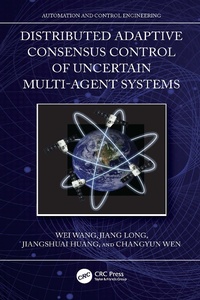
Distributed Adaptive Consensus Control of Uncertain Multi-Agent Systems
1st Edition
Published on 15. August 2024
218 pages
978-1-040-09379-5 (ISBN)
Description

Multi-agent systems are special networked systems full of research interest and practical sense, which are abundant in real life, ranging from mobile robot networks, intelligent transportation management, to multiple spacecraft, surveillance and monitoring. Consensus control is one of the most typical and hot research issues for multi-agent systems. Distributed Adaptive Consensus Control of Uncertain Multi-agent Systems provides innovative technologies to design and analyze distributed adaptive consensus for multi-agent systems with model uncertainties.
Based on the basic graph theory and adaptive backstepping control, this monograph:
? Describes the state of the art on distributed adaptive control, finite-time consensus control and event-triggered consensus control
? Studies distributed adaptive consensus under directed communication graph condition: the methods with linearly parametric reference, hierarchical decomposition, and design of auxiliary filers
? Explores adaptive finite-time consensus for uncertain nonlinear systems
? Considers distributed adaptive consensus with event-triggered communication via state feedback and output feedback
? Investigates distributed adaptive formation control of nonholonomic mobile robots with experimental verification
? Provides distributed adaptive attitude synchronization control schemes for multiple spacecraft with event-triggered communication
Distributed Adaptive Consensus Control of Uncertain Multi-agent Systems can help engineering students and professionals to efficiently learn distributed adaptive control design tool for handling uncertain multi-agent systems with directed communication graph, guaranteeing finite-time convergence and saving communication resources.
Based on the basic graph theory and adaptive backstepping control, this monograph:
? Describes the state of the art on distributed adaptive control, finite-time consensus control and event-triggered consensus control
? Studies distributed adaptive consensus under directed communication graph condition: the methods with linearly parametric reference, hierarchical decomposition, and design of auxiliary filers
? Explores adaptive finite-time consensus for uncertain nonlinear systems
? Considers distributed adaptive consensus with event-triggered communication via state feedback and output feedback
? Investigates distributed adaptive formation control of nonholonomic mobile robots with experimental verification
? Provides distributed adaptive attitude synchronization control schemes for multiple spacecraft with event-triggered communication
Distributed Adaptive Consensus Control of Uncertain Multi-agent Systems can help engineering students and professionals to efficiently learn distributed adaptive control design tool for handling uncertain multi-agent systems with directed communication graph, guaranteeing finite-time convergence and saving communication resources.
More details
Series
Edition
1. Auflage
Language
English
Place of publication
London
United Kingdom
Publishing group
Taylor & Francis Ltd
Target group
College/higher education
Professional and scholarly
Illustrations
7 Tables, black and white; 30 Line drawings, color; 31 Line drawings, black and white; 30 Illustrations, color; 31 Illustrations, black and white
ISBN-13
978-1-040-09379-5 (9781040093795)
Copyright in bibliographic data and cover images is held by Nielsen Book Services Limited or by the publishers or by their respective licensors: all rights reserved.
Schweitzer Classification
Other editions
Additional editions
Wei Wang | Jiang Long | Jiangshuai Huang
Distributed Adaptive Consensus Control of Uncertain Multi-Agent Systems
Book
approx. 07/2026
1st Edition
CRC Press
€66.00
Not yet published
Wei Wang | Jiang Long | Jiangshuai Huang
Distributed Adaptive Consensus Control of Uncertain Multi-Agent Systems
Book
08/2024
1st Edition
CRC Press
€140.40
Shipment within 10-20 days
Persons
Wei Wang received her B.Eng degree in Electrical Engineering and Automation from Beihang University (China) in 2005, M.Sc degree in Radio Frequency Communication Systems with Distinction from University of Southampton (UK) in 2006 and Ph.D degree from Nanyang Technological University (Singapore) in 2011. From January 2012 to June 2015, she was a Lecturer with the Department of Automation at Tsinghua University, China. Since July 2015, she has been with the School of Automation Science and Electrical Engineering, Beihang University, China, where she is currently a Full Professor. Her research interests include adaptive control of uncertain systems, distributed cooperative control of multi-agent systems, secure control of cyber-physical systems. Prof. Wang received Zhang Si-Ying Outstanding Youth Paper Award in the 25th Chinese Control and Decision Conference (2013) and the First Prize of Science and Technology Progress Award by Chinese Institute of Command and Control (CICC) in 2018. She is the Principle Investigator for a number of research projects including the Distinguished Young Scholars of the National Natural Science Foundation of China (2021-2023). She has been serving as Associate Editors for the IEEE Transactions on Industrial Electronics, ISA Transactions, IEEE Open Journal of Circuits and Systems, Journal of Control and Decision, Journal of Command and Control
Jiang Long received the B.Eng. degree in electrical engineering and automation from the Civil Aviation University of China, China, in July 2015 and the Ph.D. degree in control theory and control engineering from Beihang University, China, in November 2021. Since 2022, he is an Associated Professor with the School of Computer Science, Northwestern Polytechnical University, Xi'an, China. His research interests include adaptive control, nonlinear systems control, distributed adaptive control, event-triggered control. He has been serving as a Reviewer for Automatica, IEEE Transactions on Automatic Control, IEEE Transactions on Cybernetics, IEEE Transactions on Industrial Electronics, Systems & Control Letters, etc.
Jiangshuai Huang received the B.Eng. and M.Sc. degrees in automation from Huazhong University of Science and Technology, Wuhan, China, in 2007 and 2009, respectively, and the Ph.D. degree from the School of Electrical and Electronic Engineering, Nanyang Technological University, Singapore, in 2015. He was a Research Fellow with the Department of Electricity and Computer Engineering, National University of Singapore from August 2014 to September 2016. He has been with the School of Automation, Chongqing University since October 2016, where he is currently a Full Professor. His research interests include adaptive control, nonlinear systems control, underactuated mechanical system control, and multiagent system control. Prof. Huang received Zhang Si-Ying Outstanding Youth Paper Award in the 25th Chinese Control and Decision Conference, the First Prize of Science and Technology Progress Award by Chinese Institute of Command and Control (CICC) in 2018, the First Prize of Natural Science Award by Government of Chongqing in 2020 and the First Prize of Natural Science Award by Chinese Association of Automation in 2021. He is an Associate Editor for the IEEE Transactions on Cybernetics and IEEE Transactions on Industrial Electronics
Changyun Wen received his B.Eng from Xi'an Jiaotong University, China in 1983 and Ph.D from the University of Newcastle, Australia in 1990. From August 1989 to August 1991, he was a Postdoctoral Fellow at the University of Adelaide, Australia. He is presently a Professor at Nanyang Technological University, Singapore. He is a Fellow of the Academy of Engineering, Singapore, a Fellow of IEEE, was a Member of the IEEE Fellow Committee from Jan 2011 to Dec 2013 and a Distinguished Lecturer of IEEE Control Systems Society from 2010 to 2013. Currently, he is a co-Editor-in-Chief of IEEE Transactions on Industrial Electronics, an Associate Editor of Automatica and the Executive Editor-in-Chief of Journal of Control and Decision. Staring from January 2000, he also served as an Associate Editor of IEEE Transactions on Automatic Control, IEEE Transactions on Industrial Electronics and IEEE Control Systems Magazine. He has been actively involved in organizing international conferences playing the roles of General Chair, TPC Chair, General Advisor ect. He was the recipient of several outstanding awards, including the IES Prestigious Engineering Achievement Award from the Institution of Engineers, Singapore in 2005, and Best Paper Award of IEEE Transactions on Industrial Electronics in 2017.
Jiang Long received the B.Eng. degree in electrical engineering and automation from the Civil Aviation University of China, China, in July 2015 and the Ph.D. degree in control theory and control engineering from Beihang University, China, in November 2021. Since 2022, he is an Associated Professor with the School of Computer Science, Northwestern Polytechnical University, Xi'an, China. His research interests include adaptive control, nonlinear systems control, distributed adaptive control, event-triggered control. He has been serving as a Reviewer for Automatica, IEEE Transactions on Automatic Control, IEEE Transactions on Cybernetics, IEEE Transactions on Industrial Electronics, Systems & Control Letters, etc.
Jiangshuai Huang received the B.Eng. and M.Sc. degrees in automation from Huazhong University of Science and Technology, Wuhan, China, in 2007 and 2009, respectively, and the Ph.D. degree from the School of Electrical and Electronic Engineering, Nanyang Technological University, Singapore, in 2015. He was a Research Fellow with the Department of Electricity and Computer Engineering, National University of Singapore from August 2014 to September 2016. He has been with the School of Automation, Chongqing University since October 2016, where he is currently a Full Professor. His research interests include adaptive control, nonlinear systems control, underactuated mechanical system control, and multiagent system control. Prof. Huang received Zhang Si-Ying Outstanding Youth Paper Award in the 25th Chinese Control and Decision Conference, the First Prize of Science and Technology Progress Award by Chinese Institute of Command and Control (CICC) in 2018, the First Prize of Natural Science Award by Government of Chongqing in 2020 and the First Prize of Natural Science Award by Chinese Association of Automation in 2021. He is an Associate Editor for the IEEE Transactions on Cybernetics and IEEE Transactions on Industrial Electronics
Changyun Wen received his B.Eng from Xi'an Jiaotong University, China in 1983 and Ph.D from the University of Newcastle, Australia in 1990. From August 1989 to August 1991, he was a Postdoctoral Fellow at the University of Adelaide, Australia. He is presently a Professor at Nanyang Technological University, Singapore. He is a Fellow of the Academy of Engineering, Singapore, a Fellow of IEEE, was a Member of the IEEE Fellow Committee from Jan 2011 to Dec 2013 and a Distinguished Lecturer of IEEE Control Systems Society from 2010 to 2013. Currently, he is a co-Editor-in-Chief of IEEE Transactions on Industrial Electronics, an Associate Editor of Automatica and the Executive Editor-in-Chief of Journal of Control and Decision. Staring from January 2000, he also served as an Associate Editor of IEEE Transactions on Automatic Control, IEEE Transactions on Industrial Electronics and IEEE Control Systems Magazine. He has been actively involved in organizing international conferences playing the roles of General Chair, TPC Chair, General Advisor ect. He was the recipient of several outstanding awards, including the IES Prestigious Engineering Achievement Award from the Institution of Engineers, Singapore in 2005, and Best Paper Award of IEEE Transactions on Industrial Electronics in 2017.
Content
Chapter 1 Introduction
Chapter 2 Preliminaries
SECTION I Consensus Control under Directed
Graph
Chapter 3 Distributed Adaptive State Feedback Control with Linearly
Parametric Reference
Chapter 4 Auxiliary Filters based Distributed Adaptive Consensus Control
Chapter 5 Hierarchical Decomposition based Distributed Adaptive Consensus
Control
SECTION II Finite-time Consensus Control
Chapter 6 Adaptive Finite-time Consensus for Uncertain Nonlinear Mechanical
Systems
SECTION III Consensus Control with
Event-triggered Communication
Chapter 7 Distributed Event-triggered Adaptive Control: Leader-following
Case
Chapter 8 Distributed Event-triggered Adaptive Control: Leaderless Case
Chapter 9 Distributed Event-triggered Adaptive Output Feedback Control
SECTION IV Applications
Chapter 10 Distributed Adaptive Formation Control of Nonholonomic
Mobile Robots
Chapter 11 Distributed Event-triggered Adaptive Attitude Synchronization of
Multiple Spacecraft
Chapter 2 Preliminaries
SECTION I Consensus Control under Directed
Graph
Chapter 3 Distributed Adaptive State Feedback Control with Linearly
Parametric Reference
Chapter 4 Auxiliary Filters based Distributed Adaptive Consensus Control
Chapter 5 Hierarchical Decomposition based Distributed Adaptive Consensus
Control
SECTION II Finite-time Consensus Control
Chapter 6 Adaptive Finite-time Consensus for Uncertain Nonlinear Mechanical
Systems
SECTION III Consensus Control with
Event-triggered Communication
Chapter 7 Distributed Event-triggered Adaptive Control: Leader-following
Case
Chapter 8 Distributed Event-triggered Adaptive Control: Leaderless Case
Chapter 9 Distributed Event-triggered Adaptive Output Feedback Control
SECTION IV Applications
Chapter 10 Distributed Adaptive Formation Control of Nonholonomic
Mobile Robots
Chapter 11 Distributed Event-triggered Adaptive Attitude Synchronization of
Multiple Spacecraft
