

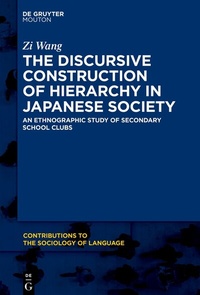
The Discursive Construction of Hierarchy in Japanese Society
Description

Seniority-based hierarchy (jouge kankei) is omnipresent in Japanese group dynamics. How one comports, depends on one's status and position vis-à-vis others. To-date, no study shows what constitutes this hierarchy, where and when individuals growing up in Japan first come into contact with it, as well as how they learn to function in it.
This book fills in the lacunae. Considering jouge kankei as a social institution and adopting a discourse analytic approach, this volume examines the ways in which institutional jouge kankei as an enduring feature of Japanese social life are created and reproduced. The monograph analyses how seniority-based relations are enacted, legitimised, transmitted, and reified by social actors through language use and paralinguistic discursive practices, such as the use of space, objects, signs, and symbols. It also looks at how established rules could be challenged. The empirical data on which findings are based are gathered through 10 months of ethnographic fieldwork from 2015 to 2018 in Japanese schools, with certain types of data (school club etiquette books and uniforms) being presented and analysed for the first time. This volume also shows continuity and change of jouge kankei from school to work.
Reviews / Votes
It is well known that Japan is a hierarchically-organised society and that this is reflected in the complex use of, for example, language and space. What is much less well understood is how that sense of hierarchy is constructed, socialised, maintained, resisted and even modified. Zi Wang's fascinating ethnographic account - based around music clubs in two Tokyo secondary schools - explains and analyses the process of this social construction in detail. It also proposes that a system that appears to be so rigid and conservative may actually also have important long-term egalitarian impacts across the society. This book fills an important gap in the literature and should go on the reading list of anyone interested in the anthropological and sociolinguistic examination of language use and socialisation practices in contemporary Japan.
Roger Goodman, Nissan Professor of Modern Japanese Studies, University of Oxford, UK
Zi Wang critically examines how seniority-based hierarchy ( jouge kankei ) in Japanese society is introduced and practiced through extra-curricular club activities ( bukatsudou ) in middle schools. This ethnographic study reveals that seniors socialize juniors into a rigidly hierarchical structure of a club through the use of linguistic and non-linguistic resources such as terms of address, honorifics, and space in routine club activities. It is eye-opening that socialization of junior students into jouge kankei is carried out by senior students who are just a year or two older. Wang convincingly argues that the socialization into jouge kankei in middle schools is the foundation for the adult corporate world in Japan. In sum, this monograph answers the question, "how do carefree young Japanese children grow to become hierarchically oriented adults in Japanese society?" This book is relevant for anthropologists, sociolinguists, and other scholars interested in Japanese language and culture as well as instructors and advanced learners of Japanese.
Haruko M. Cook, Professor of Japanese, University of Hawaii at Manoa
More details
Other editions
Additional editions
Person
Content
- Intro
- Contents
- 1 Introduction: Contextualising jouge kankei
- 2 Studying the discursive construction of jouge kankei in secondary school clubs
- 3 Ideologies, power, text, and discourse: Bukatsudou as sites of learning and socialisation in language and discourse
- 4 Address terms, honorific word choices, and the construction of hierarchy
- 5 The linguistic constitution of jouge kankei: Ideology in micro-level discourse and epistemic orders
- 6 Space, signs, symbols, and objects used in conjunction with discourse
- 7 Jouge kankei: Discursive construction, characteristics, implications and future outlook
- Appendix 1: Junior High School Curriculum Guidelines, Published by the Ministry of Education, Culture, Sports, Science and Technology (MEXT)
- Appendix 2: Guidelines for codes of conduct in extra-curricular club
- Appendix 3: On the Romanisation of Japanese
- Appendix 4: Glossary of Japanese Terms
- Appendix 5: List of Standard Abbreviations used according to the Leipzig Glossing Rules
- References
- Index
