

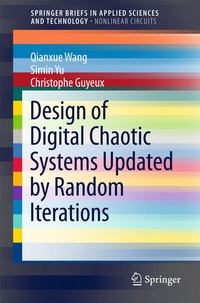
Design of Digital Chaotic Systems Updated by Random Iterations
Description

This brief studies the general problem of constructing digital chaotic systems in devices with finite precision from low-dimensional to high-dimensional settings, and establishes a general framework for composing them. The contributors demonstrate that the associated state networks of digital chaotic systems are strongly connected. They then further prove that digital chaotic systems satisfy Devaney's definition of chaos on the domain of finite precision. The book presents Lyapunov exponents, as well as implementations to show the potential application of digital chaotic systems in the real world; the authors also discuss the basic advantages and practical benefits of this approach.
The authors explore the solutions to dynamic degradation (including short cycle length, decayed distribution and low linear complexity) by proposing novel modelling methods and hardware designs for two different one-dimensional chaotic systems, which satisfy Devaney's definition of chaos. They then extend it to a higher-dimensional digital-domain chaotic system, which has been used in image-encryption technology. This ensures readers do not encounter large differences between actual and theoretical chaotic orbits through small errors.
Digital Chaotic Systems serves as an up-to-date reference on an important research topic for researchers and students in control science and engineering, computing, mathematics and other related fields of study.
More details
Other editions
Additional editions
Persons
Dr. Qianxue Wang received her Ph.D. degree (2008-2012) in University of Franche-Comté, Besançon, France. During her thesis, she has written many referenced works on building one-dimensional chaotic system by means of a chaos generation strategy controlled by random sequences. with Prof. Christophe Guyeux. She is then to extend this knowledge to higher-dimensional digital domain chaotic system while conducting post-doctoral research at College of Automation, Guangdong University of Technology, Guangzhou, China, directed by Prof. Simin Yu. She continue this research until now.
Simin Yu received the B.Sc. degree in physics from Yunnan University, Kunming, China in 1983, the M.E. degree in communication and electronic systems, and the Ph.D. degree in nonlinear circuits and systems, both from the South China University of Technology, Guangzhou, China in 1996 and 2001, respectively. Currently, he is a Full Professor in the College of Automation, Guangdong University of Technology, Guangzhou, China. His research interests include nonlinear circuits and systems, chaos theory and its applications, and multimedia chaotic secure communication technology. He has published more than 90 SCI journal papers, receiving more than 1500 SCI citations with H-index 22, 3 academic books, and 20 granted patents in the fields of chaos in electronic circuits and chaotic communications.Christophe Guyeux has a record of about 130 scholarly publications. Since 2010, he published 46 articles in peer-reviewed international journals (as a co-author, including the top-ranked ones in the areas of computer science and interdisciplinary applications, such as IEEE Transactions on Circuits and Systems I, AIP Chaos, or Clinical Infectious Diseases). He is co-author of 1 book chapter and 2 scienti fic monographs. He is also author of 4 software patents, 62 papers that appeared in proceedings of peerreviewed international conferences, and 8 articles in peer-reviewed international and national workshops. The research interests of Pr. Guyeux are in the areas of interdisciplinary sciences and complex systems. He applies techniques from mathematics and/or computer science to solve scienti c questions raised in biology, environment, or computer science elds.
