

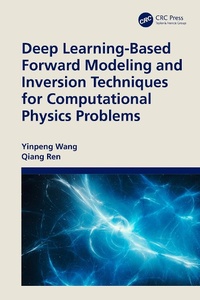
Deep Learning-Based Forward Modeling and Inversion Techniques for Computational Physics Problems
1st Edition
Published on 6. July 2023
194 pages
978-1-000-89665-7 (ISBN)
Description

This book investigates in detail the emerging deep learning (DL) technique in computational physics, assessing its promising potential to substitute conventional numerical solvers for calculating the fields in real-time. After good training, the proposed architecture can resolve both the forward computing and the inverse retrieve problems.
Pursuing a holistic perspective, the book includes the following areas. The first chapter discusses the basic DL frameworks. Then, the steady heat conduction problem is solved by the classical U-net in Chapter 2, involving both the passive and active cases. Afterwards, the sophisticated heat flux on a curved surface is reconstructed by the presented Conv-LSTM, exhibiting high accuracy and efficiency. Additionally, a physics-informed DL structure along with a nonlinear mapping module are employed to obtain the space/temperature/time-related thermal conductivity via the transient temperature in Chapter 4. Finally, in Chapter 5, a series of the latest advanced frameworks and the corresponding physics applications are introduced.
As deep learning techniques are experiencing vigorous development in computational physics, more people desire related reading materials. This book is intended for graduate students, professional practitioners, and researchers who are interested in DL for computational physics.
Pursuing a holistic perspective, the book includes the following areas. The first chapter discusses the basic DL frameworks. Then, the steady heat conduction problem is solved by the classical U-net in Chapter 2, involving both the passive and active cases. Afterwards, the sophisticated heat flux on a curved surface is reconstructed by the presented Conv-LSTM, exhibiting high accuracy and efficiency. Additionally, a physics-informed DL structure along with a nonlinear mapping module are employed to obtain the space/temperature/time-related thermal conductivity via the transient temperature in Chapter 4. Finally, in Chapter 5, a series of the latest advanced frameworks and the corresponding physics applications are introduced.
As deep learning techniques are experiencing vigorous development in computational physics, more people desire related reading materials. This book is intended for graduate students, professional practitioners, and researchers who are interested in DL for computational physics.
More details
Edition
1. Auflage
Language
English
Place of publication
London
United Kingdom
Publishing group
Taylor & Francis Ltd
Target group
College/higher education
Professional and scholarly
Illustrations
14 Tables, black and white; 83 Line drawings, black and white; 54 Halftones, black and white; 137 Illustrations, black and white
ISBN-13
978-1-000-89665-7 (9781000896657)
Copyright in bibliographic data and cover images is held by Nielsen Book Services Limited or by the publishers or by their respective licensors: all rights reserved.
Schweitzer Classification
Other editions
Additional editions
Yinpeng Wang | Qiang Ren
Deep Learning-Based Forward Modeling and Inversion Techniques for Computational Physics Problems
Book
01/2025
1st Edition
CRC Press
€69.10
Shipment within 10-20 days
Yinpeng Wang | Qiang Ren
Deep Learning-Based Forward Modeling and Inversion Techniques for Computational Physics Problems
Book
07/2023
1st Edition
CRC Press
€126.10
Shipment within 10-20 days
Persons
Yinpeng Wang received the B.S. degree in Electronic and Information Engineering from Beihang University, Beijing, China in 2020, where he is currently pursuing his M.S. degree in Electronic Science and Technology. Mr. Wang focuses on the research of electromagnetic scattering, inverse scattering, heat transfer, computational multi-physical fields, and deep learning.
Qiang Ren received the B.S. and M.S. degrees both in electrical engineering from Beihang University, Beijing, China, and Institute of Acoustics, Chinese Academy of Sciences, Beijing, China in 2008 and 2011, respectively, and the PhD degree in Electrical Engineering from Duke University, Durham, NC, in 2015. From 2016 to 2017, he was a postdoctoral researcher with the Computational Electromagnetics and Antennas Research Laboratory (CEARL) of the Pennsylvania State University, University Park, PA. In September 2017, he joined the School of Electronics and Information Engineering, Beihang University as an "Excellent Hundred" Associate Professor.
Qiang Ren received the B.S. and M.S. degrees both in electrical engineering from Beihang University, Beijing, China, and Institute of Acoustics, Chinese Academy of Sciences, Beijing, China in 2008 and 2011, respectively, and the PhD degree in Electrical Engineering from Duke University, Durham, NC, in 2015. From 2016 to 2017, he was a postdoctoral researcher with the Computational Electromagnetics and Antennas Research Laboratory (CEARL) of the Pennsylvania State University, University Park, PA. In September 2017, he joined the School of Electronics and Information Engineering, Beihang University as an "Excellent Hundred" Associate Professor.
Content
1. Deep Learning Framework and Paradigm in Computational Physics 2. Application of U-net in 3D Steady Heat Conduction Solver 3. Inversion of complex surface heat flux based on ConvLSTM 4. Time-domain electromagnetic inverse scattering based on deep learning 5. Reconstruction of thermophysical parameters based on deep learning 6. Advanced Deep Learning Techniques in Computational Physics
