

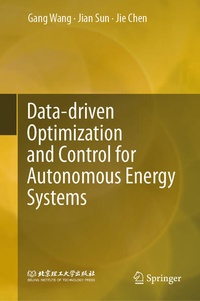
Data-driven Optimization and Control for Autonomous Energy Systems
Description

This book introduces a pioneering framework for monitoring and controlling autonomous energy systems, distinguished by its use of physics-informed deep neural networks. These networks provide accurate estimations and forecasts, interlacing with advanced composite optimization algorithms to simplify the complex processes of state estimation. This approach not only boosts operational efficiency but also maximizes flexibility through a data-driven methodology integrated with physics-based principles. The framework leverages the power of neural networks to define the intricate relationship between system states and control policies, offering precise, robust control strategies that adapt to dynamically changing system conditions. This book is essential reading for professionals looking to enhance the performance and flexibility of energy systems through cutting-edge technology.
More details
Other editions
Additional editions
Persons
Gang Wang received a B.Eng. degree in automatic control and a Ph.D. degree in control science and engineering from the Beijing Institute of Technology, Beijing, China, and a Ph.D. degree in electrical and computer engineering from the University of Minnesota, Minneapolis, MN, USA. He is currently Professor with the School of Automation, Beijing Institute of Technology.
Jian Sun received his B.Sc. degree from the Department of Automation and Electric Engineering, Jilin Institute of Technology, Changchun, China, the M.Sc. degree from the Changchun Institute of Optics, Fine Mechanics and Physics, Chinese Academy of Sciences (CAS), Changchun, China, and the Ph.D. degree from the Institute of Automation, CAS, Beijing, China. He is currently Professor with the School of Automation, Beijing Institute of Technology.
Jie Chen received his B.Sc., M.Sc., and the Ph.D. degrees in Control Theory and Control Engineering from the Beijing Institute of Technology, Beijing, China. He is currently Professor with the School of Automation, Beijing Institute of Technology and Director of the National Key Laboratory of Autonomous Intelligent Unmanned Systems (KAIUS).
Content
Introduction.- State Estimation via Composite Optimization.- State Estimation from Rank One Measurements.- State Estimation and Forecasting via Deep Unrolled Neutral Networks.- Data Graph Prior for State Estimation.- Stochastic Optimization.- Conclusion.
