

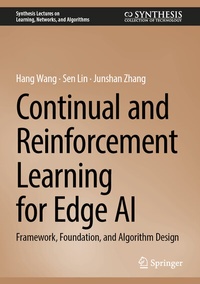
Continual and Reinforcement Learning for Edge AI
Description

This book provides a comprehensive introduction to continual and reinforcement learning for edge AI, which investigates how to build an AI agent that can continuously solve new learning tasks and enhance the AI at resource-limited edge devices. The authors introduce readers to practical frameworks and in-depth algorithmic foundations. The book surveys the recent advances in the area, coming from both academic researchers and industry professionals. The authors also present their own research findings on continual and reinforcement learning for edge AI. The book also covers the practical applications of the topic and identifies exciting future research opportunities.
More details
Other editions
Additional editions
Persons
Hang Wang is a Ph.D. candidate in the Department of Electrical and Computer Engineering at the University of California, Davis. He received his B.E. from the University of Science and Technology of China (USTC). His research aims to establish a fundamental understanding of reinforcement learning, multi-agent systems, and human-AI interaction, as well as practical applications such asautonomous driving and edge computing. His contributions have been published in NeurIPS, AAMAS. His recent work on Warm-start Reinforcement Learning also garnered attention and acclaim via an oral presentation at ICML.
Sen Lin, Ph.D., is an Assistant Professor in the Department of Computer Science at University of Houston. He received his Ph.D. degree from Arizona State University, M.S. from HKUST and B.E. from Zhejiang University. His research interests broadly fall in the intersection of machine learning and wireless networking. Currently, his research focuses on developing algorithms and theories in continual learning, meta-learning, reinforcement learning, adversarial machine learning and bilevel optimization, with applications in multiple domains, e.g., edge computing, security, network control.
Junshan Zhang, Ph.D. is a Professor in the ECE Department at the University of California, Davis. He received his Ph.D. from the School of ECE at Purdue University. His research interests fall in the general field of information networks and data science, including edge intelligence, reinforcement learning, continual learning, network optimization and control, and game theory, with applications in connected and automated vehicles, 5G and beyond, wireless networks, IoT data privacy/security, and smart grid.
Content
Introduction to Continual and Reinforcement Learning for Edge AI.- Algorithmic and Theoretical Foundations.- Federated Continual Learning.- On-device Continual Learning.- Online Meta-Learning.- Warm-start Reinforcement Learning.- Continual Reinforcement Learning.- Continual and Reinforcement Learning for Edge AI with Pre-trained Large Language Models.
