

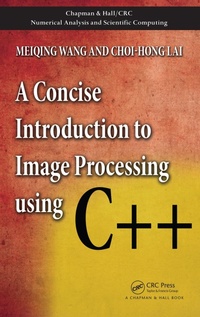
A Concise Introduction to Image Processing using C++
Published on 19. April 2016
264 pages
978-1-040-17098-4 (ISBN)
Description

Image recognition has become an increasingly dynamic field with new and emerging civil and military applications in security, exploration, and robotics. Written by experts in fractal-based image and video compression, A Concise Introduction to Image Processing using C++ strengthens your knowledge of fundamentals principles in image acquisition, conservation, processing, and manipulation, allowing you to easily apply these techniques in real-world problems.
The book presents state-of-the-art image processing methodology, including current industrial practices for image compression, image de-noising methods based on partial differential equations (PDEs), and new image compression methods, such as fractal image compression and wavelet compression. It begins with coverage of representation, and then moves on to communications and processing. It concludes with discussions of processing techniques based on image representations and transformations developed in earlier chapters. The accompanying downloadable resources contain code for all algorithms.
Suitable as a text for any course on image processing, the book can also be used as a self-study resource for researchers who need a concise and clear view of current image processing methods and coding examples. The authors introduce mathematical concepts with rigor suitable for readers with some background in calculus, algebra, geometry, and PDEs. All algorithms described are illustrated with code implementation and many images compare the results of different methods. The inclusion of C++ implementation code for each algorithm described enables students and practitioners to build up their own analysis tool.
The book presents state-of-the-art image processing methodology, including current industrial practices for image compression, image de-noising methods based on partial differential equations (PDEs), and new image compression methods, such as fractal image compression and wavelet compression. It begins with coverage of representation, and then moves on to communications and processing. It concludes with discussions of processing techniques based on image representations and transformations developed in earlier chapters. The accompanying downloadable resources contain code for all algorithms.
Suitable as a text for any course on image processing, the book can also be used as a self-study resource for researchers who need a concise and clear view of current image processing methods and coding examples. The authors introduce mathematical concepts with rigor suitable for readers with some background in calculus, algebra, geometry, and PDEs. All algorithms described are illustrated with code implementation and many images compare the results of different methods. The inclusion of C++ implementation code for each algorithm described enables students and practitioners to build up their own analysis tool.
Reviews / Votes
"This book is exactly what the title says: a very brief outline of the most popular methods used in image processing. Each chapter contains the absolute essentials of the subject with a large set of examples at the end and, of course, C++ code. ... the book could be used as a quick guide to the most standard image processing techniques."-Leslie P. Piegl, Zentralblatt MATH 1171
"This book presents a compact overview of the current methods used in modern computer image processing and their applications. ... All chapters are accompanied by C++ implementation of the method. This book requires only some background in geometry, algebra, and calculus and can serve as an excellent starting book for anyone who needs to become familiar with current methods in the field of image processing."
-EMS Newsletter, June 2009
More details
Series
Language
English
Place of publication
London
United Kingdom
Publishing group
Taylor & Francis Ltd
Target group
College/higher education
File size
4,42 MB
ISBN-13
978-1-040-17098-4 (9781040170984)
Copyright in bibliographic data and cover images is held by Nielsen Book Services Limited or by the publishers or by their respective licensors: all rights reserved.
Schweitzer Classification
Other editions
Additional editions
Meiqing Wang | Choi-Hong Lai
A Concise Introduction to Image Processing using C++
Book
11/2008
1st Edition
Chapman & Hall/CRC
€148.56
Shipment within 15-20 days
Content
Basic Concepts of Images. Fundamental Tools for Image Processing. Image Pre-Processing. Image Compression. Image Segmentation. Object Recognition. Mathematical Morphology.
