

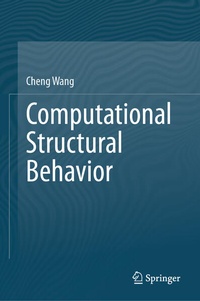
Computational Structural Behavior
Description

As intelligent behavior modeling grows increasingly complex, existing models have reached a bottleneck in their ability to express behavior. This book proposed the concept-Behavioral Molecular Structure-to redefine behavior representation from a structural perspective, paving the way for an entirely new research paradigm: Computational Structural Behavior.
Addressing cutting-edge applications in behavior analysis, modeling, and prediction, this book explores how behavioral molecular structures can enhance the expressive power of intelligent models in handling complex behavioral data. It covers key topics such as behavioral space definition, molecular structure construction, representation learning, and downstream task integration, demonstrating their impact through real-world applications in fraud detection, behavior prediction, anomaly detection, and behavior generation.
Suitable for researchers, engineers, and professionals in computer science, artificial intelligence, and behavioral studies, this book bridges the gap between theory and practice, offering a novel approach to improving behavior modeling. Whether you're seeking innovative methodologies to enhance intelligent systems or exploring new frontiers in behavioral research, this book provides essential insights and practical guidance.
More details
Other editions
Additional editions
Person
Cheng Wang is a professor at the School of Computer Science and Technology, Tongji University, specializing in computational behavior analysis, artificial intelligence, and security informatics. He has published over 150 academic papers, in addition to 34 granted invention patents and leadership in prominent national initiatives, such as the National Key Research and Development Program of the Ministry of Science and Technology and the Industrial Internet Innovation and Development Engineering Program of the Ministry of Industry and Information Technology. He earned the National Science and Technology Progress Award and the Outstanding Ph.D. Dissertation Award from the China Computer Federation (CCF). Dr. Wang is also the author of two books published by Springer, Universal Behavior Computing for Security and Safety and Human Factor Security and Safety .
Content
Chapter 1. Overview of Computational Structural Behavior.- Chapter 2. Enhancing Behavior Expression through Behavioral Structure.- Chapter 3. Behavior Molecule-level Learning by Behavioral Interior Reconstruction.- Chapter 4. Behavior Molecule-level Learning on Fine-grained Attribute Structure.- Chapter 5. Improving Behavioral Data by Behavioral Molecule Generation.- Chapter 6. Identifying Hidden Cybercrime Behavior by Behavior Tomographer.- Chapter 7. Predicting Extraordinary Behavior Sequence by Spatiotemporal Transformer.- Chapter 8. Detecting Evolving Behavior in Open World.
