

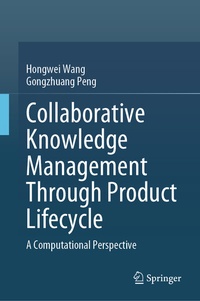
Collaborative Knowledge Management Through Product Lifecycle
Description

This book not only presents the state-of-the-art research on knowledge modelling, knowledge retrieval and knowledge reuse, but also elaborates the Collaborative Knowledge Management (CKM) paradigm and the architecture for the next generation of knowledge management systems. Although knowledge management has been extensively studied, particularly in the fields of business management and engineering design, there is a lack of systematic methodologies for addressing the integrated and collaborative dimension of knowledge management during the collaborative process of designing and developing complex systems, products, processes and services. The rapid development of information technologies, together with their applications in engineering and management, has laid the foundation for a Collaborative Knowledge Management (CKM) paradigm. The book specifically discusses this paradigm from a computational perspective.
By exploring specific research findings underpinning further CKM research and applications and describing methods related to hot research topics and new research areas, the book appeals to professionals, researchers and graduate students who are interested in knowledge management and related topics and who have a basic understanding of information technologies, computational methods, and knowledge management.
More details
Other editions
Additional editions
Persons
Dr. Hongwei Wang is a tenured full professor with Zhejiang University and the University of Illinois at Urbana-Champaign Joint Institute where he serves as the vice dean in research and academic lead in intelligent manufacturing. He received the B.S. degree in information technology and instrumentation from Zhejiang University, China, in 2004, the M.S. degree in control science and engineering from Tsinghua University, China, in 2007, and completed the Ph.D. degree in engineering design from the University of Cambridge, in 2010. Prio to joining Zhejiang University, he was a Senior Lecturer in engineering design with the University of Portsmouth, the United Kingdom. His research interests include knowledge engineering, industrial knowledge graph, intelligent and collaborative systems, and data-driven fault diagnosis. His research in these areas has been published in over 120 peer-reviewed papers in well-established journals and international conferences. He has delivered two keynotespeeches and has won four best paper awards in international conferences.
Dr. Gongzhuang Peng is an assistant professor with the Engineering Research Institute, University of Science and Technology Beijing. He received the B.S. degree from School of Automation Science and Electrical Engineering, Beihang University, Beijing, China, in 2012, and the Ph.D. degree from the Department of Automation, Tsinghua University, Beijing, China, in 2018. His research interest concerns knowledge management and smart manufacturing. He has published near 40 peer-reviewed papers in international journals and international conferences, and has won two best paper awards in international conferences.
Content
Knowledge management through product lifecycle.- The collaborative knowledge management paradigm.- Knowledge modelling methods.- Advanced knowledge retrieval methods.- Knowledge reuse in collaborative knowledge management.- Discussion.
