

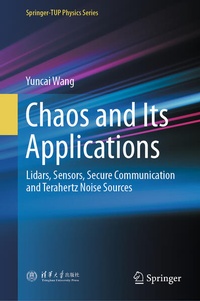
Chaos and Its Applications
Description

This book highlights the applications of optoelectronic chaotic signals in various fields, including lidars/radars, sensors, secure communication, and millimeter/terahertz noise generation. It covers the following topics:
- In lidar/radar detection, the book discusses chaotic lidars, chaotic through-wall life detection radars, and chaotic ground penetrating radars.
- Regarding optical fiber measurement and sensing, it provides a detailed examination of chaotic time-domain reflection measurement and chaotic distributed fiber sensing technologies.
- In the realm of secure communication, the book reviews optical chaos synchronization, chaotic secure optical communication, physical random number generators, and secure key distribution based on chaotic synchronization.
- For noise generation, it summarizes the millimeter/terahertz noise generation mechanism and noise source prototypes that utilize photo-mixing chaotic lights.
This book is a valuable resource for professionals, educators, graduate students, and advanced undergraduates involved in fields such as radar detection, laser technology, fiber optic sensing, optical communication, and testing and measurement technology and instruments.
More details
Other editions
Additional editions
Person
Dr. Yuncai Wang obtained his Bachelor of Science degree from Nankai University in Tianjin, China, in 1986. He later pursued his graduate studies at the Xi'an Institute of Optics and Precision Mechanics, Chinese Academy of Sciences, in Beijing, China, earning his Master of Science in 1994 and his Doctor of Philosophy in optics in 1997.
From 1986 to 2018, Dr. Wang was a faculty member at Taiyuan University of Technology (TYUT). He served as a professor and chairman of the Department of Physics from 2004 to 2011. Between 2011 and 2014, he held the position of the dean of the College of Physics and Optoelectronics. From 2012 to 2019, Dr. Wang was a professor and head of the Key Laboratory of Advanced Sensor and Intelligent Control at the Ministry of Education. Additionally, he was the director of the Science & Technology Division at TYUT from 2013 to 2018. He was a Visiting Scholar with the Technical University of Berlin from 2001 to 2002 and the Technical University of Darmstadt in 2009, Germany.
In 2019, he joined the Institute of Advanced Photonics Technology, Guangdong University of Technology. His research interests include chaos applications, terahertz photomixers and noise sources. He is a vice Chairman of the Opto-Electro-Mechanical Technology and System Integration Committee, Chinese Instrument and Control Society, a Senior Member of the Chinese Optical Society and the Chinese Physical Society.
Content
Chaos Theory and Its Development.- Chaotic Distributed Fiber Optic Sensing.
