

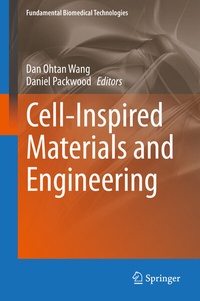
Cell-Inspired Materials and Engineering
Description

This book highlights cutting-edge studies in the development of cell-inspired biomaterials and synthetic materials that manipulate cell functions and provide the next generation with contemporary tools for treating complex human diseases. It explores the convergence of synthetic materials with cell and molecular biology and surveys how functional materials, when patterned with spatial and temporal precision, can be used effectively to maintain cell proliferation and phenotype in vitro, to trigger specific cell functions, and to redirect cell-fate decisions. Human stem cells are a frequently discussed subject in this book. This is an ideal book for students, cell biologists, researchers interested in interdisciplinary research, and biomedical engineers.
This book also:
Highlights successfully developed technologies in cell engineering that make possible new therapeutic development for previously untreatable conditionsCovers topics including bio-inspired micropatterning, DNA origami technology, synthetic NOS inspired by compartmentalized signaling in cells, and light-induced depolarization of the cell membrane
Illustrates in detail the use of stem cells and synthetic scaffolds to model ethically sensitive embryonic tissues and organs
More details
Other editions
Additional editions
Persons
Daniel Packwood is a Senior Lecturer at the Institute for Integrated Cell-Material Sciences (iCeMS) at Kyoto University.
Content
1. Generation of hepatocytes for human ES/iPS cells for regenerative medicine.- 2. Construction of multi-step catalytic systems in protein assemblies.- 3. Machine learning and Monte Carlo methods for surface-assisted molecular self-assembly.- 4. DNA nanotechnology to disclose molecular events at the nanoscale and mesoscale levels.- 5. Materials designed for biological nitric oxide delivery.- 6. Designing bio-mimicking synthetic transcription factors for therapeutic gene modulation.- 7. Magnetic nanoparticles and alternating magnetic field for cancer therapy: From cells to clinics.- 8. Light-control of cell membrane potential and its environment.- 9. Physical concepts towards cell-material integration.- 10. Using stem cells and synthetic scaffolds to model ethically sensitive human placental tissue.- 11. Nanofiber extracellular matrices in regenerative medicine.
