

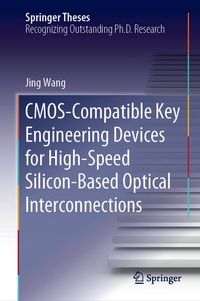
CMOS-Compatible Key Engineering Devices for High-Speed Silicon-Based Optical Interconnections
Description

This book discusses some research results for CMOS-compatible silicon-based optical devices and interconnections. With accurate simulation and experimental demonstration, it provides insights on silicon-based modulation, advanced multiplexing, polarization and efficient coupling controlling technologies, which are widely used in silicon photonics. Researchers, scientists, engineers and especially students in the field of silicon photonics can benefit from the book. This book provides valuable knowledge, useful methods and practical design that can be considered in emerging silicon-based optical interconnections and communications. And it also give some guidance to student how to organize and complete an good dissertation.
More details
Other editions
Additional editions
Person
Dr. Jing Wang received his B.S. degree in Electrical Engineering from the University of Science and Technology of China (USTC) in 2010. He then joined Prof. Fuwan Gan's group at Shanghai Institute of Microsystem and Information Technology, Chinese Academy of Sciences (SIMIT, CAS) and received his Ph.D. degree in 2015. He studied at Purdue University as a joint Ph.D. student from 2013-2014. From 2015-2018, he worked as a senior research engineer and project manager in Huawei Technologies Co. Ltd., Shenzhen, China. He is currently a co-founder of a start-up company on solid-state Lidar.
His research interests cover various silicon photonic devices for optical interconnection and sensing. He has published more than 20 conference and journal papers, and holds more than 10 patents. He won a National Scholarship for Doctoral Students and the CAS President Fellowships in 2014 and 2015, respectively. In addition, his dissertation was selected as a CAS Excellent DoctoralDissertation in 2016. He was also included in Shenzhen's high-level talent plan in 2015.
