

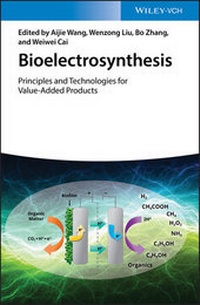
Bioelectrosynthesis
Description

Bioelectrosynthesis represents a promising approach for storing renewable energy or producing target chemicals in an energy-sustainable and low-cost way. This timely and important book systemically introduces the hot issues surrounding bioelectrosynthesis, including potential value-added products via bioelectrochemical system, reactor development of bioelectrosynthesis, and microbial biology on biofilm communities and metabolism pathways. It presents readers with unique viewpoints on basic principles and mechanisms along with new developments on reactor and microbial ecology.
Beginning with a principle and products overview of bioelectrosynthesis, Bioelectrosynthesis: Principles and Technologies for Value-Added Products goes on to offer in-depth sections on: biogas production and upgrading technology via bioelectrolysis; organic synthesis on cathodes; chemical products and nitrogen recovery; external electron transfer and electrode material promotion; and the microbiology of bioelectrosynthesis. Topics covered include: hydrogen production from waste stream with microbial electrolysis cell; microbial electrolysis cell; inorganic compound synthesis in bioelectrochemical system; microbial growth, ecological, and metabolic characteristics in bioelectrosynthesis systems; microbial metabolism kinetics and interactions in bioelectrosynthesis system; and more.
* Comprehensively covers all of the key issues of biolelectrosynthesis
* Features contributions from top experts in the field
* Examines the conversion of organic wastes to methane via electromethanogenesis; methane production at biocathodes; extracellular electron transport of electroactive biofilm; and more
Bioelectrosynthesis: Principles and Technologies for Value-Added Products will appeal to chemists, electrochemists, environmental chemists, water chemists, microbiologists, biochemists, and graduate students involved in the field.
More details
Other editions
Additional editions
Persons
Dr. Wenzong Liu is an associate professor of RCEES, CAS since 2013. He received his B.S. in Bioengineering in 2005 from the University of Petroleum of China, and obtained his M.S. and Ph.D degree of Environmental Science and Engineering in 2007 and 2011 from Harbin Institute of Technology. His research interests are the electron transfer mechanism of bioelectrochemical degradation of organic pollutants, microbial ecology related to bioenergy and bioresource recovery. He has published more than 60 peer-reviewed papers. Dr. Liu has received several awards, including "Young Ambassador to America Society for Microbiology" in China (2012-2015), "Young Technology Innovation of Microbial Ecology Award" in 2012.
Dr. Bo Zhang is an assistant professor at RCEES, CAS. He obtained his B.S. degree in environmental engineering from Nanjing University in 2007 and his M.S. degree and Ph.D. degree from Clarkson University and University of Wisconsin, Milwaukee, respectively. He then worked as a postdoc at RCEES in Prof. Aijie Wang's group. His research interests include bioelectrochemical systems and extracellular electron transfer in engineered and natural systems.
Mr. Weiwei Cai is a PhD student in Harbin Institute of Technology. His main interests focus on Electron transfer of bioelectrochemical methane production; In situ accelerating and upgrading methane with aid of bioelectrochemistry; ecology dynamics related to bio(electro)-methanogenesis from wastes and wastewater; Molecular mechanism of bio-methanogenesis coupling emerging techniques (conductive carriers, bioelectrochemistry, novel nanomaterials and quorum sensing).
Content
Section I: Principle and products overview of bioelectrosynthesis
Chapter 1: Principle and products overview of bioelectrosynthesis
Section II: Biogas production and upgrading technology via bioelectrolysis
Chapter 2: Hydrogen production from waste stream with microbial electrolysis cell
Chapter 3: A Promising Strategy for Renewable Energy Recovery: Conversion of Organic Wastes to Methane via Electromethanogenesis
Chapter 4: Microbial electrolysis Cell (MEC): an innovative waste to bioenergy and value-added byproducts technology
Chapter 5: Methane production at biocathodes: principles and applications
Section III: Organic synthesis on cathodes
Chapter 6: Organic synthesis on cathodes
Section IV: Chemical products and nitrogen recovery
Chapter 7: Inorganic compound synthesis in bioelectrochemical system: generation rate increase and application
Chapter 8: Bioelectrochemical ammonium production--Nitrogen removal and recovery in BES
Chapter 9: Bioelectrochemical systems for heavy metal pollution control and resource recovery
Section V: External electron transfer and electrode material promotion
Chapter 10: External electron transfer and electrode material promotion
Chapter 11: External electron transfer: Pathway, mechanism and microorganisms involved
Chapter 12: Extracellular electron transport of electroactive biofilm
Section VI: The microbiology of bioelectrosynthesis
Chapter 13: Microbial growth, ecological and metabolic characteristics in bioelectrosynthesis systems
Chapter 14: An update-perspective of electron transfer in electro-syntrophic-methanogenesis: from VFAs to methane
Chapter 15: Microbial metabolism kinetics and interactions in bioelectrosynthesis system
Preface
Bioelectrosynthesis: Here to Stay!
Many things in science move in waves until they finally land. In the 1960s, with the advent of the fuel cell, it was found that microbial decomposition of organic matter could also be directly linked to power production in microbial fuel cells (MFC) [1]. The power production was modest, and the top ic lead a latent existence until the petroleum crisis of the late 1970s when novel routes for chemical production were explored. Visionary scientists then coupled this microbial electron transfer for the production of organic molecules such as glutamic acid and butanol [2-4]. At that time, technology did not follow and titers and rates were limited, not competitive to existing bioproduction approaches. Then, in the late 1990s, the old topic of the MFC resurfaced, with new discoveries on electron flow [5-7]. This time, technology had evolved as well, enabling higher production rates [8, 9] and also enabling different process outcomes such as hydrogen [10] or caustic soda [11] production. Unfortunately, for MFCs, even by then also, an alternative technology generating power from biomass had matured: anaerobic digestion. In this process, biogas is produced. Nowadays, anaerobic digesters can deal from small to large scale with complex waste streams, they are very robust, and most importantly they can deal with high loading rates. Top systems now convert over 50?kg organics/m3 reactor per day to methane. In terms of electron flow, this implies a current of almost 7000?A, going to methane. To my opinion, it will be extremely difficult for MFCs to become an alternative to this, certainly considering the higher complexity of the systems and the presently lower rate.
No, besides the niches for MFC in sensing, the major promise lies in the return of the second wave: bioelectrosynthesis. Although there were some isolated reports on production of methane at cathodes in the late 1990s as well [6], around 2010, the topic truly resurfaced in the context of production of modest amounts of acetate from CO2 and electricity [12] in so-called microbial electrosynthesis (MES). Since then, titers and rates rapidly increased because of the availability of better technology, to now reach gram per liter levels [13]. Simultaneously, it is possible to also extract the product and thus obtain concentrates [14]. The product portfolio has expanded, from acetate to butyrate, caproate, and caprylate [15], toward alcohols such as ethanol [16] and isopropanol [17], even toward esters such as ethylacetate [18]. It appears that electricity-driven CO2 reduction is here to stay, and there are multiple good reasons for this: society is electrifying, which means that new applications are shifting to the use of electricity as energy source. The electricity is ubiquitously available, can be produced from renewable sources, and when used in the context of production leaves no traces such as salts in the water or the product. The coupling of electricity to CO2 conversion in the so-called carbon capture and utilization is rapidly emerging and MES will find its place within this portfolio.
Already in 2010, we made the point that MES is more than reducing CO2 [19]. Many existing production processes are imbalanced in terms of electrons, requiring, e.g., the supply of very well-controlled amounts of oxygen, which complicates many production processes. Flynn et al. [20] showed elegantly that an anode could solve the electron imbalance, enabling production of ethanol from glycerol with an engineered Shewanella?oneidensis strain. Later, Lai et al. [21] showed anode-associated conversion of glucose to a-ketogluconic acid at efficiencies over 90% by coupling the metabolism of Pseudomonas?putida, remarkably a strict aerobe, to an anode. The use of this organism opens up an enormous array of novel production routes, multiple of the most attractive routes have recently been identified by Kracke and Krömer [22].
MES thus encompasses a broad range of production processes, both anodic and cathodic, both starting from CO2 and from substrate organics [23]. Similar processes emerge to produce methane or upgrade biogas and to produce inorganic products such as hydrogen peroxide or ammonia, many of which are discussed in detail in the following book and which all have the potential to evolve into mature technologies and processes.
The challenges toward this are considerable and are both technological and microbial. When reading this book, grasp the excitement of this great field of science and engineering on the verge of breakthrough. This interface between biology and electrochemistry has already taught us many things about how microorganisms and microbial communities work, and they will continue to amaze us. Think about new, creative uses of bugs and electricity or how electron flow could affect our natural environment.
Enjoy,
Korneel Rabaey
January 2018
Ghent University, Centre for Microbial Ecology and Technology (CMET), Faculty of Bioscience Engineering, Coupure Links 653, 9000 Gent, Belgium
References
- 1 Davis, J.B. and Yarbrough, H.F. (1962). Preliminary experiments on a microbial fuel cell. Science 137 (3530): 615-616.
- 2 Hongo, M. and Iwahara, M. (1979). Electrochemical studies on fermentation. 1. Application of electro-energizing method to L-glutamic acid fermentation. Agri. Biol. Chem. 43 (10): 2075-2081.
- 3 Ghosh, B.K. and Zeikus, J.G. (1987). Electroenergization for control of H2 transformation in acetone butanol fermentations. Abstr. Papers Am. Chem. Soc. 194: 79-MBTD.
- 4 Kim, T.S. and Kim, B.H. (1988). Electron flow shift in Clostridium acetobutylicum by electrochemically introduced reducing equivalent. Biotechnol. Lett. 10 (2): 123-128.
- 5 Kim, B.H., Kim, H.J., Hyun, M.S., and Park, D.H. (1999). Direct electrode reaction of Fe(III)-reducing bacterium, Shewanella putrefaciens. J. Microbiol. Biotechnol. 9 (2): 127-131.
- 6 Park, D.H., Laivenieks, M., Guettler, M.V. et al. (1999). Microbial utilization of electrically reduced neutral red as the sole electron donor for growth and metabolite production. Appl. Environ. Microbiol. 65 (7): 2912-2917.
- 7 Bond, D.R., Holmes, D.E., Tender, L.M., and Lovley, D.R. (2002). Electrode-reducing microorganisms that harvest energy from marine sediments. Science 295 (5554): 483-485.
- 8 Rabaey, K., Lissens, G., Siciliano, S.D., and Verstraete, W. (2003). A microbial fuel cell capable of converting glucose to electricity at high rate and efficiency. Biotechnol. Lett. 25 (18): 1531-1535.
- 9 Logan, B., Aelterman, P., Hamelers, B. et al. (2006). Microbial fuel cells: methodology and technology. Environ. Sci. Technol. 40 (17): 5181-5192.
- 10 Liu, H., Grot, S., and Logan, B.E. (2005). Electrochemically assisted microbial production of hydrogen from acetate. Environ. Sci. Technol. 39 (11): 4317-4320.
- 11 Rabaey, K., Bützer, S., Brown, S. et al. (2010). High current generation coupled to caustic production using a lamellar bioelectrochemical system. Environ. Sci. Technol. 44 (11): 4315-4321.
- 12 Nevin, K.P., Woodard, T.L., Franks, A.E. et al. (2010). Microbial electrosynthesis: feeding microbes electricity to convert carbon dioxide and water to multicarbon extracellular organic compounds. mBio 1 (2): e00103-e00110. https://doi.org/10.1128/mBio.00103-10.
- 13 Patil, S.A., Arends, J.B.A., Vanwonterghem, I. et al. (2015). Selective enrichment establishes a stable performing community for microbial electrosynthesis of acetate from CO2. Environ. Sci. Technol. 49 (14): 8833-8843.
- 14 Gildemyn, S., Verbeeck, K., Slabbinck, R. et al. (2015). Integrated production, extraction, and concentration of acetic acid from CO2 through microbial electrosynthesis. Environ. Sci. Technol. Lett. 2 (11): 325-328.
- 15 Van Eerten-Jansen, M.C.A.A., Ter Heijne, A., Grootscholten, T.I.M. et al. (2013). Bioelectrochemical production of caproate and caprylate from acetate by mixed cultures. ACS Sustainable Chem. Eng. 1 (5): 513-518.
- 16 Steinbusch, K.J.J., Hamelers, H.V.M., Schaap, J.D. et al. (2010). Bioelectrochemical ethanol production through mediated acetate reduction by mixed cultures. Environ. Sci. Technol. 44 (1): 513-517.
- 17 Arends, J.B.A., Patil, S.A., Roume, H., Rabaey, K. (2017). Continuous long-term electricity-driven bioproduction of carboxylates and isopropanol from CO2 with a mixed microbial community. J. CO2 Util. 20: 141-149.
- 18 Andersen, S.J., Berton, J., Naert, P. et al. (2016). Extraction and esterification of low-titer short-chain volatile fatty acids from anaerobic fermentation with ionic liquids. ChemSusChem 9 (16): 2059-2063.
- 19 Rabaey, K. and Rozendal, R.A. (2010). Microbial electrosynthesis-revisiting the electrical route for microbial production. Nat. Rev. Microbiol. 8: 706-716.
- 20 Flynn, J.M., Ross, D.E., Hunt, K.A. et al....
