

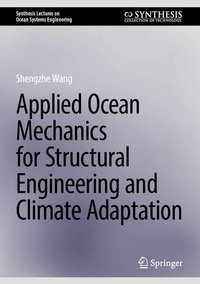
Applied Ocean Mechanics for Structural Engineering and Climate Adaptation
Description

This book introduces the theory and applications of ocean mechanics at a senior undergraduate or graduate level without assuming prior knowledge of hydrodynamics, wave theory, or related subjects. The objective is to equip students, educators, researchers, and designers with the necessary tools to promote infrastructure solutions that are more resilient and adaptable to ocean hazards exacerbated by a changing climate. The book contains four main sections: (1) mathematical fundamentals, (2) mechanics of surface waves, (3) wave interactions with fixed structures, and (4) wave interactions with floating structures.
The first chapters review important mathematical concepts relating to fluid dynamics before introducing the fundamental mechanics of surface gravity waves. Readers are next introduced to the prediction of wave forces on different structural systems produced by wind-driven waves and tsunamis. Theories pertaining to wave attenuation over submerged vegetation are further presented to demonstrate the potential of "green" infrastructure as a sustainable approach to climate adaptation. The final chapters introduce the design of floating structures, with discussions focusing on hydrostatic stability, rigid-body dynamics, as well as comfort criteria for floating buildings.
More details
Other editions
Additional editions
Person
Dr. Shengzhe Wang is an Assistant Professor in the Department of Civil Engineering and Construction at the University of Colorado Denver. He holds a BEng in Structural Engineering from the University of Auckland, an MPhil in Civil Engineering from the University of Sydney, and a Ph.D. in Civil and Environmental Engineering from Princeton University.
Dr. Wang's work encompasses the disciplines of ocean, structural, and mechanical engineering to find innovative solutions for climate change adaptation. Through this interdisciplinary perspective, his research explores the interaction between extreme hydrodynamic events with onshore, offshore, and floating structures; architecture and nature-inspired solutions to coastal resilience; and the geometric mechanics of thin-shell structures across different scales and fields of application. His research methodologies employ advanced numerical and virtual reality simulations, hydraulic experiments, quasi-static and high strain rate testing, as well as human behavioral research.
Content
1. Introduction to Fluid Dynamics.- 2. The Navier-Stokes and Bernoulli Equations.- 3. Linear Wave Theory and Surface Gravity Waves.- 4. Wave Energetics.- 5. Irregular Waves and the Wave Spectrum.- 6. Wind and Waves in Tropical Cyclones.- 7. Hydrostatic Pressure.- 8. Wave Forces on Walls.- 9. Wave Forces on Piles.- 10. Tsunami Forces on Overland Structures.- 11. Wave Attenuation Over Vegetated Terrain.- 12. Static Analysis and Stability of Floating Structures.- 13. Rigid-body Dynamics of Floating Structures.- 14. Floating Structures under Regular Waves.- 15. Floating Structures under Irregular Waves.
