

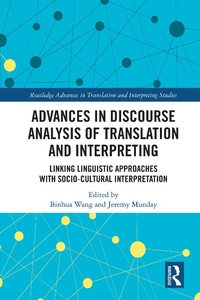
Advances in Discourse Analysis of Translation and Interpreting
Linking Linguistic Approaches with Socio-cultural Interpretation
1st Edition
Published on 22. October 2020
240 pages
978-1-000-17906-4 (ISBN)
Description

This edited thematic collection features latest developments of discourse analysis in translation and interpreting studies. It investigates the process of how cultural and ideological intervention is conducted in translation and interpreting using a wide array of discourse analysis and systemic functional linguistic approaches and drawing on empirical data from the Chinese context. The book is divided into four main sections: I. uncovering positioning and ideology in interpreting and translation, II. linking linguistic approach with socio-cultural interpretation, III. discourse analysis into news translation and IV. analysis of multimodal and intersemiotic discourse in translation.
The different approaches to discourse analysis provide a much-needed contribution to the field of translation and interpreting studies. This combination of discourse analysis and corpus analysis demonstrates the interconnectedness of these fields and offers a rich source of conceptual and methodological tools.
This book will appeal to scholars and research students in translation and interpreting studies, cross-linguistic discourse analysis and Chinese studies.
The different approaches to discourse analysis provide a much-needed contribution to the field of translation and interpreting studies. This combination of discourse analysis and corpus analysis demonstrates the interconnectedness of these fields and offers a rich source of conceptual and methodological tools.
This book will appeal to scholars and research students in translation and interpreting studies, cross-linguistic discourse analysis and Chinese studies.
Reviews / Votes
"This volume explores new grounds in applied linguistics and serves as a substantial contribution in fusion ofDA and corpus linguistics in Translation and Interpretations, and thus it is beneficial to scholars of corpus linguistics, media studies, socio-linguistics and translation, and interpreting studies. Also, this book would be one of the strong references for future applied linguistics researchers."---Chao Liu, PhD Student, Graduate School of Translation and Interpretation, Beijing Foreign Studies University, Beijing, China"The essence of translation and interpretation is communication. It has been a trend in translation and interpreting studies that the object of investigation is more viewed as a socio-cultural activity where the translators and interpreters are inevitably a cultural and ideological mediator rather than just a linguistic and communicative one. Against this backdrop, Binghua Wang and Jeremy Munday, in their edited book, Advances in discourse analysis of translation and interpreting: Linking linguistic approaches with socio-cultural interpretation, explore the connection between the linguistic and textual features on the micro level of analysis, and the social and cultural functions on the macro one.
The book consists of 11 chapters or four parts, respectively, on uncovering positioning and ideology in translation and interpreting, linking linguistic analysis with socio-cultural interpretation, discourse analysis of news translation, and analysis of multimodal and intersemiotic discourse in translation."---Xuelei Wang, School of International Studies, Hangzhou Normal University, China
"This book provides readers with diverse discourse analytical approaches to analyze translations and interpretations ranging from systemic-functional analysis, narrative theory, critical discourse analysis, the corpus-based method to visual semiotics. The various case studies have borne out the applicability and importance of discourse analysis in uncovering cultural and ideological interventions in translation and interpreting. Although many models in discourse analysis have been developed initially for analyzing monolingual texts, especially English ones, contributions in this monograph have testified to the potential and possibility of exploiting these models to examine bilingual texts. This volume is a valuable resource for scholars and students interested in discourse analytical approaches to translated and interpreted discourse. It is an in-time contribution to demonstrating the "innovation, enhancement and renewal" that have taken place in the overlapped area between discourse analysis and translation and interpreting studies."---Weixin Zeng, Department of Chinese and Bilingual Studies, The Hong Kong Polytechnic University, Hong Kong, China
More details
Series
Edition
1. Auflage
Language
English
Place of publication
London
United Kingdom
Publishing group
Taylor & Francis Ltd
Target group
College/higher education
Illustrations
35 Tables, black and white; 10 Line drawings, black and white; 15 Halftones, black and white; 25 Illustrations, black and white
ISBN-13
978-1-000-17906-4 (9781000179064)
Copyright in bibliographic data and cover images is held by Nielsen Book Services Limited or by the publishers or by their respective licensors: all rights reserved.
Schweitzer Classification
Other editions
Additional editions
Binhua Wang | Jeremy Munday
Advances in Discourse Analysis of Translation and Interpreting
Linking Linguistic Approaches with Socio-cultural Interpretation
Book
04/2022
1st Edition
Routledge
€67.10
Shipment within 15-20 days
Binhua Wang | Jeremy Munday
Advances in Discourse Analysis of Translation and Interpreting
Linking Linguistic Approaches with Socio-cultural Interpretation
Book
10/2020
1st Edition
Routledge
€206.40
Shipment within 15-20 days
Advances in Discourse Analysis of Translation and Interpreting
Linking Linguistic Approaches with Socio-Cultural Interpretation
Book
09/2020
Routledge
Unfortunately, price unknown
Available (delivery time upon request)
Persons
Binhua Wang is Professor of Interpreting and Translation Studies and currently director of the Centre for Translation Studies at the University of Leeds, UK. His research has focused on various aspects of interpreting and translation studies, in which he has published widely in refereed CSSCI/Core journals and SSCI/A&HCI journals. His latest book is Theorising Interpreting Studies (2019).
Jeremy Munday is Professor of Translation Studies at the University of Leeds, UK. His specialisms are linguistic translation theories, discourse analysis (including systemic functional linguistics), ideology and translation, and Latin American literature in translation. He is author of Introducing Translation Studies (Routledge, 4th edition, 2016) and Evaluation in Translation: Critical Points of Translator Decision-Making (Routledge, 2012).
Jeremy Munday is Professor of Translation Studies at the University of Leeds, UK. His specialisms are linguistic translation theories, discourse analysis (including systemic functional linguistics), ideology and translation, and Latin American literature in translation. He is author of Introducing Translation Studies (Routledge, 4th edition, 2016) and Evaluation in Translation: Critical Points of Translator Decision-Making (Routledge, 2012).
Content
Introduction Binhua Wang and Jeremy Munday 1. Presentation, re-presentation and perception of China's political concepts - A corpus-based analysis into the discourse on the 'Belt and Road' 2. From linguistic manipulation to discourse re-construction: a case study of conference interpreting at the World Economic Forum in China 3. A corpus-based CDA on government interpreters' metadiscursive (re)construction of truth, fact and reality 4. Competing narratives and interpreters' choices: a case study on a China-US military exercise 5. Functions of the pronoun 'we' in the English translations of Chinese government reports 6. Interpreting as institutional gatekeeping: a critical discourse analysis of interpreted questions at the Chinese Foreign Minister's press conferences 7. Stance mediation in media translation of political speeches: an analytical model of appraisal and framing in news discourse 8. Representations of the 2014 Hong Kong protests in news translation: a corpus-based critical discourse analysis 9. Reframing China in conflicts: a case study of English translation of South China Sea dispute 10. Translation of public notices in Macao: a multimodal perspective 11. Representation of identity in dubbed Italian versions of multicultural sitcoms: An SFL perspective
