

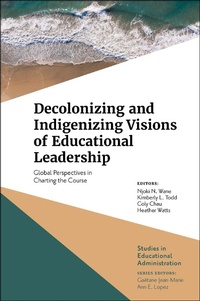
Decolonizing and Indigenizing Visions of Educational Leadership
Global Perspectives in Charting the Course
Published on 21. November 2022
280 pages
978-1-83982-470-8 (ISBN)
Description

This edited collection centres the reclamation of global counter and Indigenous knowledges, epistemologies, ontologies, axiologies, and cosmovisions that have the capacity to create new educational leadership frameworks that chart courses to visions beyond the current oppressive systems of education. Contributing authors discuss what does it look like to have thriving decolonial educational systems? What is the educational leadership that is needed and required to get us there? What does it look like from these global Indigenous and decolonial perspectives? How do we begin dismantling dominant and colonial systems, structures and styles of leadership?
Schooling and education in the wake of ongoing colonial injustices requires a revolutionary (re)awakening and the creation of schooling and educational systems that inherently honour the sacredness of life on this Earth, beyond the anthropocentric. The centring, reclamation and reaffirmation of global counter and Indigenous knowledges in educational leadership is not an individual, nor isolated endeavour. Through this understanding, this anthology is centred around themes of schooling, community building, liberatory praxis and decolonial movements, and Indigenous governance.
Schooling and education in the wake of ongoing colonial injustices requires a revolutionary (re)awakening and the creation of schooling and educational systems that inherently honour the sacredness of life on this Earth, beyond the anthropocentric. The centring, reclamation and reaffirmation of global counter and Indigenous knowledges in educational leadership is not an individual, nor isolated endeavour. Through this understanding, this anthology is centred around themes of schooling, community building, liberatory praxis and decolonial movements, and Indigenous governance.
Reviews / Votes
Finally, a truly international and substantial collection on indigenous beliefs and their application to educational leadership. The beliefs and practices in various areas identified in this collection should seriously challenge the mainstream discourse on educational leadership which, while making reference to social justice and inclusion, has not sufficiently questioned the colonial legacy in education and social movements. In many ways educational leadership in practice continues to reproduce a colonial psyche and habitus by supporting testing like PISA and others that continue to control formerly colonized populations. This collection offers a meaningful theoretical basis and examples of how to challenge and substantively reconstruct systemic problems in educational leadership. -- Professor Emeritus John P. Portelli * OISE, University of Toronto * This exciting collection of articles reveals the inadequacy of academic and policy approaches that consider 'leadership' and 'education' as simply detached spheres of professional practice. Scholars from Africa, Europe, Asia and the Americas with broad knowledge of and respect for Indigenous worldviews and western wisdom traditions offer careful analyses of colonialism as well as leadership and education. Their critical and visionary articles on current issues in education and beyond, draw on personal, communal, historical, philosophical, practical and empirical knowledge. With these diverse cases from across the globe Decolonizing and Indigenizing Visions of Educational Leadership makes an important and convincing claim that: "Educational leadership at its deepest core, needs to center relationalities that transform and reconnect us to each other, the Earth, and our ancestors who have taught and guided us to the present". -- Angela Miles * Ontario Institute for Studies in Education *More details
Series
Language
English
Place of publication
Bingley
United Kingdom
Target group
Professional and scholarly
File size
2,86 MB
ISBN-13
978-1-83982-470-8 (9781839824708)
Copyright in bibliographic data and cover images is held by Nielsen Book Services Limited or by the publishers or by their respective licensors: all rights reserved.
Schweitzer Classification
Other editions
Additional editions
Njoki N. Wane | Kimberly L. Todd | Coly Chau
Decolonizing and Indigenizing Visions of Educational Leadership
Global Perspectives in Charting the Course
Book
11/2022
Emerald Publishing Limited
€114.70
Shipment within 3-4 weeks
Persons
Njoki N. Wane, PhD, is a Professor at the University of Toronto. She is currently serving as Chair in the Department of Social Justice Education at the Ontario Institute for Studies in Education (OISE). Professor Wane headed the Office of Teaching Support at OISE from 2009 to 2012 establishing its priorities and activities while recognizing equity as a central dimension of good teaching.
Kimberly L. Todd is a Ph.D. Candidate in the Department of Social Justice Education at Ontario Institute for Studies in Education, University of Toronto. She is currently a Part-Time Professor at Seneca College in the Department of English and Liberal Studies.
Coly Chau received a M.Ed. in the Department of Social Justice Education from the Ontario Institute for Studies in Education, University of Toronto. Her research interests include race, gender, sexuality, migration, anti-colonial thought and spirituality.
Heather Watts [she/her] is a Ph.D. student in the Department of Social Justice Education at the Ontario Institute for Studies in Education, University of Toronto. Her research interests include Reconciliation, reclamation of Indigenous ways of knowing, traditional healing, and curricula development.
Kimberly L. Todd is a Ph.D. Candidate in the Department of Social Justice Education at Ontario Institute for Studies in Education, University of Toronto. She is currently a Part-Time Professor at Seneca College in the Department of English and Liberal Studies.
Coly Chau received a M.Ed. in the Department of Social Justice Education from the Ontario Institute for Studies in Education, University of Toronto. Her research interests include race, gender, sexuality, migration, anti-colonial thought and spirituality.
Heather Watts [she/her] is a Ph.D. student in the Department of Social Justice Education at the Ontario Institute for Studies in Education, University of Toronto. Her research interests include Reconciliation, reclamation of Indigenous ways of knowing, traditional healing, and curricula development.
Content
Introduction - Centrering Relationality in Decolonizing and Indigenizing Visions of Educational Leadership; Njoki N. Wane, Coly Chau, Kimberly L. Todd, and Heather Watts
Schooling
Chapter 1. Tapovana: Indigenous Source for Learning and Living (Experiences from Nepal); Ukesh Raj Bhuju
Chapter 2. Buddhist Learning Pedagogy and Decolonization: Re-imagining in the Context of Neocolonial Education and Development in Bangladesh; Bijoy P. Barua
Chapter 3. Reclaiming the Wisdom of Leadership through Meraki, Metanoia and Metis: Meditations on Spiritually Regenerative Educational Imaginaries; Maria Vamvalis
Chapter 4. Queens, Kings, Mother Africa, and ROCK: A Leadership Vision for Humanizing Schools Post-Pandemic; Kirby Mitchell
Indigenous Governance
Chapter 5. Women of Power Revisited: African Women in Leadership through the Ages, Space, Time and Governance; Njoki N. Wane, Madrine King'endo, and Sein A. Kipusi
Chapter 6. Governance in Indigenous Societies; George Muthaa
Chapter 7. Indigenization of the Professional Cook Program in the Province of British Columbia; Andrew George
Chapter 8. Latin American Matriarchal Epistemologies: Pedagogies of Hope and Indigenous Guidance; Jean Baptista and Bianca Bee Brigidi
Chapter 9. Indigenous Governance in Africa: A Decolonial Dialogue; Njoki N. Wane, Willis Opondo, Sarah Alam, Evelyn Kipkosgei, and Isaac Tarus
Chapter 10. Beyond Integration of Indigenous or Tribal and Ethnic Minorities: A Case of India and Pakistan; Njoki N. Wane and Sarah Alam
Community
Chapter 11. The Praxis of Love: Love as a Decolonial and Political Practice in Human Service Work with BIPOC Children, Youth, and Families; Shantelle Moreno
Chapter 12. Sister-Mother, Community-Mothers and Female-Father; Devi Dee Mucina
Chapter 13. Fearless Futures: Local and Global Indigenous Collaborations for Healing; Morgan Mowatt, Mandeep Kaur Mucina, Gina Mowatt, Josephine Simone, and Shilo Shiv Suleman
Conclusion - Beginning of Another Journey; Njoki N. Wane, Kimberly L. Todd, Coly Chau, and Heather Watts
Schooling
Chapter 1. Tapovana: Indigenous Source for Learning and Living (Experiences from Nepal); Ukesh Raj Bhuju
Chapter 2. Buddhist Learning Pedagogy and Decolonization: Re-imagining in the Context of Neocolonial Education and Development in Bangladesh; Bijoy P. Barua
Chapter 3. Reclaiming the Wisdom of Leadership through Meraki, Metanoia and Metis: Meditations on Spiritually Regenerative Educational Imaginaries; Maria Vamvalis
Chapter 4. Queens, Kings, Mother Africa, and ROCK: A Leadership Vision for Humanizing Schools Post-Pandemic; Kirby Mitchell
Indigenous Governance
Chapter 5. Women of Power Revisited: African Women in Leadership through the Ages, Space, Time and Governance; Njoki N. Wane, Madrine King'endo, and Sein A. Kipusi
Chapter 6. Governance in Indigenous Societies; George Muthaa
Chapter 7. Indigenization of the Professional Cook Program in the Province of British Columbia; Andrew George
Chapter 8. Latin American Matriarchal Epistemologies: Pedagogies of Hope and Indigenous Guidance; Jean Baptista and Bianca Bee Brigidi
Chapter 9. Indigenous Governance in Africa: A Decolonial Dialogue; Njoki N. Wane, Willis Opondo, Sarah Alam, Evelyn Kipkosgei, and Isaac Tarus
Chapter 10. Beyond Integration of Indigenous or Tribal and Ethnic Minorities: A Case of India and Pakistan; Njoki N. Wane and Sarah Alam
Community
Chapter 11. The Praxis of Love: Love as a Decolonial and Political Practice in Human Service Work with BIPOC Children, Youth, and Families; Shantelle Moreno
Chapter 12. Sister-Mother, Community-Mothers and Female-Father; Devi Dee Mucina
Chapter 13. Fearless Futures: Local and Global Indigenous Collaborations for Healing; Morgan Mowatt, Mandeep Kaur Mucina, Gina Mowatt, Josephine Simone, and Shilo Shiv Suleman
Conclusion - Beginning of Another Journey; Njoki N. Wane, Kimberly L. Todd, Coly Chau, and Heather Watts
