

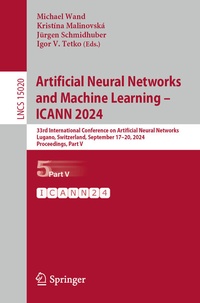
Artificial Neural Networks and Machine Learning - ICANN 2024
Description

The ten-volume set LNCS 15016-15025 constitutes the refereed proceedings of the 33rd International Conference on Artificial Neural Networks and Machine Learning, ICANN 2024, held in Lugano, Switzerland, during September 17-20, 2024.
The 294 full papers and 16 short papers included in these proceedings were carefully reviewed and selected from 764 submissions. The papers cover the following topics:
Part I - theory of neural networks and machine learning; novel methods in machine learning; novel neural architectures; neural architecture search; self-organization; neural processes; novel architectures for computer vision; and fairness in machine learning.
Part II - computer vision: classification; computer vision: object detection; computer vision: security and adversarial attacks; computer vision: image enhancement; and computer vision: 3D methods.
Part III - computer vision: anomaly detection; computer vision: segmentation; computer vision: pose estimation and tracking; computer vision: video processing; computer vision: generative methods; and topics in computer vision.
Part IV - brain-inspired computing; cognitive and computational neuroscience; explainable artificial intelligence; robotics; and reinforcement learning.
Part V - graph neural networks; and large language models.
Part VI - multimodality; federated learning; and time series processing.
Part VII - speech processing; natural language processing; and language modeling.
Part VIII - biosignal processing in medicine and physiology; and medical image processing.
Part IX - human-computer interfaces; recommender systems; environment and climate; city planning; machine learning in engineering and industry; applications in finance; artificial intelligence in education; social network analysis; artificial intelligence and music; and software security.
Part X - workshop: AI in drug discovery; workshop: reservoir computing; special session: accuracy, stability, and robustness in deep neural networks; special session: neurorobotics; and special session: spiking neural networks.
More details
Other editions
Additional editions
Content
.- Graph Neural Networks.
.- 3D Lattice Deformation Prediction with Hierarchical Graph Attention Networks.
.- Beyond Homophily: Attributed Graph Anomaly Detection via Heterophily-aware Contrastive Learning Network.
.- Boosting Attributed Graph Anomaly Detection via Negative Sample Awareness.
.- CauchyGCN: Preserving Local Smoothness in Graph Convolutional Networks via a Cauchy-Based Message-Passing Scheme and Clustering Analysis.
.- ComMGAE: Community Aware Masked Graph AutoEncoder.
.- CTQW-GraphSAGE: Trainabel Continuous-Time Quantum Walk On Graph.
.- Edged Weisfeiler-Lehman algorithm.
.- Enhancing Fraud Detection via GNNs with Synthetic Fraud Node Generation and Integrated Structural Features.
.- Graph-Guided Multi-View Text Classification: Advanced Solutions for Fast Inference.
.- Invariant Graph Contrastive Learning for Mitigating Neighborhood Bias in Graph Neural Network based Recommender Systems.
.- Key Substructure-Driven Backdoor Attacks on Graph Neural Networks.
.- Missing Data Imputation via Neighbor Data Feature-enriched Neural Ordinary Differential Equations.
.- Multi-graph Fusion and Virtual Node Enhanced Graph Neural Networks.
.- STGNA: Spatial-Temporal Graph Convolutional Networks with Node Level Attention for Shortwave Communications Parameters Forecasting.
.- Virtual Nodes based Heterogeneous Graph Convolutional Neural Network for Efficient Long-Range Information Aggregation.
.- Large Language Models.
.- A Three-Phases-LORA Finetuned Hybrid LLM Integrated with Strong Prior Module in the Eduation Context.
.- An Enhanced Prompt-Based LLM Reasoning Scheme via Knowledge Graph-Integrated Collaboration.
.- Assessing the Emergent Symbolic Reasoning Abilities of Llama Large Language Models.
.- BiosERC: Integrating Biography Speakers Supported by LLMs for ERC Tasks.
.- CSAFT: Continuous Semantic Augmentation Fine-Tuning for Legal Large Language Models.
.- FashionGPT: A Large Vision-Language Model for Enhancing Fashion Understanding.
.- Generative Chain-of-Thought for Zero-shot Cognitive Reasoning.
.- Generic Joke Generation with Moral Constraints.
.- Large Language Model Ranker with Graph Reasoning for Zero-Shot Recommendation.
.- REM: A Ranking-based Automatic Evaluation Method for LLMs.
.- Semantics-Preserved Distortion for Personal Privacy Protection in Information Management.
.- Towards Minimal Edits in Automated Program Repair: A Hybrid Framework Integrating Graph Neural Networks and Large Language Models.
.- Unveiling Vulnerabilities in Large Vision-Language Models: The SAVJ Jailbreak Approach.
