

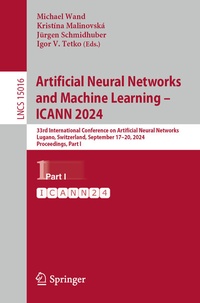
Artificial Neural Networks and Machine Learning - ICANN 2024
Description

The ten-volume set LNCS 15016-15025 constitutes the refereed proceedings of the 33rd International Conference on Artificial Neural Networks and Machine Learning, ICANN 2024, held in Lugano, Switzerland, during September 17-20, 2024.
The 294 full papers and 16 short papers included in these proceedings were carefully reviewed and selected from 764 submissions. The papers cover the following topics:
Part I - theory of neural networks and machine learning; novel methods in machine learning; novel neural architectures; neural architecture search; self-organization; neural processes; novel architectures for computer vision; and fairness in machine learning.
Part II - computer vision: classification; computer vision: object detection; computer vision: security and adversarial attacks; computer vision: image enhancement; and computer vision: 3D methods.
Part III - computer vision: anomaly detection; computer vision: segmentation; computer vision: pose estimation and tracking; computer vision: video processing; computer vision: generative methods; and topics in computer vision.
Part IV - brain-inspired computing; cognitive and computational neuroscience; explainable artificial intelligence; robotics; and reinforcement learning.
Part V - graph neural networks; and large language models.
Part VI - multimodality; federated learning; and time series processing.
Part VII - speech processing; natural language processing; and language modeling.
Part VIII - biosignal processing in medicine and physiology; and medical image processing.
Part IX - human-computer interfaces; recommender systems; environment and climate; city planning; machine learning in engineering and industry; applications in finance; artificial intelligence in education; social network analysis; artificial intelligence and music; and software security.
Part X - workshop: AI in drug discovery; workshop: reservoir computing; special session: accuracy, stability, and robustness in deep neural networks; special session: neurorobotics; and special session: spiking neural networks.
More details
Other editions
Additional editions
Content
.- Theory of Neural Networks and Machine Learning.
.- Multi-label Robust Feature Selection via Subspace-Sparsity Learning.
.- Nullspace-based metric for classification of dynamical systems and sensors.
.- On the Bayesian Interpretation of Robust Regression Neural Networks.
.- Probability-Generating Function Kernels for Spherical Data.
.- Tailored Finite Point Operator Networks for Interface problems.
.- Novel Methods in Machine Learning.
.- A Simple Task-aware Contrastive Local Descriptor Selection Strategy for Few-shot Learning between inter class and intra class.
.- Adaptive Compression of the Latent Space in Variational Autoencoders.
.- Asymmetric Isomap for Dimensionality Reduction and Data Visualization.
.- CALICO: Confident Active Learning with Integrated Calibration.
.- Improved Multi-hop Reasoning through Sampling and Aggregating.
.- Learning Solutions of Stochastic Optimization Problems with Bayesian Neural Networks.
.- Revealing Unintentional Information Leakage in Low-Dimensional Facial Portrait Representations.
.- Safe Data Resampling Method based on Counterfactuals Analysis.
.- Test-Time Augmentation for Traveling Salesperson Problem.
.- Novel Neural Architectures.
.- Resonator-Gated RNNs.
.- Towards a model of associative memory with learned distributed representations.
.- Neural Architecture Search.
.- Accelerated NAS via pretrained ensembles and multi-fidelity Bayesian Optimization.
.- Feature Activation-Driven Zero-Shot NAS: A Contrastive Learning Framework.
.- NAS-Bench-Compre: A Comprehensive Neural Architecture Search Benchmark with Customizable Components.
.- NAVIGATOR-D3: Neural Architecture search using VarIational Graph Auto-encoder Toward Optimal aRchitecture Design for Diverse Datasets.
.- ResBuilder: Automated Learning of Depth with Residual Structures
.- Self-Organization.
.- A Neuron Coverage-based Self-Organizing Approach for RBFNNs in Multi-Class Classification Tasks.
.- Self-Organising Neural Discrete Representation Learning à la Kohonen.
.- Neural Processes.
.- Combined Global and Local Information Diffusion of Neural Processes.
.- Topology of Neural Processes.
.- Novel Architectures for Computer Vision.
.- DEEPAM: Toward Deeper Attention Module in Residual Convolutional Neural Networks.
.- Differentiable Largest Connected Component Layer for Image Mattin.
.- Enhancing Generalization in Convolutional Neural Networks through Regularization with Edge and Line Features.
.- Transformer Tracker based on Multi-level Residual Perception Structure.
.-Multimodal Architectures.
.- CAW: Confidence-based Adaptive Weighted Model for Multi-modal Entity Linking.
.- Exploring Interpretable Semantic Alignment for Multimodal Machine Translation.
.- Fairness in Machine Learning.
.- CFP: A Reinforcement Learning Framework for Comprehensive Fairness-Performance Trade-off in Machine Learning.
