

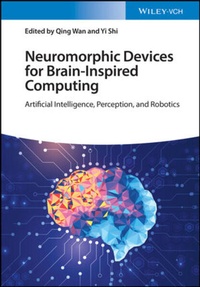
Neuromorphic Devices for Brain-inspired Computing
Artificial Intelligence, Perception and Robotics
1st Edition
Published on 10. December 2021
256 pages
978-3-527-83529-4 (ISBN)
Description

This book provides comprehensive and timely summary on the most recent achievements on neuromorphic devices based on five kinds of materials/configurations and two exciting and promising applications of this area.
More details
Other editions
Additional editions
Qing Wan | Yi Shi
Neuromorphic Devices for Brain-inspired Computing
Artificial Intelligence, Perception and Robotics
Book
01/2022
1st Edition
Wiley-VCH
€145.00
Shipment within 5-7 days
Qing Wan | Yi Shi
Neuromorphic Devices for Brain-inspired Computing - Artificial Intelligence, Perception and Robotics
Software
12/2021
Wiley-VCH
€190.00
No shipping information available
Persons
Qing Wan is currently a professor in the School of Electronic Science and Engineering, Nanjing University, China. He received PhD degree from Shanghai Institute of micro-system and Information Technology, Chinese Academy of Sciences in 2004. From 2004 to 2005, he worked as a postdoctoral researcher at the Department of Materials, University of Cambridge. From 2006 to 2007, he also worked as a postdoctoral researcher at the Department of Electronic Engineering, University of Michigan, Ann Arbor. His research focused on the semiconductor micro/nano structures for new-concept device applications. Qing Wan has published more than 200 scientific papers and SCI cited more than 10000 times. Qing Wan has won many awards, including National Youth Top-notch Talent, China Youth Science and Technology Award, Natural Science prize of the Ministry of Education (first-class prize), Author of National Excellent Doctoral Dissertation of PR China, Special award of the President of the Chinese Academy of Sciences, NSF distinguished Young Scholars.
Yi Shi is a full professor of the school of Electronic Engineering, Nanjing University. He obtained Ph. D in Department of physics, Nanjing University in 1989. He has been visiting professor to Cambridge University, Tohoku University, and University of California (Berkeley). He has published over 300 articles on peer reviewed journals including Nature Commun., Nano Lett., Adv. Mater., and Appl. Phys. Lett. He was promoted to Changjiang Chair Professor in 2007, and is the principle scientist of several scientific research plans, such as the national basic research program of China. His research interests mainly focused on Nanoelectronics and Nanophotoelectronics.
Yi Shi is a full professor of the school of Electronic Engineering, Nanjing University. He obtained Ph. D in Department of physics, Nanjing University in 1989. He has been visiting professor to Cambridge University, Tohoku University, and University of California (Berkeley). He has published over 300 articles on peer reviewed journals including Nature Commun., Nano Lett., Adv. Mater., and Appl. Phys. Lett. He was promoted to Changjiang Chair Professor in 2007, and is the principle scientist of several scientific research plans, such as the national basic research program of China. His research interests mainly focused on Nanoelectronics and Nanophotoelectronics.
Content
TWO-TERMINAL NEUROMORPHIC MEMRISTORS
Memristive Devices
Resistive switching mechanisms
Memristive Bioinspired Devices
Memristive Neural Networks
Summary and Outlook
SPINTRONIC NEUROMORPHIC DEVICES
Spintronic Synapses
Spintronic Neurons
Implementation of Spintronic Neuromorphic Computing Systems
Summary and Outlook
MULTI-TERMINAL NEUROMORPHIC DEVICES WITH COGNITIVE BEHAVIORS
Introduction
Multi-Terminal Neuromorphic Memristors
Multi-Terminal Neuromorphic Transistors
Neuromorphic Transistors for Perception Learning Activities
Conclusion and Outlook
NEUROMORPHIC DEVICES BASED ON CHALCOGENIDE MATERIALS
Chalcogenide Materials
Nonvolatile Phase Change Memory Switching Mechanisms
Volatile Threshold Switching Mechanisms
Implementation of Artificial Synapses based on MS Effects
Implementation of Artificial Neurons based on TS Effects
Hardware Neural Networks
Summary and Outlook
NEUROMORPHIC DEVICES BASED ON ORGANIC MATERIALS
Two-Terminal Organic Neuromorphic Devices
Three-Terminal Organic Neuromorphic Devices
Innovative Applications of Organic Neuromorphic Devices for Artificial Sensory Systems
Summary and Outlook
NEUROMORPHIC COMPUTING SYSTEMS WITH EMERGING DEVICES
Introduction
Neuromorphic Devices
DNN based on Synaptic Devices
SNN based on Neuromorphic Devices
Other Systems based on Neuromorphic Devices
Summary and Outlook
NEUROMORPHIC PERCEPTUAL SYSTEMS WITH EMERGING DEVICES
Background
Sensation and Perception
Implementation of Artificial Perception
Summary and Outlook
Memristive Devices
Resistive switching mechanisms
Memristive Bioinspired Devices
Memristive Neural Networks
Summary and Outlook
SPINTRONIC NEUROMORPHIC DEVICES
Spintronic Synapses
Spintronic Neurons
Implementation of Spintronic Neuromorphic Computing Systems
Summary and Outlook
MULTI-TERMINAL NEUROMORPHIC DEVICES WITH COGNITIVE BEHAVIORS
Introduction
Multi-Terminal Neuromorphic Memristors
Multi-Terminal Neuromorphic Transistors
Neuromorphic Transistors for Perception Learning Activities
Conclusion and Outlook
NEUROMORPHIC DEVICES BASED ON CHALCOGENIDE MATERIALS
Chalcogenide Materials
Nonvolatile Phase Change Memory Switching Mechanisms
Volatile Threshold Switching Mechanisms
Implementation of Artificial Synapses based on MS Effects
Implementation of Artificial Neurons based on TS Effects
Hardware Neural Networks
Summary and Outlook
NEUROMORPHIC DEVICES BASED ON ORGANIC MATERIALS
Two-Terminal Organic Neuromorphic Devices
Three-Terminal Organic Neuromorphic Devices
Innovative Applications of Organic Neuromorphic Devices for Artificial Sensory Systems
Summary and Outlook
NEUROMORPHIC COMPUTING SYSTEMS WITH EMERGING DEVICES
Introduction
Neuromorphic Devices
DNN based on Synaptic Devices
SNN based on Neuromorphic Devices
Other Systems based on Neuromorphic Devices
Summary and Outlook
NEUROMORPHIC PERCEPTUAL SYSTEMS WITH EMERGING DEVICES
Background
Sensation and Perception
Implementation of Artificial Perception
Summary and Outlook
