

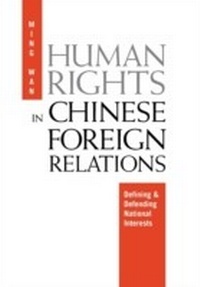
Human Rights in Chinese Foreign Relations
Defining and Defending National Interests
1st Edition
Published on 9. October 2013
200 pages
978-0-8122-0305-9 (ISBN)
Description

Few issues in the relations between China and the West invoke as much passion as human rights. At stake, however, are much more than moral concerns and hurt national feelings. To Washington, the undemocratic nature of the Chinese government makes it ultimately suspect on all issues. To Beijing, the human rights pressure exerted by the West on China seems designed to compromise its legitimacy. As China's economic power grows and its influence on the politics of developing countries continues, an understanding of the place of human rights in China's foreign relations is crucial to the implementation of an effective international human rights agenda.
In Human Rights in Chinese Foreign Relations, Ming Wan examines China's relations with the United States, Western Europe, Japan, and the United Nations human rights institutions.
Wan shows that, after a decade of persistent external pressure to reform its practices, China still plays human rights diplomacy as traditional power politics and deflects pressure by mobilizing its propaganda machine to neutralize Western criticism, by making compromises that do not threaten core interests, and by offering commercial incentives to important nations to help prevent a unified Western front. Furthermore, at the UN, China has largely succeeded in rallying developing nation members to defeat Western efforts at censure.
In turn, it is apparent to Wan that, while the idea of human rights matters in Western policy, it has seldom prevailed over economic considerations or concerns about national security. Western governments have not committed as many policy resources to pressuring Beijing on human rights as to other issues, and the differing degrees of commitment to human rights-related foreign policy explain why Japan, Western Europe, and the United States, in that order, have gradually retreated from confronting China on human rights issues.
In Human Rights in Chinese Foreign Relations, Ming Wan examines China's relations with the United States, Western Europe, Japan, and the United Nations human rights institutions.
Wan shows that, after a decade of persistent external pressure to reform its practices, China still plays human rights diplomacy as traditional power politics and deflects pressure by mobilizing its propaganda machine to neutralize Western criticism, by making compromises that do not threaten core interests, and by offering commercial incentives to important nations to help prevent a unified Western front. Furthermore, at the UN, China has largely succeeded in rallying developing nation members to defeat Western efforts at censure.
In turn, it is apparent to Wan that, while the idea of human rights matters in Western policy, it has seldom prevailed over economic considerations or concerns about national security. Western governments have not committed as many policy resources to pressuring Beijing on human rights as to other issues, and the differing degrees of commitment to human rights-related foreign policy explain why Japan, Western Europe, and the United States, in that order, have gradually retreated from confronting China on human rights issues.
Reviews / Votes
"Essential reading for anyone wishing to understand why human rights advocacy has failed in international relations." (Asia and Pacific)All prices
More details
Series
Language
English
Place of publication
Pennsylvania
United States
Target group
College/higher education
US School Grade: College Graduate Student
File size
2,08 MB
ISBN-13
978-0-8122-0305-9 (9780812203059)
Copyright in bibliographic data and cover images is held by Nielsen Book Services Limited or by the publishers or by their respective licensors: all rights reserved.
Schweitzer Classification
Other editions
Additional editions
Book
04/2001
University of Pennsylvania Press
€70.00
Shipment within 10-20 days
Person
Ming Wan is Associate Professor of Public and International Affairs at George Mason University.
Content
- Cover
- Title Page
- Copyright Page
- Dedication Page
- Table of Contents
- 1. Introduction
- 2. Chinese Views of Human Rights
- 3. Human Rights and Sino-U.S. Relations
- 4. Human Rights and Sino-European Relations
- 5. Human Rights and Sino-Japanese Relations
- 6. Human Rights and Sino-UN Relations
- 7. Conclusion
- Notes
- Bibliography
- Index
- Acknowledgments

